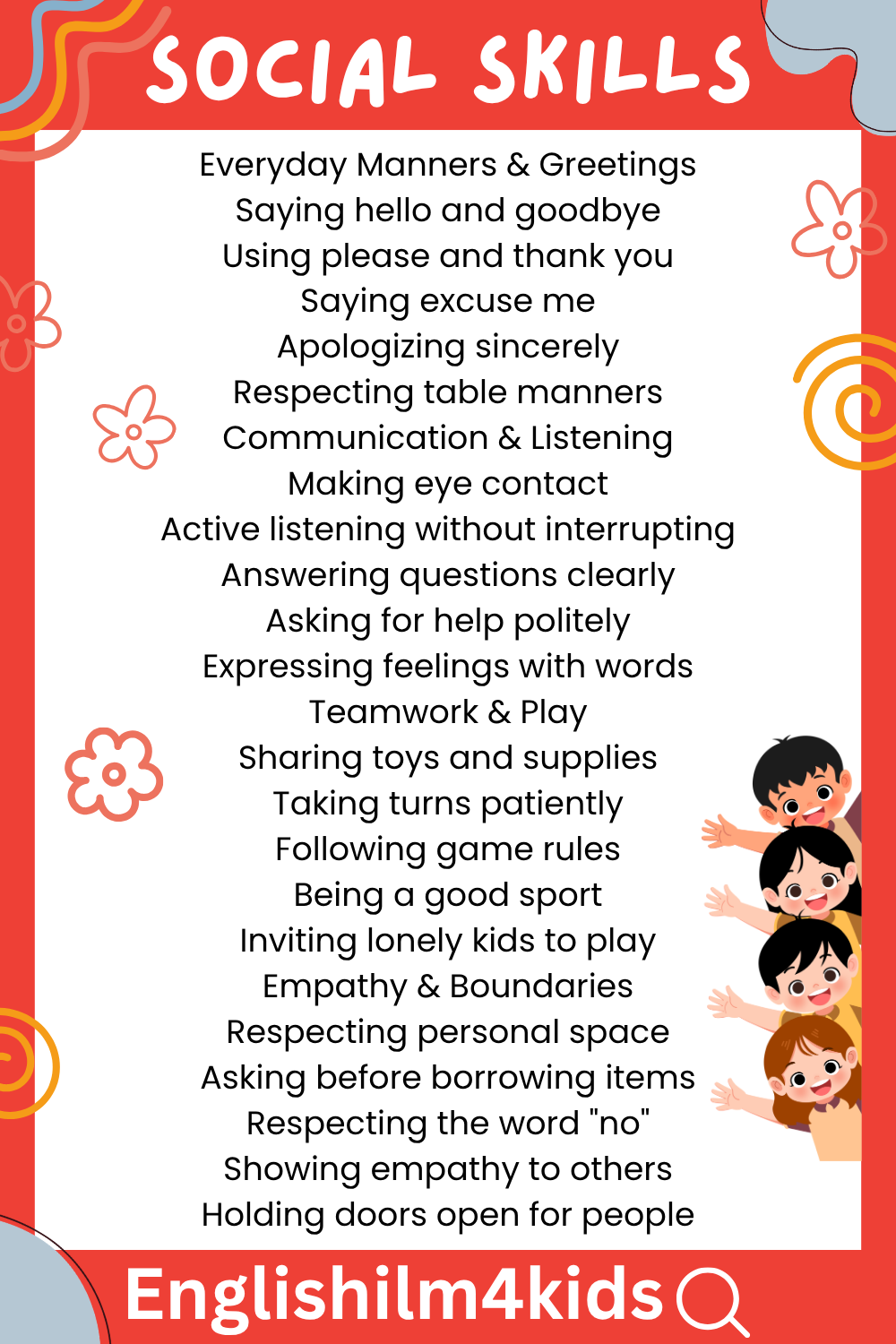
Learning social skills for kids is an important part of growing up. Children use social skills every day when they talk to parents, play with friends, work with classmates, and meet new people.
Social skills help children communicate clearly, listen to others, share, take turns, solve problems, show kindness, and build friendships.
Some children naturally find it easy to interact with others, while others need a little more practice and encouragement. The good news is that social skills can be learned through simple conversations, games, stories, and everyday activities.
Social skills are the skills children use to communicate and interact with other people in a positive way.
For example, a child uses social skills when they:
Say hello to someone
Listen while another person is talking
Ask a question
Share toys
Take turns
Say “please” and “thank you”
Ask for help
Give a compliment
Join a game
Work with others
Apologize after making a mistake
Respect someone’s personal space
Why Are Social Skills Important for Kids?
Good social skills can help children develop healthy relationships at home, at school, and in their community.
Here are some important benefits of teaching social skills to children:
1. They Help Kids Make Friends
Children who know how to introduce themselves, listen, share, and take turns may find it easier to make new friends.
2. They Improve Communication
Social skills teach children how to express their thoughts, feelings, needs, and ideas clearly.
3. They Build Confidence
When children know what to say and how to behave in different situations, they feel more confident interacting with peers.
4. They Encourage Kindness
Children learn that their words and actions can directly affect other people’s feelings.
5. They Help With Teamwork
Sharing ideas, listening, cooperating, and taking turns are highly useful skills for classroom activities and group games.
6. They Help Children Solve Problems
Social skills can help children handle disagreements and look for peaceful, constructive solutions.
Important Social Skills for Kids
Children can learn many different social skills as they grow. Here are some of the most useful ones to focus on.
1. Saying Hello
Greeting people is one of the first social skills children can learn. Simple examples include:
“Hello!”
“Hi!”
“Good morning!”
“How are you?”
2. Listening
Good communication is not only about speaking. Listening is an important social skill too. Children can practice looking toward the speaker, waiting for their turn, and not interrupting.
3. Taking Turns
Taking turns teaches children patience and fairness. Useful phrases include:
“It’s your turn.”
“Can I have a turn?”
“Let’s take turns.”
4. Sharing
Sharing helps children understand cooperation and consideration. Children can practice sharing toys, books, art supplies, and snacks. Encourage them gradually rather than forcing them to give away something they are actively using.
5. Using Polite Words
Polite language is an important part of positive social behavior. Teach children words and phrases such as Please, Thank you, You’re welcome, Sorry, and Excuse me.
6. Asking for Help
Children should know that asking for help is perfectly okay. They can practice saying, “Can you help me, please?” or “I don’t understand.”
7. Giving Compliments
A kind compliment can make someone feel happy and appreciated. Children can say, “I like your drawing!” or “You did a great job!”
8. Respecting Personal Space
Children should learn that everyone has personal boundaries. Simple rules include asking before hugging, not pushing, and keeping hands to oneself.
9. Showing Empathy
Empathy means trying to understand how another person feels. Ask children questions like, “How do you think your friend feels right now?” to build this mindset.
10. Solving Problems Peacefully
Disagreements are a normal part of childhood. Teach them to stop, take a breath, listen to the other person, and explain how they feel instead of shouting.
Social Skills Activities for Kids
Children often learn best through fun and practical activities. Try these simple social skills activities at home or in the classroom.
Role-Playing Games: Pretend to be in different situations, such as meeting a new friend at the park or ordering food at a restaurant.
Feelings Game: Show children pictures of different facial expressions and ask them to identify the emotion (e.g., happy, sad, surprised).
Compliment Circle: Gather a small group and have each child give the person next to them a simple, positive compliment.
Storytime Discussions: After reading a children’s story, ask questions like, “Was that character being kind?” or “What could they have done differently?”
Social Skills for Kids
Social Skills Kids Can Practice Every Day
Parents and teachers don’t need special equipment to teach social skills. Everyday moments provide many natural opportunities.
Situation
Social Skill to Practice
Greeting a neighbor
Saying hello politely
Playing with friends
Taking turns and sharing
Talking with parents
Active listening without interrupting
Classroom activities
Teamwork and cooperation
Making a mistake
Saying sorry sincerely
Seeing someone upset
Showing empathy and comfort
Meeting someone new
Introducing yourself clearly
Simple Social Phrases for Kids
Teaching children specific phrases gives them the confidence to initiate conversations. Here are some easy phrases kids can practice:
“Can I play with you?” (To join a group game)
“Thank you for sharing your toys.” (To show appreciation)
“Excuse me, may I borrow that crayon?” (To politely ask for something)
“It’s okay, we can try again.” (To comfort a classmate who made a mistake)
“I’m sorry I accidentally bumped into you.” (To resolve minor accidents)