
Learning English tenses can be fun for kids when they understand simple rules and practice with easy examples. The Future Perfect and Future Perfect Continuous Tenses help us talk about actions that will happen before a particular time in the future. These two tenses may look similar, but they have different purposes. The Future Perfect tense usually focuses on an action that will be completed before a certain future time. The Future Perfect Continuous tense focuses on an activity that will have continued for a period of time before a certain future point. In this easy guide, kids will learn the formulas, rules, examples, differences, common mistakes, and useful tips for understanding both tenses.
Future Perfect Tense Notes for Kids
Before learning the details, remember this simple idea:
Future Perfect: Focuses on an action that will be completed before a specific time in the future.
Future Perfect Continuous: Focuses on an activity that will have continued for a period of time before a specific future time.
What Is Future Perfect Tense?
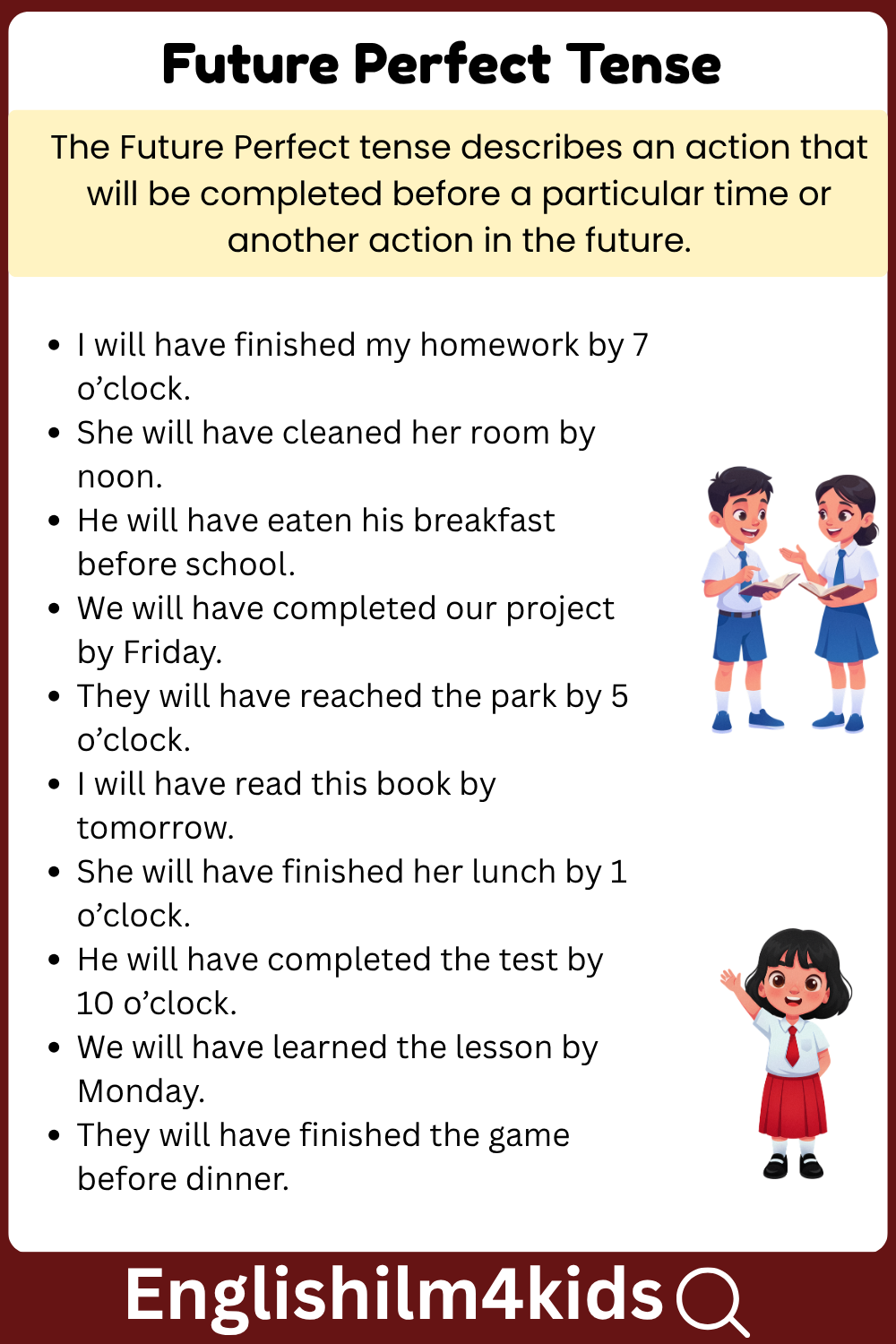
The Future Perfect tense describes an action that will be completed before a particular time or another action in the future.
For example:
I will have finished my homework by 8 o’clock.
This means the homework will be complete before 8 o’clock.
We often use words such as by, before, and by the time with this tense.
Future Perfect Tense Formula and Rules
The basic formula is:
Subject + will have + V3
We use will have with all subjects.
Examples:
- I will have finished my work.
- She will have cleaned her room.
- They will have reached the school.
- He will have eaten his lunch.
- We will have completed the project.
Future Perfect Tense Examples for Kids
Here are some simple sentences:
- I will have finished my homework by 7 o’clock.
- She will have cleaned her room by noon.
- He will have eaten his breakfast before school.
- We will have completed our project by Friday.
- They will have reached the park by 5 o’clock.
Each sentence describes an action that will be completed before a specific future time.
Future Perfect Negative Form
To make a negative sentence, put not after will.
Formula:
Subject + will not have + V3
Examples:
- I will not have finished my homework by 7 o’clock.
- She will not have cleaned her room by noon.
- He will not have eaten his breakfast before school.
- They will not have reached the station by 5 o’clock.
- We will not have completed the work by Friday.
The short form is:
will not = won’t
For example:
I won’t have finished my homework by 7 o’clock.
Future Perfect Question Form
To make a question, place will before the subject.
Formula:
Will + subject + have + V3?
Examples:
- Will you have finished your homework by 7 o’clock?
- Will she have cleaned her room?
- Will they have reached the school by noon?
- Will he have eaten his lunch?
- Will we have completed the project by Friday?
Short answers can also be used.
Will you have finished your homework?
Yes, I will.
Will she have cleaned her room?
No, she won’t.
What Is Future Perfect Continuous Tense?
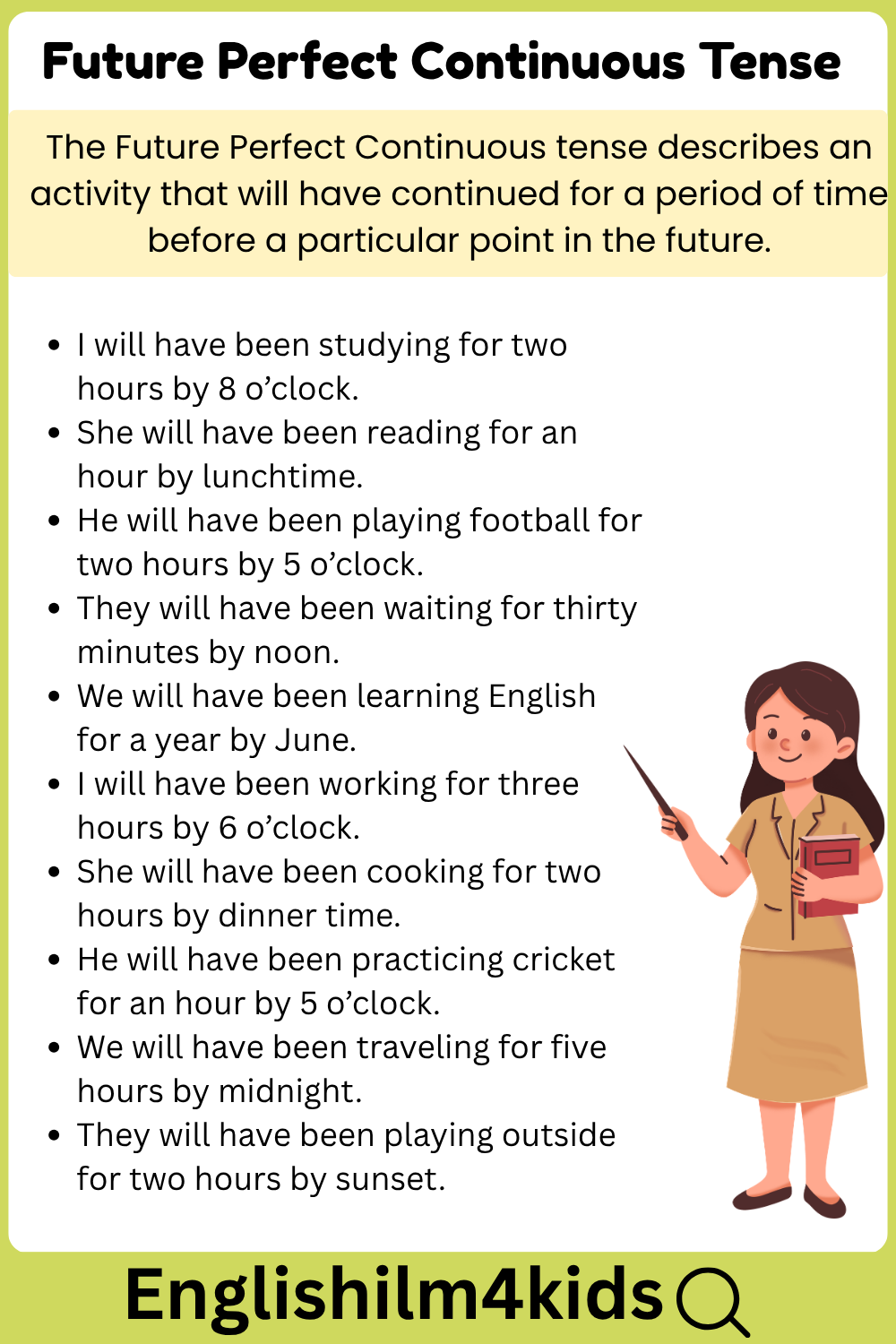
The Future Perfect Continuous tense describes an activity that will have continued for a period of time before a particular point in the future.
It focuses mainly on the duration of an activity.
For example:
I will have been studying for two hours by 8 o’clock.
This tells us how long the activity will have continued before 8 o’clock.
We often use for and since when talking about duration.
For shows a period of time.
Examples:
- for two hours
- for three days
- for a week
Since shows the starting point.
Examples:
- since Monday
- since morning
- since eight o’clock
Future Perfect Continuous Tense Formula and Rules
The basic formula is:
Subject + will have been + verb-ing
Examples:
- I will have been studying.
- She will have been reading.
- They will have been playing.
- He will have been working.
Future Perfect Continuous Tense Examples for Kids
Here are some simple examples:
- I will have been studying for two hours by 8 o’clock.
- She will have been reading for an hour by lunchtime.
- They will have been playing football for two hours by 5 o’clock.
- He will have been waiting for thirty minutes by noon.
- We will have been learning English for a year by June.
Continuous Negative Sentences
To make a negative sentence, use not after will.
Formula:
Subject + will not have been + verb-ing
Examples:
- I will not have been studying for two hours by 8 o’clock.
- She will not have been reading for an hour by lunchtime.
- He will not have been playing outside for long.
- They will not have been waiting for thirty minutes.
- We will not have been working all morning.
The short form is:
will not = won’t
For example:
She won’t have been studying for two hours by 8 o’clock.
Continuous Tense Questions
The question formula is:
Will + subject + have been + verb-ing?
Examples:
- Will you have been studying for two hours?
- Will she have been reading by lunchtime?
- Will he have been playing football for an hour?
- Will they have been waiting for long?
- Will we have been working all morning?
Future Perfect vs. Future Perfect Continuous
The two tenses both talk about the future, but they do not focus on the same thing.
The Future Perfect usually emphasizes the completion or result of an action.
The Future Perfect Continuous emphasizes the activity or duration of an action.
The Difference for Kids
Look at these two sentences:
I will have cleaned my room by 6 o’clock.
This means the cleaning will be complete before 6 o’clock. The result is important.
I will have been cleaning my room for two hours by 6 o’clock.
This focuses on the activity and tells us how long it will have continued.
A simple trick is to remember:
Completed action → Future Perfect
Activity or duration → Future Perfect Continuous
For example:
- She will have finished her homework by 8 o’clock.
- He will have painted the wall by tomorrow.
- We will have completed the project by Friday.
- She will have been studying for three hours by 8 o’clock.
- He will have been painting the wall for two hours.
- We will have been working on the project all day.
Future Perfect Examples for Kids
Kids can use this tense in many everyday situations.
- I will have finished my homework by dinner time.
- She will have opened the presents by noon.
- He will have completed the test by 10 o’clock.
- We will have reached school by 8 a.m.
- They will have won the match by the afternoon.
- My brother will have cleaned his room by Saturday.
- I will have read the book by next week.
- She will have learned the lesson by tomorrow.
- We will have completed our project by Friday.
- They will have finished the game before dinner.
Some common time expressions used with this tense are by, before, by the time, and before then.
Examples:
- I will have finished it by Monday.
- She will have arrived by noon.
- They will have left before we arrive.
- We will have completed the work by the time you come.
Future Perfect Continuous Examples for Kids
Here are some examples that focus on an activity or duration:
- I will have been studying for three hours by 9 o’clock.
- She will have been reading for two hours by lunchtime.
- He will have been playing cricket for an hour by 5 o’clock.
- We will have been waiting for thirty minutes by noon.
- They will have been working on their project for two weeks by Friday.
- My mother will have been cooking for two hours by dinner time.
- The children will have been playing outside for an hour by 4 o’clock.
- I will have been learning English for one year by June.
Common Tense Mistakes Kids Make
Making mistakes is a normal part of learning English. The following examples can help children remember the correct forms.
Future Perfect Common Mistakes
Wrong: She will has finished her homework.
Correct: She will have finished her homework.
Remember:
will + have + V3
Another common mistake is using the wrong verb form.
Wrong: I will have went to school.
Correct: I will have gone to school.
After will have, use the third form of the verb.
For example:
- will have eaten, not will have ate
- will have written, not will have wrote
- will have seen, not will have saw
- will have gone, not will have went
Future Perfect Continuous Mistakes
Wrong: He will have been study English.
Correct: He will have been studying English.
After will have been, use the -ing form of the verb.
Another common mistake is forgetting the duration.
Wrong: I will have been studying two hours by 8 o’clock.
Correct: I will have been studying for two hours by 8 o’clock.
Remember:
For = length of time
Since = starting point
Examples:
For:
- for two hours
- for three days
- for a week
Since:
- since Monday
- since morning
- since eight o’clock
Short Notes for Kids
Future Perfect
Formula: Subject + will have + V3
Example: She will have finished her homework by 8 o’clock.
Focus: Completion or result before a future time
Future Perfect Continuous
Formula: Subject + will have been + verb-ing
Example: She will have been studying for two hours by 8 o’clock.
Focus: Activity or duration before a future time
A helpful way to remember the difference is to ask:
- What will have been completed?
- How long will the activity have continued?
Tense Quiz for Kids
Now it is time to check your understanding. Choose the correct answer.
Question 1
Choose the correct sentence.
A. She will has finished her homework.
B. She will have finished her homework.
C. She will have finish her homework.
D. She has will finished her homework.
Correct Answer: B. She will have finished her homework.
Question 2
Which sentence uses the continuous form?
A. I will have cleaned my room.
B. I will clean my room.
C. I will have been cleaning my room.
D. I cleaned my room.
Correct Answer: C. I will have been cleaning my room.
Question 3
Choose the correct word.
“I will have been studying ___ two hours by 8 o’clock.”
A. since
B. for
C. at
D. on
Correct Answer: B. for
Question 4
Which sentence is correct?
A. He will have been play football.
B. He will has been playing football.
C. He will have been playing football.
D. He will have playing football.
Correct Answer: C. He will have been playing football.
Question 5
Which tense usually focuses more on the completion of an action?
A. Future Perfect
B. Future Perfect Continuous
C. Simple Future
D. Simple Present
Correct Answer: A. Future Perfect
Frequently Asked Questions
What Is Future Perfect Tense?
The Future Perfect tense is used to talk about an action that will be completed before a particular time or another event in the future. Its basic structure is will have + V3.
What Is Future Perfect Continuous Tense?
The Future Perfect Continuous tense is used to talk about an activity that will have continued for a period of time before a particular point in the future. Its basic structure is will have been + verb-ing.
What Is the Difference Between These Two Tenses?
The main difference is the focus. Future Perfect usually focuses on the completion or result of an action, while Future Perfect Continuous focuses on an activity and how long it will have continued.
When Do We Use “For” and “Since”?
Use for to show the length of time, such as for two hours or for three days.
Use since to show the starting point, such as since Monday or since morning.
Can Children Learn These Tenses Easily?
Yes. Children can learn these grammar rules by studying simple formulas and practicing everyday examples. Regular practice can make it easier to understand when to use each form.
ConclusionLearning these two future tenses becomes easier when kids understand what each one focuses on. The Future Perfect tense is generally used for actions that will be completed before a specific time in the future. The Future Perfect Continuous tense focuses more on activities and how long they will have continued before a future point. The two important formulas are: Future Perfect: Will have + V3 Future Perfect Continuous: Will have been + verb-ing Kids can practice by making simple sentences about homework, games, reading, studying, and other daily activities. With regular practice, these grammar rules will become easier to remember and use correctly.
|
Learn More Tense
- What is Tense? Three Types of Tenses
- Present Indefinite & Continuous Tense
- Present Perfect & Perfect Continuous Tense
- Past Indefinite and Past Continuous Tense
- Past Perfect and Past Perfect Continuous Tense
- Future Indefinite & Continuous Tense for Kids