
Learning how to talk kindly to others is an important part of growing up and communicating well. Kind words can make people feel respected, welcome, and happy. Children use words every day when they talk to parents, teachers, friends, classmates, and other people. How to Talk Kindly to Others for kids teaches simple ways to choose polite and caring words in everyday situations. Instead of using hurtful or rude language, children can learn to listen, speak calmly, say “please” and “thank you,” and show respect for different feelings and opinions. These small habits can make conversations friendlier and help children build positive relationships with the people around them.
What Does It Mean to Talk Kindly to Others?
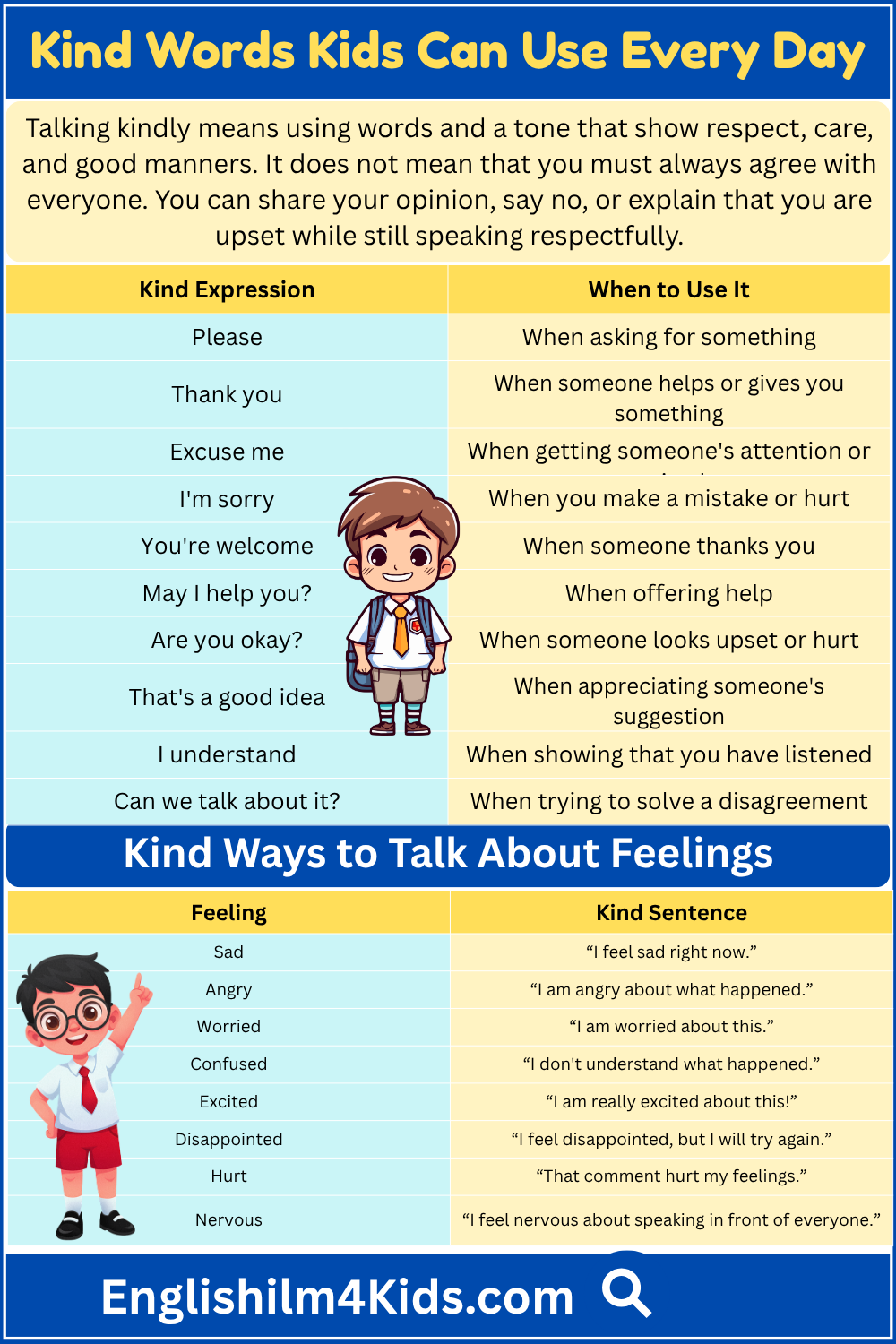
Talking kindly means using words and a tone that show respect, care, and good manners. It does not mean that you must always agree with everyone. You can share your opinion, say no, or explain that you are upset while still speaking respectfully.
For example:
- “Could you please help me?”
- “Thank you for helping me.”
- “I understand what you mean.”
- “I am sorry I hurt your feelings.”
- “Can we talk about it calmly?”
- “That is a nice idea.”
Why Is It Important to Talk Kindly?
Kind communication can make everyday conversations easier and more pleasant. Children may use kind words at home, in the classroom, on the playground, or while talking with friends.
- Show respect to others
- Make conversations more friendly
- Express feelings in a better way
- Solve small disagreements peacefully
- Build good friendships
- Communicate clearly with adults
- Make others feel welcome
- Learn good manners
Simple Ways to Talk Kindly to Others
Children can practice a few simple habits when speaking to others.
Use Polite Words
Words such as please, thank you, sorry, excuse me, and welcome are useful in everyday conversations.
Example:
Instead of:
“Give me your pencil.”
Say:
“Could you please lend me your pencil?”
Speak in a Calm Voice
Even good words can sound unfriendly if they are shouted. Try to use a calm and respectful voice when talking to others.
Listen When Someone Is Speaking
Kind communication is not only about speaking. Listening is also important. Let the other person finish speaking before you answer.
Think Before You Speak
Before saying something, ask yourself:
“Could my words hurt this person?”
If the answer is yes, try to choose kinder words.
Respect Other People’s Feelings
People may have different feelings, ideas, and opinions. You can disagree without insulting someone.
For example:
“I have a different idea. Can I explain it?”
This sounds much kinder than:
“Your idea is stupid.”
Kind Words Kids Can Use Every Day
| Kind Expression | When to Use It |
|---|---|
| Please | When asking for something |
| Thank you | When someone helps or gives you something |
| Excuse me | When getting someone’s attention or passing by |
| I’m sorry | When you make a mistake or hurt someone |
| You’re welcome | When someone thanks you |
| May I help you? | When offering help |
| Are you okay? | When someone looks upset or hurt |
| That’s a good idea | When appreciating someone’s suggestion |
| I understand | When showing that you have listened |
| Can we talk about it? | When trying to solve a disagreement |
How to Talk Kindly at Home
Home is one of the best places for children to practice kind communication. Children can use polite words when speaking with parents, grandparents, brothers, sisters, and other family members.
Instead of saying:
“Move!”
Try:
“Could you please move a little?”
Instead of:
“I want water.”
Try:
“Could I please have some water?”
Instead of:
“You took my toy!”
Try:
“I was playing with that toy. Could I have it back, please?”
These small changes can make conversations more respectful.
How to Talk Kindly at School
School gives children many opportunities to practice kind communication. They may need to talk to teachers, classmates, friends, and other school staff.
With a Teacher
You can say:
- “Excuse me, may I ask a question?”
- “Could you please explain this again?”
- “I don’t understand this part.”
- “May I borrow a pencil, please?”
- “Thank you for explaining it.”
With a Classmate
You can say:
- “Can I sit here, please?”
- “Would you like to work together?”
- “Can I borrow your ruler?”
- “That was a great answer.”
- “It’s okay. We can try again.”
How to Talk Kindly to Friends
Good friends do not always agree with each other. They may have different ideas, interests, and feelings. Kind communication helps friends handle these differences.
If your friend makes a mistake, you can say:
“That’s okay. Everyone makes mistakes.”
If you disagree, you can say:
“I see your point, but I think differently.”
If your friend looks sad, you can ask:
“Are you okay? Do you want to talk?”
If your friend helps you, say:
“Thank you. I really appreciate your help.”
How to Disagree Without Being Rude
It is normal for people to disagree. The important thing is to express your opinion respectfully.
Kind Ways to Disagree
- “I have a different opinion.”
- “I don’t think so, but I understand your idea.”
- “Maybe we can try another way.”
- “I see what you mean.”
- “Can we find a solution together?”
- “I think there may be another answer.”
Words to Avoid
Children should avoid words that insult, embarrass, or deliberately hurt another person.
For example, instead of:
“You’re wrong!”
Try:
“I think there may be another answer.”
Instead of:
“That’s a bad idea!”
Try:
“Maybe we can think of another idea.”
How to Talk Kindly When You Are Angry
Everyone gets angry sometimes. Being angry does not mean you have to use hurtful words.
When you feel angry:
- Stop for a moment.
- Take a slow breath.
- Think about what happened.
- Use calm words to explain your feelings.
- Listen to the other person.
- Try to solve the problem peacefully.
For example:
“I felt upset when you took my book without asking.”
This is clearer and kinder than:
“You are so mean!”
Talking about the problem instead of attacking the person can help make a difficult conversation calmer.
Kind Ways to Talk About Feelings
| Feeling | Kind Sentence |
|---|---|
| Sad | “I feel sad right now.” |
| Angry | “I am angry about what happened.” |
| Worried | “I am worried about this.” |
| Confused | “I don’t understand what happened.” |
| Excited | “I am really excited about this!” |
| Disappointed | “I feel disappointed, but I will try again.” |
| Hurt | “That comment hurt my feelings.” |
| Nervous | “I feel nervous about speaking in front of everyone.” |
Short Dialogues for Practicing Kind Speech
Dialogue 1: Asking for a Pencil
- Ali: Excuse me, Sara. Could I borrow your pencil, please?
- Sara: Sure. Here you are.
- Ali: Thank you!
- Sara: You’re welcome.
Dialogue 2: Helping a Friend
- Mia: I can’t find my notebook.
- Emma: Don’t worry. Can I help you look for it?
- Mia: Yes, please. Thank you.
- Emma: You’re welcome.
Dialogue 3: A Small Disagreement
- Sam: I think we should draw a house.
- Leo: I think a park would be better.
- Sam: That’s okay. Maybe we can draw both.
- Leo: Great idea!
Dialogue 4: Saying Sorry
- Tom: I’m sorry I stepped on your foot.
- Ben: It’s okay.
- Tom: Are you all right?
- Ben: Yes, I’m fine.
- Kind and Unkind Ways to Speak
| Unkind Way | Kinder Way |
|---|---|
| Give me that! | Could I please have that? |
| Move! | Excuse me, could I get past? |
| You’re wrong! | I have a different idea. |
| Be quiet! | Could you please speak quietly? |
| That’s mine! | I was using that. May I have it back? |
| I don’t like it! | It’s not my favorite, but I understand. |
| Go away! | I need some quiet time, please. |
| You can’t play! | We are playing this game now. You can join the next round. |
What Should You Do If You Hurt Someone With Your Words?
Sometimes children say something unkind without meaning to hurt another person. If this happens, it is important to take responsibility.
You can:
- Stop and think about what you said.
- Say that you are sorry.
- Listen to the other person’s feelings.
- Avoid making excuses.
- Try to use kinder words next time.
A simple apology can be:
“I’m sorry for what I said. I didn’t mean to hurt your feelings.”
A sincere apology shows that you understand your words affected someone.
How to Talk Kindly Online
Children should also use respectful language when communicating through messages, online classrooms, or other digital spaces.
Remember to:
- Use polite words.
- Avoid insulting people.
- Do not type angry messages quickly.
- Think before sending a message.
- Respect different opinions.
- Never share hurtful comments about someone.
- Tell a trusted adult if an online conversation makes you uncomfortable.
Simple Rules for Kind Communication
- Think before you speak.
- Listen before you answer.
- Use polite words.
- Speak calmly.
- Respect other people’s feelings.
- Say sorry when you make a mistake.
- Say thank you when someone helps you.
- Disagree without insulting others.
Practice: Choose the Kinder Sentence
Choose the sentence that sounds more respectful.
- A. Give me your book.
B. Could I please borrow your book? - A. You’re wrong!
B. I have a different idea. - A. Move away!
B. Excuse me, may I get past? - A. That’s a stupid idea.
B. Maybe we can think of another idea. - A. Help me now!
B. Could you please help me? - A. Be quiet!
B. Could you please speak more quietly? - A. I don’t want to play with you.
B. I would like some quiet time right now. - A. You hurt me!
B. That hurt my feelings.
Answer Key
- B
- B
- B
- B
- B
- B
- B
- B
Speaking Practice for Kids
- Good morning, how are you?
- I am fine, thank you.
- What is your name?
- My name is Ali.
- Where do you live?
- I live with my family.
- What are you doing?
- I am doing my homework.
- Can you help me, please?
- Yes, I can help you.
- May I come in?
- May I use your pencil?
- Please give me some water.
- I am feeling very happy today.
- What is your favorite game?
- My favorite game is football.
- I like reading storybooks.
- Can we play together?
- See you again tomorrow.
- Have a nice day!
Frequently Asked Questions
What does it mean to talk kindly to others?
Talking kindly means using respectful words, a calm voice, and considerate language when speaking with other people.
How can children speak more politely?
Children can use words such as “please,” “thank you,” “excuse me,” and “sorry.” They should also listen carefully and avoid insulting others.
What should I say when I disagree with someone?
You can say, “I have a different idea,” or “I understand your point, but I think differently.”
How can I talk kindly when I am angry?
Take a moment to calm down and then explain your feelings without insulting or blaming the other person.
Why should children use kind words?
Kind words help children communicate respectfully and handle everyday conversations and disagreements in a better way.
What should I say if I hurt someone’s feelings?
You can give a sincere apology, such as, “I’m sorry for what I said. I didn’t mean to hurt your feelings.”
How can parents help children learn kind communication?
Parents can model respectful language at home, listen to children, and practice simple conversations and polite expressions with them.
Can children disagree and still be kind?
Yes. Children can have different opinions while remaining respectful. They should focus on the idea rather than insulting the person.
Kids related articles
Pingback: Sharing and Taking Turns for Kids: Easy Friendship Skills - Englishilm4kids.com