
Learning how to say sorry politely is an important part of being kind and respectful. Children make mistakes while playing, learning, and spending time with others. A simple “I am sorry” can help them show that they care about someone’s feelings. It is also a good way to learn honesty and responsibility. In this article, kids will discover easy English apology words, polite phrases, and simple sorry sentences they can use at home, at school, and with friends. These examples will help young learners practice kind words in everyday life.
What Does It Mean to Say Sorry Politely
Saying sorry politely means telling someone that you feel sorry for a mistake or something that hurt their feelings. It shows that you care about the other person and want to make things better.
For example, if you accidentally step on your friend’s foot, you can say, “I am sorry. Are you okay?”
A polite apology is not just about saying words. It is also about being honest, speaking kindly, and trying to fix the mistake.
Why Is Saying Sorry Important for Kids
Learning to apologize helps children build good habits and treat others with care. It also teaches them that everyone makes mistakes and can learn from them.
- It shows kindness: Saying sorry helps children show that they care about others.
- It teaches honesty: Children learn to admit when they have made a mistake.
- It helps friendships: A sincere apology can help friends understand each other and move forward.
- It builds responsibility: Children learn to take responsibility for their actions.
- It shows respect: Polite words help children treat family members, teachers, and friends respectfully.
Polite Ways to Say Sorry in English
There are many simple ways to apologize in English. Children can choose a phrase that matches the situation.
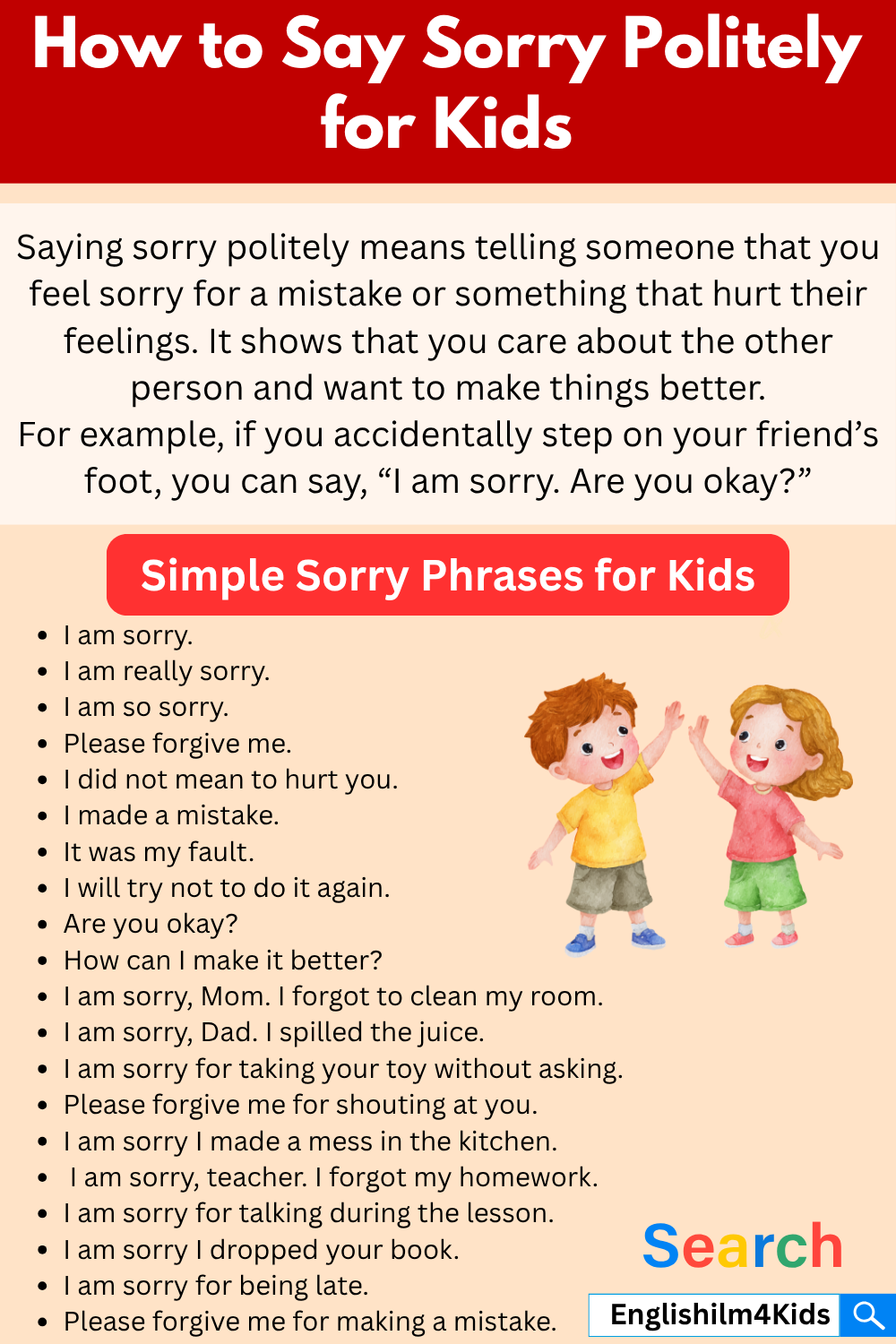
Simple Sorry Phrases for Kids
- I am sorry.
- I am really sorry.
- I am so sorry.
- Please forgive me.
- I did not mean to hurt you.
- I made a mistake.
- It was my fault.
- I will try not to do it again.
- Are you okay?
- How can I make it better?
How to Say Sorry Politely in Everyday Situations
Children can use polite apology phrases in many everyday situations. Here are some easy examples to help them understand when to say sorry.
How to Say Sorry at Home
- I am sorry, Mom. I forgot to clean my room.
- I am sorry, Dad. I spilled the juice.
- I am sorry for taking your toy without asking.
- Please forgive me for shouting at you.
- I am sorry I made a mess in the kitchen.
How to Say Sorry at School
- I am sorry, teacher. I forgot my homework.
- I am sorry for talking during the lesson.
- I am sorry I dropped your book.
- I am sorry for being late.
- Please forgive me for making a mistake.
How to Say Sorry to Friends
- I am sorry I took your ball.
- I am sorry I did not wait for you.
- I am sorry for hurting your feelings.
- I am sorry I did not share my toys.
- Can we play together again?
How to Say Sorry When You Make a Mistake
- I am sorry I wrote the wrong answer.
- I made a mistake. I will try again.
- I am sorry I forgot to bring my book.
- I am sorry I broke the pencil.
- I will be more careful next time.
How to Say Sorry When You Hurt Someone’s Feelings
Sometimes words or actions can make another person feel sad. Children should listen, speak gently, and try to understand how the other person feels.
- I am sorry I said something unkind.
- I did not mean to make you sad.
- I am sorry I laughed at your mistake.
- I am sorry I did not listen to you.
- I will try to use kinder words.
20 Simple Sorry Sentences for Kids
- I am sorry for my mistake.
- I am sorry I made you sad.
- I am sorry I broke your crayon.
- I am sorry I forgot your birthday.
- I am sorry I pushed you by accident.
- I am sorry I took your seat.
- I am sorry I made too much noise.
- I am sorry I lost your pencil.
- I am sorry I spilled the water.
- I am sorry I did not share my snack.
- I am sorry I forgot to say thank you.
- I am sorry I interrupted you.
- I am sorry I did not follow the rules.
- I am sorry I stepped on your foot.
- I am sorry I damaged your drawing.
- I am sorry I left my toys on the floor.
- I am sorry I did not wait for my turn.
- I am sorry I spoke too loudly.
- I am sorry I forgot to help you.
- I am sorry. I will do better next time.
Short Conversations About Saying Sorry Politely
Children can learn polite English by practicing short conversations with friends, family members, or teachers.
Conversation Between Two Friends
Ali: I am sorry I took your ball without asking.
Ahmed: That is okay. Please ask me next time.
Ali: I will. Can we play together now?
Ahmed: Yes, let’s play!
Conversation Between a Child and a Teacher
Teacher: You forgot to bring your homework today.
Sara: I am sorry, teacher. I left it at home.
Teacher: Please remember it tomorrow.
Sara: Yes, teacher. I will bring it tomorrow.
Conversation Between a Brother and Sister
Ayesha: I am sorry I broke your toy.
Hassan: I feel sad because I liked that toy.
Ayesha: I understand. I will help you fix it.
Hassan: Thank you for helping me.
Simple Steps for Making a Sincere Apology
A sincere apology means that you really want to make things better. Children can follow these easy steps when they make a mistake.
Step 1 Admit your mistake
Tell the truth about what happened. For example, “I took your pencil without asking.”
Step 2 Say sorry kindly
Use a gentle voice and say, “I am sorry for taking your pencil.”
Step 3 Listen to the other person
Give them time to share how they feel. Listen without interrupting.
Step 4 Try to make things right
Help fix the problem. You can return something, clean up a mess, or offer help.
Step 5 Learn from your mistake
Think about what you can do differently next time. Try to make a better choice.
Remember, saying sorry does not mean that the other person must forgive you right away. Give them time and show through your actions that you care.
Tips for Parents and Teachers to Teach Kids to Say Sorry
Parents and teachers can help children learn polite apologies through everyday examples and gentle guidance.
- Be a good example: Use “I am sorry” when you make a mistake.
- Explain feelings: Help children understand how their actions may affect others.
- Use simple words: Teach short phrases that children can remember easily.
- Practice through role-play: Act out common situations at home or in the classroom.
- Encourage honest apologies: Help children understand their mistakes instead of forcing them to repeat words.
- Praise kind actions: Notice when children take responsibility and try to make things right.
Practice Activities for Kids
Try these simple activities to practice saying sorry politely in English.
Sorry Sentence Practice
1. You accidentally step on your friend’s foot. What can you say?
- I am sorry. Are you okay?
- Give me your shoes.
- That is funny!
2. You take your sister’s toy without asking. What should you say?
- It is mine now.
- I am sorry I took your toy without asking.
- You can never have it.
3. You spill water on the table. What can you say?
- Someone else did it.
- I do not care.
- I am sorry. I will clean it up.
4. Your friend feels sad because of your unkind words. What can you say?
- I am sorry I hurt your feelings.
- Stop being sad.
- It was only a joke.
5. You interrupt someone while they are talking. What can you say?
- Talk faster.
- I am sorry for interrupting you.
- Be quiet.
Frequently Asked Questions
How do you say sorry politely in English?
You can say, “I am sorry,” “I am really sorry,” or “Please forgive me.” Choose a phrase that matches what happened.
What are some simple sorry sentences for kids?
“I am sorry for my mistake,” “I am sorry I hurt your feelings,” and “I will try to do better next time” are easy examples.
How can children apologize to their friends?
Children can explain what happened, say sorry kindly, listen to their friends, and try to fix the problem.
Why should kids learn to say sorry?
It helps children practice honesty, kindness, respect, and responsibility when they make mistakes.
What should a child do after saying sorry?
A child should listen, try to make things right, and learn from the mistake. The other person may need time to forgive.
More Kids related articles