
Learning polite words is an important part of growing up. Please and thank you are two simple English expressions that children can use every day at home, school, and with friends. These words help children ask for things politely and show appreciation when someone helps them or gives them something. Learning please and thank you for kids is also a useful way to build everyday English speaking skills. With simple examples and practice, children can learn when to use each word and feel more comfortable speaking politely in different situations.
What Does “Please” Mean?
Please is a polite word we use when we ask someone for something or request help. It makes a request sound kinder and more respectful.
For example, instead of saying, “Give me a pencil,” a child can say, “Please give me a pencil.”
Here are some easy examples:
- Please give me some water.
- Please help me with my homework.
- Can I have a pencil, please?
- Please open the door.
- Please pass me the book.
- Please wait for me.
- Please sit here.
- Can you please help me?
What Does “Thank You” Mean?
Thank you is a polite expression used to show that you appreciate something someone has done for you. We can say it when someone helps us, gives us something, shares with us, or does something kind.
For example, if your friend gives you a pencil, you can smile and say, “Thank you.”
- Thank you for helping me.
- Thank you for the gift.
- Thank you, Mom.
- Thank you for sharing.
- Thank you for the water.
- Thank you for your help.
- Thank you for waiting for me.
- Thank you for the book.
Why Should Kids Say Please and Thank You?
Children hear and use many words every day. Learning polite words helps them communicate with others in a friendly way.
Showing Respect
Using polite words shows that children care about how they speak to other people. Saying “please” when making a request is a simple way to show respect.
Being Kind
Kind words can make everyday conversations more pleasant. A child who uses polite expressions can make others feel appreciated and respected.
Speaking Politely
“Please” helps turn a simple request into a polite request. For example:
Give me the crayons.
Please give me the crayons.
The second sentence sounds more polite because it includes “please.”
Showing Appreciation
“Thank you” lets someone know that you noticed and appreciated their kindness or help.
Making Conversations Friendly
Polite expressions can make conversations easier and friendlier. Children can use them with family members, teachers, classmates, friends, and other people they meet.
When Should Kids Say “Please”?
Children can use please whenever they make a polite request.
At Home
- Please give me some milk.
- Can I watch TV, please?
- Please help me find my shoes.
- Please pass the salt.
At School
- May I borrow your pencil, please?
- Please explain this question again.
- Can I go outside, please?
- Please pass me the ruler.
At the Playground
- Can I have a turn, please?
- Please wait for me.
- Can I play with you, please?
- Please give me the ball.
In Shops
- Can I have this one, please?
- Please put it in the bag.
- Can I see that toy, please?
In Restaurants
- Can I have some water, please?
- Please give me a spoon.
- Can I have some juice, please?
With Friends
- Please share the crayons.
- Can I use your pencil, please?
- Please wait for me.
- Can you help me, please?
When Should Kids Say “Thank You”?
Children should say thank you when someone does something helpful or kind for them.
When Receiving Something
If someone gives a child a book, toy, pencil, or snack, the child can say:
“Thank you!”
When Getting Help
If a teacher helps with a difficult question, a child can say:
“Thank you for helping me.”
When Receiving a Gift
When someone gives a child a birthday or other gift, saying “thank you” shows appreciation.
When Someone Shares
If a friend shares crayons, toys, food, or another item, the child can say:
“Thank you for sharing.”
When Someone Does Something Kind
A child can also say thank you when someone opens a door, carries something, gives directions, or waits for them.
Please vs. Thank You
| Word | Meaning | When to Use | Example |
|---|---|---|---|
| Please | A polite way to ask for something | When making a request | Please give me a pencil. |
| Thank You | A way to show appreciation | After receiving help or kindness | Thank you for the pencil. |
A simple way to remember them is:
Please = I am asking.
Thank you = I am appreciating.
Easy Please and Thank You Sentences for Kids
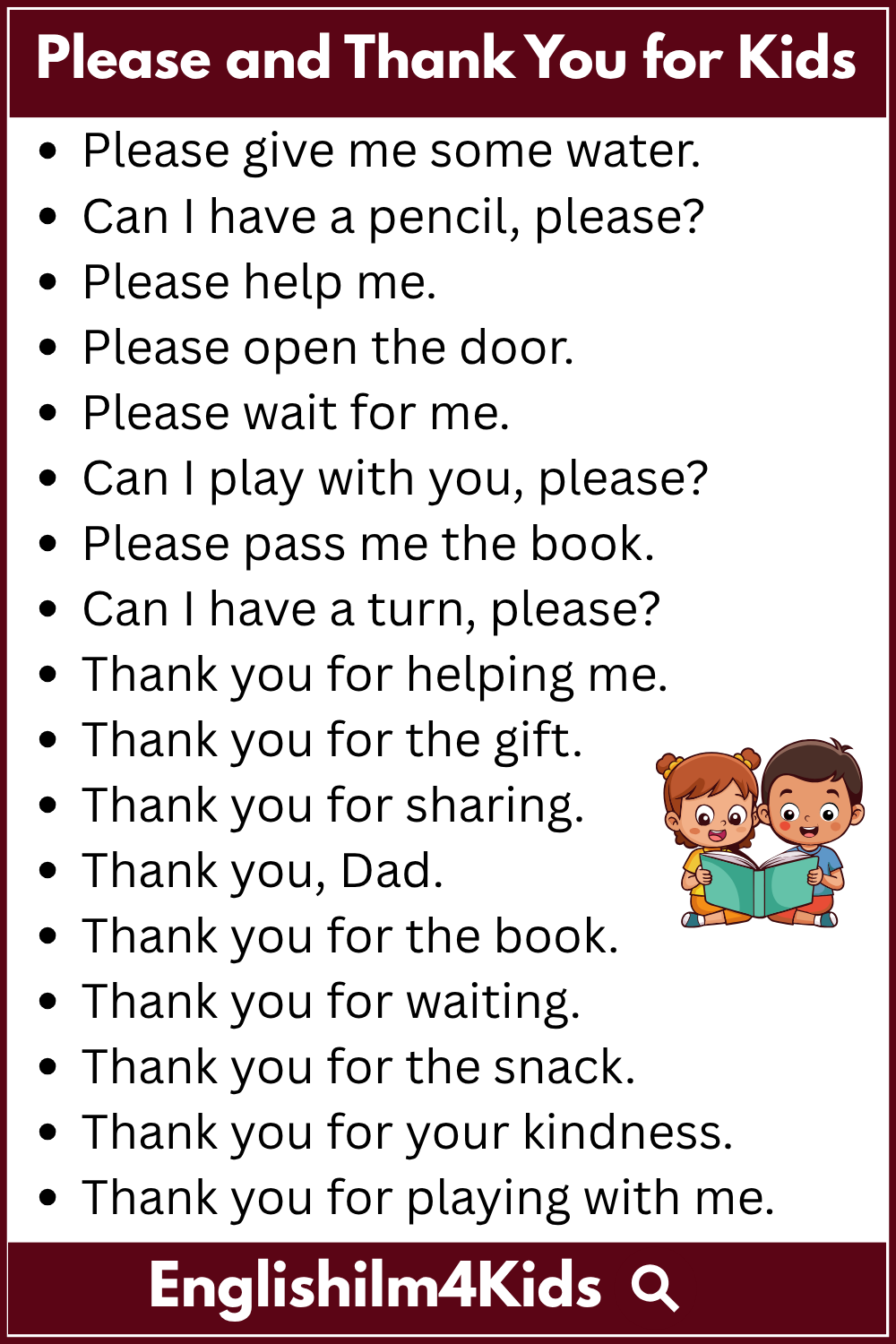
- Please give me some water.
- Can I have a pencil, please?
- Please help me.
- Please open the door.
- Please wait for me.
- Can I play with you, please?
- Please pass me the book.
- Can I have a turn, please?
- Thank you for helping me.
- Thank you for the gift.
- Thank you for sharing.
- Thank you, Dad.
- Thank you for the book.
- Thank you for waiting.
- Thank you for the snack.
- Thank you for your kindness.
- Thank you for helping with my homework.
- Thank you for playing with me.
Short Conversation Using Please and Thank You
- Ali: Can I borrow your blue pencil, please?
- Sara: Sure. Here you are.
- Ali: Thank you!
- Sara: You’re welcome.
- Ali: Can I also use your ruler, please?
- Sara: Yes, you can.
- Ali: Thank you, Sara.
- Sara: You’re welcome!
Please and Thank You at Home
Home is one of the best places for children to practice polite words. Children can use “please” when asking parents, brothers, sisters, or other family members for something.
- Please give me my shoes.
- Can you help me, please?
- Please pass the plate.
- Can I have some juice, please?
When someone helps them, children can respond with:
- Thank you, Mom.
- Thank you, Dad.
- Thank you for helping me.
- Thank you for making my lunch.
Please and Thank You at School
School provides many opportunities to practice good manners. Children can use polite words when talking to teachers, classmates, school staff, and friends.
For example, a student might say:
“Could you please explain this?”
After receiving help, the student can say:
“Thank you for explaining it.”
Children can also use “please” when borrowing classroom supplies and “thank you” when someone shares or helps them.
Using polite expressions at school can become a natural part of everyday communication.
Fun Practice Activity
Choose “please” or “thank you” for each situation.
Questions about Please and Thank for Kids
- You want your friend to give you a pencil. What do you say?
- Your teacher helps you with a question. What do you say?
- You want some water. What word should you use?
- Your brother gives you your book. What do you say?
- You want your friend to wait for you. What should you say?
- Your mother gives you a snack. What do you say?
- You want to borrow a toy. Which polite word can you use?
- Your friend shares crayons with you. What do you say?
- You want someone to open the door. What should you say?
- Your teacher gives you a new book. What do you say?
Answers
- Please
- Thank you
- Please
- Thank you
- Please
- Thank you
- Please
- Thank you
- Please
- Thank you
Good Manners for Kids
Besides “please” and “thank you,” children can learn several other useful polite expressions.
Excuse Me
Use excuse me when getting someone’s attention or politely moving past someone.
Example: Excuse me, may I ask a question?
Sorry
Use sorry when you make a mistake or hurt someone’s feelings.
Example: Sorry, I did not mean to break it.
You’re Welcome
You’re welcome is often used as a response after someone says “thank you.”
Example:
Tom: Thank you!
Sam: You’re welcome.
May I?
May I? is a polite way to ask for permission.
Example: May I use your pencil?
Could You Please…?
This expression is useful for making a polite request.
Example: Could you please help me?
Tips for Parents and Teachers
Children usually need regular practice before polite expressions become natural.
Model Polite Language
Parents and teachers can use “please” and “thank you” during normal conversations so children can hear them in real situations.
Practice Through Daily Activities
Mealtimes, shopping, classroom activities, and playtime can all become opportunities to practice polite English.
Use Short Examples
Young children learn more easily when sentences are short and clear.
Praise Natural Use
When a child remembers to use a polite expression, a simple positive response can encourage them to continue.
Practice Through Role-Play
Children can pretend to be customers, teachers, shopkeepers, parents, or friends. This gives them a fun way to practice everyday conversations.
The goal is not simply to make children repeat words. It is to help them understand when and why those words are useful.
More helpful articles