
Sometimes children disagree with their friends, siblings, or classmates. Two children may want the same toy, have different ideas for a game, or feel upset because of something someone said. These problems are a normal part of everyday life, but learning to handle them calmly is important. Knowing how to solve problems peacefully helps children express their feelings, listen to others, and find fair solutions without hurting anyone. Children do not have to agree on everything to get along. They can learn to use kind words, take turns, and ask for help when needed. Let’s explore simple ways to solve problems peacefully at home, at school, and with friends.
What Does It Mean to Solve Problems Peacefully?
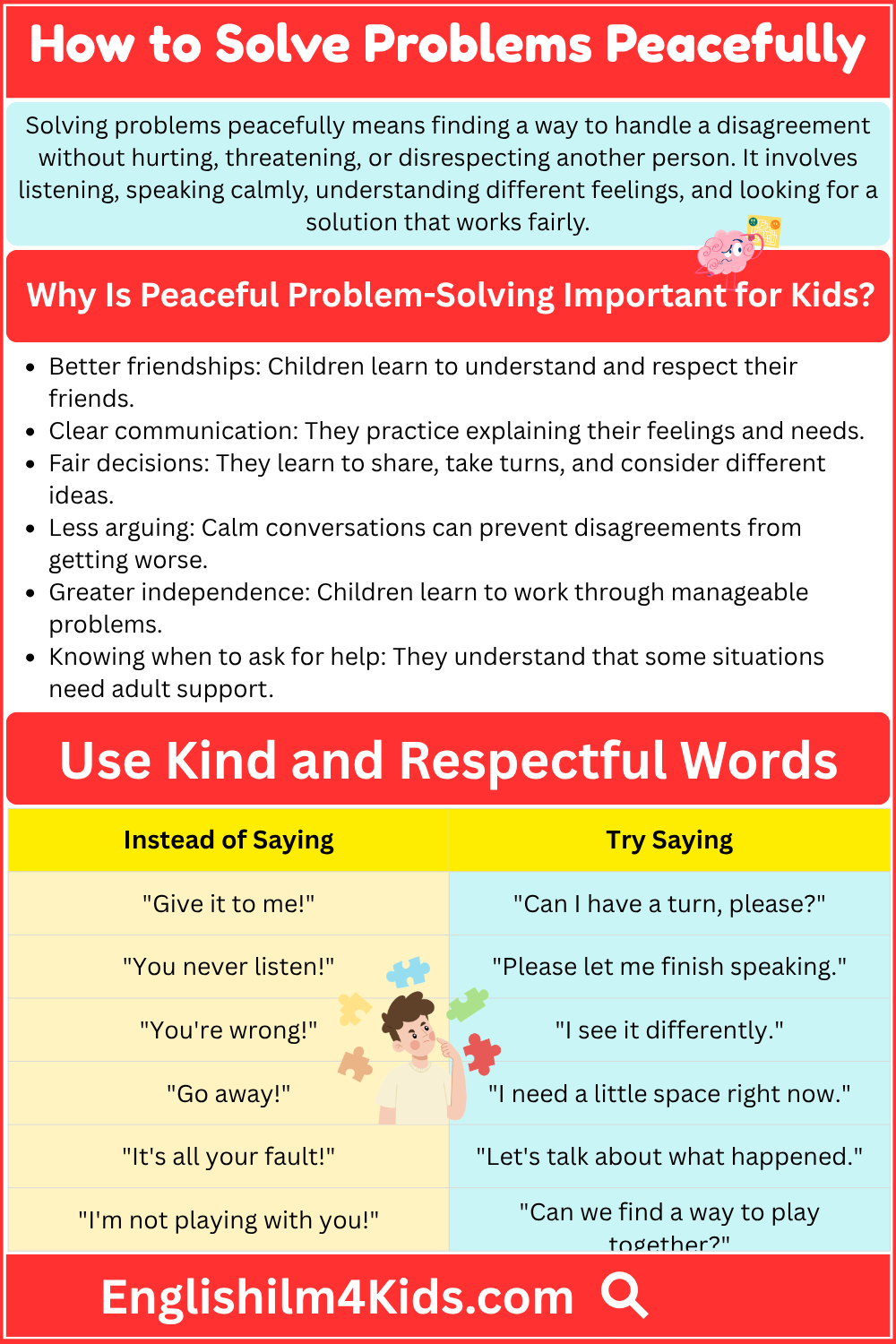
Solving problems peacefully means finding a way to handle a disagreement without hurting, threatening, or disrespecting another person. It involves listening, speaking calmly, understanding different feelings, and looking for a solution that works fairly.
For example, imagine that two friends want to play with the same ball. Instead of fighting over it, they can agree to take turns or choose a game they can play together.
Peaceful problem-solving does not mean hiding your feelings or always agreeing with others. It means expressing what you think and feel in a safe and respectful way.
Why Is Peaceful Problem-Solving Important for Kids?
- Better friendships: Children learn to understand and respect their friends.
- Clear communication: They practice explaining their feelings and needs.
- Fair decisions: They learn to share, take turns, and consider different ideas.
- Less arguing: Calm conversations can prevent disagreements from getting worse.
- Greater independence: Children learn to work through manageable problems.
- Knowing when to ask for help: They understand that some situations need adult support.
7 Simple Steps to Solve Problems Peacefully
1. Stop and Stay Calm
When you feel angry, frustrated, or upset, take a short pause before speaking or acting. You can take a few slow breaths, relax your hands, or step away briefly if it is safe.
It is easier to think clearly when you are calm enough to talk.
Example: Your brother takes the pencil you were using. Instead of shouting, pause and take a slow breath.
Remember: Feeling angry is okay. Hurting someone because you are angry is not okay.
2. Explain the Problem
Think about what happened and explain it using simple, clear words. Talk about the action that upset you rather than insulting the other person.
For example, instead of saying, “You are so mean!” you could say, “I felt upset when you took my pencil without asking.”
This helps the other person understand what went wrong.
Helpful sentence: “I felt upset when __________ because __________.”
3. Listen to the Other Person
Give the other person a chance to explain what happened. Listen without interrupting, laughing at them, or shouting over them.
You may discover that they misunderstood the situation or did not realize their actions upset you.
Example:
- Maya: “I was upset because you changed the rules of our game.”
- Ali: “I thought everyone wanted to try a new rule.”
- Maya: “I didn’t know that. Let’s talk about it.”
Listening does not mean you must agree with everything the other person says. It means you are willing to understand their point of view.
4. Use Kind and Respectful Words
Words can help solve a problem or make it worse. Try to speak calmly and avoid name-calling, threats, and hurtful comments.
Here are some helpful expressions:
| Instead of Saying | Try Saying |
|---|---|
| “Give it to me!” | “Can I have a turn, please?” |
| “You never listen!” | “Please let me finish speaking.” |
| “You’re wrong!” | “I see it differently.” |
| “Go away!” | “I need a little space right now.” |
| “It’s all your fault!” | “Let’s talk about what happened.” |
| “I’m not playing with you!” | “Can we find a way to play together?” |
You can be firm about what you need while still treating others respectfully.
5. Think of Possible Solutions
Once everyone has explained the problem, think about different ways to solve it.
Ask yourself:
- Can we take turns?
- Can we share?
- Can we choose another activity?
- Can we change the rules fairly?
- Can we find a solution that respects everyone’s needs?
Example: Two classmates want to sit in the same seat. They could take turns on different days or choose two other seats together.
Try to find a solution that is safe and fair. A peaceful solution does not require anyone to accept something harmful or unfair.
6. Agree on a Fair Solution
Choose a solution that everyone involved can accept freely and safely. Make sure everyone understands what will happen next.
For example, if two friends want to use the same coloring book, they could agree to color one page each before switching.
Sometimes the first idea will not work. That is okay. You can suggest another solution or ask an adult to help.
Helpful sentence: “How can we make this fair for both of us?”
7. Check Whether the Problem Is Solved
After trying the solution, think about whether it worked.
Ask:
- Does everyone understand the agreement?
- Did we treat each other respectfully?
- Is the solution safe and fair?
- Do we need to try something different?
Real-Life Examples of Solving Problems Peacefully
Children can practice peaceful problem-solving in many everyday situations.
Situation 1: Two Friends Want the Same Toy
Problem: Sara and Ayesha both want to play with the same toy car.
Unhelpful response: They pull the car in opposite directions and begin shouting.
Peaceful response:
- Sara: “I would like to play with the car.”
- Ayesha: “I want to play with it, too.”
- Sara: “Would you like to take turns?”
- Ayesha: “Yes. You can go first, and then it will be my turn.”
Lesson: Sharing and taking turns can help friends solve disagreements fairly.
Situation 2: A Classmate Interrupts You
Problem: You are telling your teacher something, but a classmate keeps interrupting.
Peaceful response:
- You: “Please let me finish speaking.”
- Classmate: “Sorry. Go ahead.”
- You: “Thank you for listening.”
Lesson: Calm, clear words can help you express your needs without starting an argument.
Situation 3: Siblings Disagree About a Game
Problem: One child wants to play a board game, but the other wants to draw.
Peaceful response:
- Child 1: “I want to play a board game.”
- Child 2: “I would rather draw.”
- Child 1: “Can we draw for a little while and play the game afterward?”
- Child 2: “That sounds fair.”
Lesson: Taking turns choosing activities can help siblings respect each other’s interests.
Situation 4: A Friend Does Not Follow the Rules
Problem: Your friend changes the rules during a game, and you feel that it is unfair.
Peaceful response:
- You: “I thought we agreed to follow these rules.”
- Friend: “I wanted to make the game more exciting.”
- You: “Let’s stop for a moment and agree on the rules together.”
Lesson: Talking about the problem and agreeing on clear rules can help everyone enjoy the game.
Situation 5: Someone Hurts Your Feelings
Problem: A friend makes an unkind comment about your drawing.
Peaceful response:
- You: “That comment hurt my feelings.”
- Friend: “I didn’t know it would upset you.”
- You: “Please speak kindly about my work.”
Lesson: It is okay to explain your feelings and ask others to treat you respectfully.
Useful Sentences for Peaceful Problem-Solving
| Purpose | Helpful Sentence |
|---|---|
| Explaining feelings | “I feel upset about what happened.” |
| Asking for a turn | “Can I have a turn, please?” |
| Listening respectfully | “I understand what you mean.” |
| Disagreeing politely | “I have a different idea.” |
| Asking for space | “I need a little time to calm down.” |
| Suggesting a solution | “What if we take turns?” |
| Finding a compromise | “Can we choose something we both like?” |
| Apologizing | “I’m sorry I hurt your feelings.” |
| Accepting an apology | “Thank you for saying sorry.” |
| Asking for help | “Can you help us solve this problem?” |
| Setting a boundary | “Please stop. I don’t like that.” |
| Ending an argument | “Let’s talk when we are both calm.” |
What Should Kids Avoid During a Disagreement?
- Shouting: Loud voices can make it harder for people to listen.
- Hitting or pushing: Physical actions can hurt someone.
- Name-calling: Insults can damage friendships and hurt feelings.
- Blaming without listening: It is important to understand what happened before deciding how to respond.
- Interrupting: Everyone deserves a chance to speak.
- Refusing every solution: Being willing to consider different ideas can help resolve a disagreement.
- Spreading gossip: Talking negatively about someone to others can create more problems.
- Forcing an agreement: A child should not have to accept an unsafe or unfair solution just to end an argument.
How Parents and Teachers Can Teach Peaceful Problem-Solving
1. Set a Good Example
Use calm words when you disagree with someone. Children can learn from seeing adults listen, explain their feelings, and look for fair solutions.
2. Help Children Name Their Feelings
Ask questions such as, “Are you feeling angry, sad, or frustrated?” Naming feelings can help children explain what is bothering them.
3. Listen to Both Sides
When children disagree, give each child a chance to explain what happened. Avoid deciding who is at fault before understanding the situation.
4. Ask Questions Instead of Giving Every Answer
Try asking:
- “What do you think the problem is?”
- “How do you think your friend feels?”
- “What could you do differently?”
- “Which solution would be fair and safe?”
5. Practice Through Role-Play
Act out simple situations, such as sharing a toy or choosing a game. Let children practice using calm words and finding solutions.
6. Praise Helpful Actions
Notice when children wait their turn, listen carefully, apologize sincerely, or suggest a fair solution. Give specific feedback, such as, “You listened to your sister and found a solution together.”
7. Step In When Necessary
Adults should intervene when children are unsafe, cannot resolve a problem, or are dealing with repeated bullying or intimidation. Children should never be expected to solve a dangerous situation alone.
A Simple Peaceful Problem-Solving Activity
Activity: Find a Fair Solution
Read the situation below and ask the child to suggest a peaceful answer.
Situation: Two friends are building a tower. One friend wants to use all the blocks for a tall tower. The other friend wants some blocks to build a small house.
Discuss these questions:
- What is the problem?
- How might each friend feel?
- What could the friends say to each other?
- What are two possible solutions?
- Which solution is safe and fair for both friends?
Example answer: The friends could agree to build a large house together or divide the blocks so that each child can build something.
Practice Exercises: How to Solve Problems Peacefully
Exercise 1: Choose the Best Answer
1. Your friend takes your pencil without asking. What should you do?
a. Shout at your friend.
b. Calmly ask for your pencil back.
c. Push your friend.
2. You and your sister want to watch different programs. What could you do?
a. Argue until someone gives up.
b. Take the remote away.
c. Take turns choosing what to watch.
3. Your classmate disagrees with your idea. What should you do?
a. Listen to the classmate’s idea.
b. Call the classmate names.
c. Refuse to listen.
4. You are too angry to talk calmly. What is a good choice?
a. Say something hurtful.
b. Take a safe break and calm down.
c. Break something.
5. Two friends cannot agree on a solution. What should they do?
a. Start fighting.
b. Blame each other.
c. Ask a trusted adult for help.
Exercise 2: Fill in the Blanks
Use the words in the box.
Words: listen, calm, fair, kind, help
- Take a deep breath and stay __________.
- __________ carefully when another person speaks.
- Use __________ words during a disagreement.
- Try to find a __________ solution.
- Ask an adult for __________ when you need it.
Answer Key
Exercise 1: 1. b, 2. c, 3. a, 4. b, 5. c
Exercise 2: 1. calm, 2. listen, 3. kind, 4. fair, 5. help
Frequently Asked Questions
1. How can kids solve problems peacefully?
Kids can pause to calm down, explain the problem, listen to each other, use respectful words, think of solutions, and agree on a safe and fair next step.
2. What are the five steps to resolving a conflict?
Five useful steps are to stay calm, explain the problem, listen to the other person, suggest solutions, and agree on a safe and fair solution. Some problems may require additional help from an adult.
3. Why is peaceful problem-solving important for children?
It helps children communicate clearly, understand different points of view, handle disagreements, and build respectful relationships with family members and friends.
4. What words can children use to solve problems?
Children can say, “I feel upset,” “Can we take turns?” “I see it differently,” “Let’s find a solution,” and “Can you help us?”
5. What should a child do if a friend refuses to cooperate?
The child can explain their feelings calmly, suggest another option, or choose to step away. If the situation becomes unsafe or continues to cause distress, they should ask a trusted adult for help.
6. Should children always compromise to solve a problem?
No. Compromise can be helpful, but children should not have to accept bullying, threats, harm, or unfair treatment. Safety and personal boundaries matter.
7. How can parents teach children to handle arguments?
Parents can model calm communication, listen to both sides, help children identify feelings, practice possible solutions, and guide them toward safe and respectful choices.
8. What is the difference between peaceful problem-solving and avoiding a problem?
Peaceful problem-solving means addressing a disagreement respectfully and looking for a solution. Avoiding a problem means leaving it unresolved. Taking a temporary break can help, but some problems need to be discussed or brought to a trusted adult.
ConclusionLearning how to solve problems peacefully is an important life skill for every child. By staying calm, listening carefully, using kind words, and looking for fair solutions, children can handle disagreements more positively. Not every problem will have an easy answer, and sometimes children will need help from a parent or teacher. What matters is learning to treat others with respect while also standing up for personal needs and safety. Encourage children to practice these steps in everyday situations so they can become more confident communicators and thoughtful friends.
Read More
Pingback: How to Show Respect: Simple Lessons for Kids - Englishilm4kids.com