
Why Are Playground Rules Important?
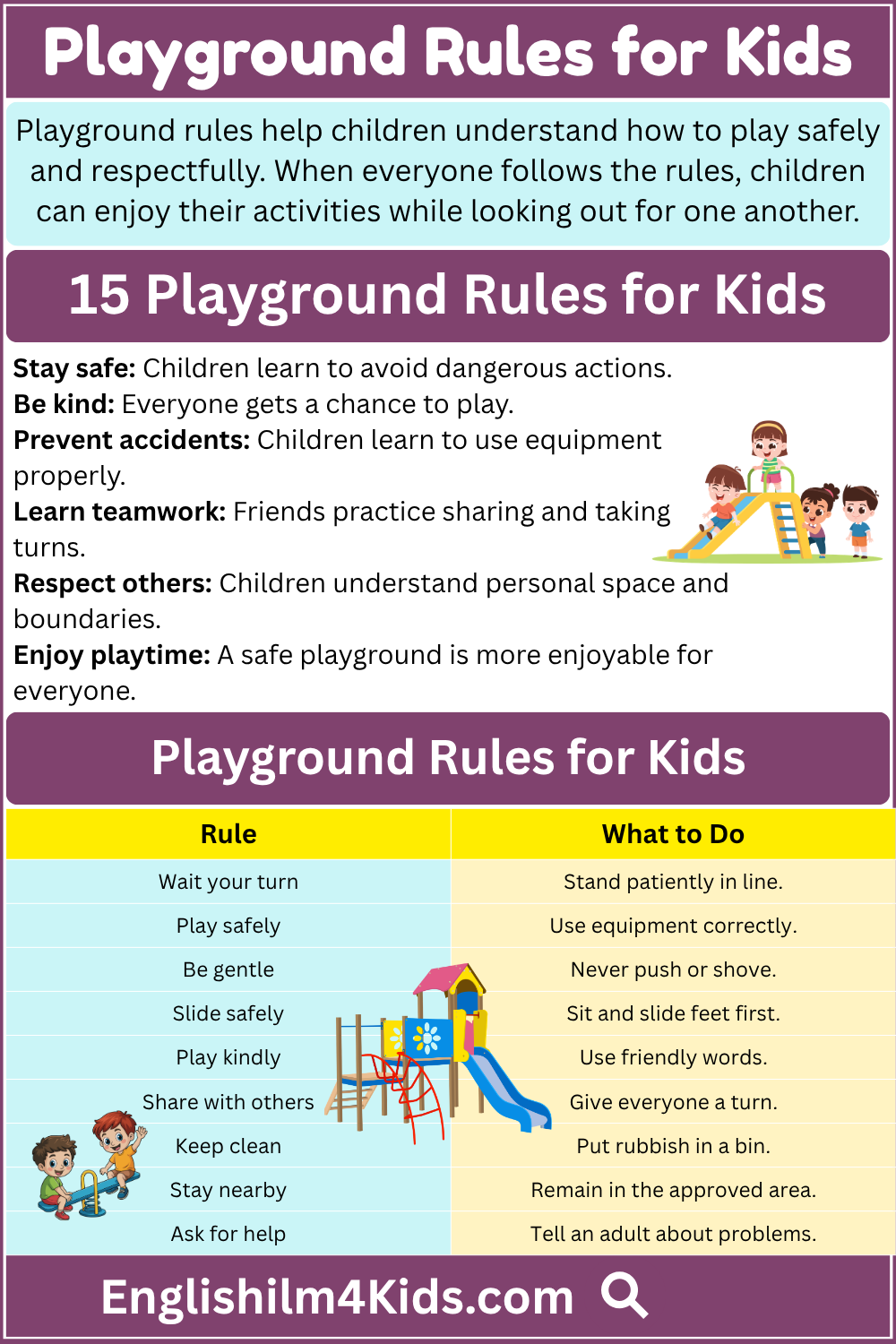
Playground rules help children understand how to play safely and respectfully. When everyone follows the rules, children can enjoy their activities while looking out for one another.
- Be kind: Everyone gets a chance to play.
- Prevent accidents: Children learn to use equipment properly.
- Learn teamwork: Friends practice sharing and taking turns.
- Respect others: Children understand personal space and boundaries.
- Enjoy playtime: A safe playground is more enjoyable for everyone.
15 Playground Rules for Kids
1. Listen to Your Teacher or Caregiver
Always listen when a teacher, parent, or playground supervisor gives instructions. Adults can help children understand which areas are safe and how to use the equipment correctly.
Example: Stop playing and listen when your teacher asks everyone to line up.
2. Wait for Your Turn
Some playground equipment, such as slides and swings, may be busy. Wait patiently until the child ahead of you has finished.
Example: Stand in line and wait until the slide is free.
3. Use Playground Equipment Correctly
Use swings, slides, climbing frames, and other equipment as intended. Follow the posted rules and the instructions of a responsible adult.
Example: Sit properly on a swing instead of standing on it.
4. Never Push or Shove
Pushing can make someone lose their balance and get hurt. Keep your hands to yourself and give other children enough space.
Example: Walk around a friend instead of pushing past them.
5. Slide Down Feet First
When using a slide, sit down and slide feet first. Use the ladder or steps to reach the top, and make sure the bottom is clear before sliding.
Example: Sit on the slide, face forward, and keep your feet in front of you.
6. Hold On When Climbing
Use the handholds and footholds provided on climbing equipment. Climb carefully and avoid climbing on wet, damaged, or unsuitable surfaces.
Example: Hold the climbing bars securely and move one step at a time.
7. Keep a Safe Distance from Moving Swings
A moving swing can hit someone who stands too close. Walk around the swing area carefully and wait until the swing stops before approaching it.
Example: Walk behind the marked swing area instead of running in front of a moving swing.
8. Keep Sand, Stones, and Toys on the Ground
Never throw sand, stones, sticks, or toys at other children. These objects can hurt someone, especially if they hit the face or eyes.
Example: Build a sandcastle instead of throwing sand at a friend.
9. Share Playground Equipment
Let other children enjoy the playground too. Take turns with popular equipment and avoid keeping it for too long when others are waiting.
Example: After your turn on the swing, let another child have a turn.
10. Use Kind Words
Speak politely and treat other children with respect. Kind words help everyone feel welcome.
Example: Say, “Would you like to play with us?” instead of telling someone to go away.
11. Keep Your Hands and Feet to Yourself
Avoid hitting, kicking, grabbing, or pulling other children. Play in ways that do not hurt or frighten anyone.
Example: If a friend takes your toy, ask for help instead of hitting them.
12. Stay Within the Playground Area
Play in the area approved by your teacher, parent, or caregiver. Do not leave the playground without permission.
Example: Ask an adult before going to another part of the park.
13. Watch Where You Are Going
Look ahead while running or walking. Be careful around other children, steps, equipment, and objects on the ground.
Example: Slow down when approaching the slide ladder.
14. Keep the Playground Clean
Put rubbish in a bin and return toys to their proper place. A clean playground is easier for everyone to enjoy.
Example: Pick up your empty snack wrapper and put it in the bin.
15. Tell an Adult When Something Is Wrong
Tell a trusted adult if someone is hurt, equipment looks broken, or a situation feels unsafe. Do not try to fix broken equipment yourself.
Example: If you see a loose swing chain, tell your teacher and stay away from it.
Playground Rules for Kids: Quick Reference Table
| Rule | What to Do |
|---|---|
| Listen carefully | Follow adult instructions. |
| Wait your turn | Stand patiently in line. |
| Play safely | Use equipment correctly. |
| Be gentle | Never push or shove. |
| Slide safely | Sit and slide feet first. |
| Climb carefully | Hold on securely. |
| Stay clear of swings | Keep away from moving swings. |
| Play kindly | Use friendly words. |
| Share with others | Give everyone a turn. |
| Keep clean | Put rubbish in a bin. |
| Stay nearby | Remain in the approved area. |
| Ask for help | Tell an adult about problems. |
Simple Playground Safety Rules for Preschoolers
Young children need short, clear instructions that are easy to remember. Parents and teachers can teach these basic rules before children start playing.
- Walk carefully.
- Wait your turn.
- Use gentle hands.
- Keep sand on the ground.
- Sit on the swing.
- Slide feet first.
- Hold on when climbing.
- Share with friends.
- Listen to your teacher.
- Tell an adult if you get hurt.
Good Playground Manners for Kids
Playground manners help children become considerate playmates. Safety rules protect children from danger, while good manners help everyone feel respected and included.
- Say “please” when asking for something.
- Say “thank you” when someone helps you.
- Ask before joining a game.
- Let other children have a turn.
- Encourage friends who are learning something new.
- Say “I’m sorry” when you hurt someone’s feelings or make a mistake.
- Invite others to join when appropriate.
- Respect a friend who does not want to play a particular game.
Helpful Playground Sentences
| Situation | Sentence |
|---|---|
| Asking to play | “Can I play with you?” |
| Asking for a turn | “Can I have a turn, please?” |
| Letting someone go first | “You can go first.” |
| Offering help | “Can I help you?” |
| Saying thank you | “Thank you for sharing.” |
| Apologizing | “I’m sorry. Are you okay?” |
| Asking someone to stop | “Please stop. I don’t like that.” |
| Asking an adult for help | “Excuse me, can you help me?” |
What Should Kids Do If Someone Breaks the Playground Rules?
Sometimes children forget the rules or become too excited while playing. Knowing what to do can help prevent small problems from becoming bigger ones.
- Stay calm. Do not respond by pushing or hitting.
- Move away if necessary. Give yourself space if someone is playing dangerously.
- Use clear words. Say, “Please stop. That is not safe.”
- Tell an adult. Ask a teacher, parent, or supervisor for help if the problem continues or someone may get hurt.
- Help safely. If a child falls or gets hurt, tell an adult immediately rather than attempting a risky rescue.
Exercise 1: Fill in the Blanks
Use these words to complete the sentences.
Words: share, adult, turn, safely, kind
- We should play __________ on the playground.
- We should be __________ to our friends.
- We should wait for our __________.
- We should __________ playground equipment.
- We should tell an __________ when someone gets hurt.
Exercise 2: True or False
Write True or False for each statement.
- It is safe to push friends on the playground.
- Children should wait patiently for their turn.
- We should throw sand at other children.
- We should tell an adult about broken equipment.
- Everyone deserves to be treated with respect.
Answer Key
Exercise 1: 1. safely, 2. kind, 3. turn, 4. share, 5. adult
Exercise 2: 1. False, 2. True, 3. False, 4. True, 5. True
Frequently Asked Questions About Playground Rules for Kids
1. What are playground rules for kids?
Playground rules are simple instructions that help children play safely, respect others, share equipment, and enjoy outdoor activities without unnecessary risks.
2. Why should children follow playground safety rules?
Children should follow playground safety rules to reduce the risk of accidents, use equipment correctly, and help make playtime safer and more enjoyable for everyone.
3. What are the five basic playground rules?
Five basic rules are to listen to adults, wait your turn, use equipment correctly, keep your hands to yourself, and tell an adult when something is wrong.
4. What should children never do on a playground?
Children should never push others, throw objects, misuse equipment, stand too close to moving swings, or leave the approved play area without permission.
5. How can children show good manners on the playground?
Children can show good manners by sharing, using kind words, taking turns, inviting others to play, and respecting other people’s space and feelings.
6. What should a child do if someone gets hurt on the playground?
The child should tell a trusted adult immediately. If the injured child is in danger, children should keep away from hazards and follow the adult’s instructions.
7. How can parents teach playground rules to young children?
Parents can explain one rule at a time, demonstrate safe behavior, practice simple sentences, and remind children of the rules before playtime.
8. Should playground rules be the same for every age group?
The main principles of safety, kindness, and respect apply to all children. However, equipment rules and supervision should be appropriate for each child’s age, abilities, and the playground’s instructions.
ConclusionFollowing playground rules helps children enjoy playtime while learning important lessons about safety, kindness, and respect. Simple habits such as waiting for a turn, using equipment correctly, sharing with friends, and listening to adults can make the playground a better place for everyone. Parents and teachers can help children learn these habits through practice and gentle reminders. Encourage your child to remember these 15 playground rules and use them every day. Play safely, be kind to others, and make every playground visit a happy experience!
Pingback: How to Solve Problems Peacefully: Simple Steps for Kids - Englishilm4kids.com