
Respect is an important part of getting along with others. It means treating people with kindness, listening to their thoughts, and caring about their feelings. Children can show respect at home, at school, on the playground, and in many other everyday situations. Learning how to show respect helps kids use kind words, make thoughtful choices, and build better relationships with family members, teachers, and friends.
What Does Respect Mean?
Respect means treating other people with care, kindness, and fairness. It also means understanding that everyone has feelings, ideas, and personal boundaries.
For example, when you listen while your friend is speaking, you show respect. When you ask before borrowing someone’s pencil, you show respect for their belongings.
10 Simple Ways to Show Respect
1. Use Polite Words
Words such as please, thank you, excuse me, and you’re welcome help us communicate politely.
Examples:
- “Please pass me the book.”
- “Thank you for helping me.”
- “Excuse me, may I ask a question?”
- “You’re welcome!”
2. Listen When Someone Is Speaking
Give the speaker your attention. Try not to interrupt or talk over them.
Example:
Your teacher is explaining an activity. You stop chatting with your friend and listen carefully.
You can also show that you are listening by asking a relevant question or responding when the other person finishes speaking.
3. Respect Your Parents and Family
Family members often help us learn, grow, and feel safe. You can show respect by speaking kindly, listening to one another, and helping with suitable tasks.
Examples:
- Speak politely to your parents and caregivers.
- Help put away your toys.
- Knock before entering a closed room when appropriate.
- Listen when a family member explains an important rule.
- Say thank you when someone helps you.
4. Show Respect to Teachers
Teachers help students learn new things and practice important skills. Showing respect helps everyone take part in classroom activities.
Examples:
- Raise your hand when you want to speak, if that is the classroom rule.
- Listen to instructions.
- Take care of classroom materials.
- Ask questions politely.
- Follow reasonable classroom rules.
5. Be Kind to Friends and Classmates
Respect helps friendships grow. Treat your classmates fairly, even if they have different interests or opinions.
Examples:
- Invite someone to join a game.
- Share classroom materials when appropriate.
- Avoid teasing people about their appearance or abilities.
- Celebrate a friend’s success.
- Give others a chance to speak.
6. Respect Other People’s Belongings
Everyone deserves to have their belongings treated carefully.
Before using something that belongs to another person, ask permission.
Examples:
- “May I borrow your pencil, please?”
- Return a borrowed book in good condition.
- Put shared toys away after playing.
- Do not take someone’s things without asking.
- Ask before using another person’s phone or personal items.
7. Respect Different Opinions
People may enjoy different games, foods, books, traditions, or activities. They may also have different ideas about a subject.
Examples:
- “I understand your idea.”
- “I think differently, but I respect your opinion.”
- “That sounds interesting. Can you tell me more?”
- “We can like different things and still be friends.”
8. Respect Personal Space and Boundaries
Personal space is the area around a person that helps them feel comfortable. People may have different preferences about physical contact and privacy.
Examples:
- Ask before hugging someone.
- Give people enough space when standing in a line.
- Knock before entering a private room.
- Stop when someone asks you not to touch their belongings.
- Respect a person’s answer when they do not want to join a game.
You can say, “Would you like a hug?” instead of assuming that someone wants one.
9. Say Sorry When You Make a Mistake
Everyone makes mistakes. A respectful person tries to take responsibility for their actions.
A meaningful apology includes admitting what happened, saying sorry, and trying to fix the problem.
Example:
“I’m sorry I interrupted you. I should have waited for you to finish speaking.”
You can also ask, “How can I make this right?”
Remember that saying sorry is important, but changing your behavior is important, too.
10. Treat Everyone Fairly
Respect is not only for people we know or people who can help us. We should try to treat everyone fairly.
Examples:
- Speak kindly to new classmates.
- Include others when possible.
- Do not laugh at someone who makes a mistake.
- Take turns during games.
- Avoid judging people because they look or act differently from you.
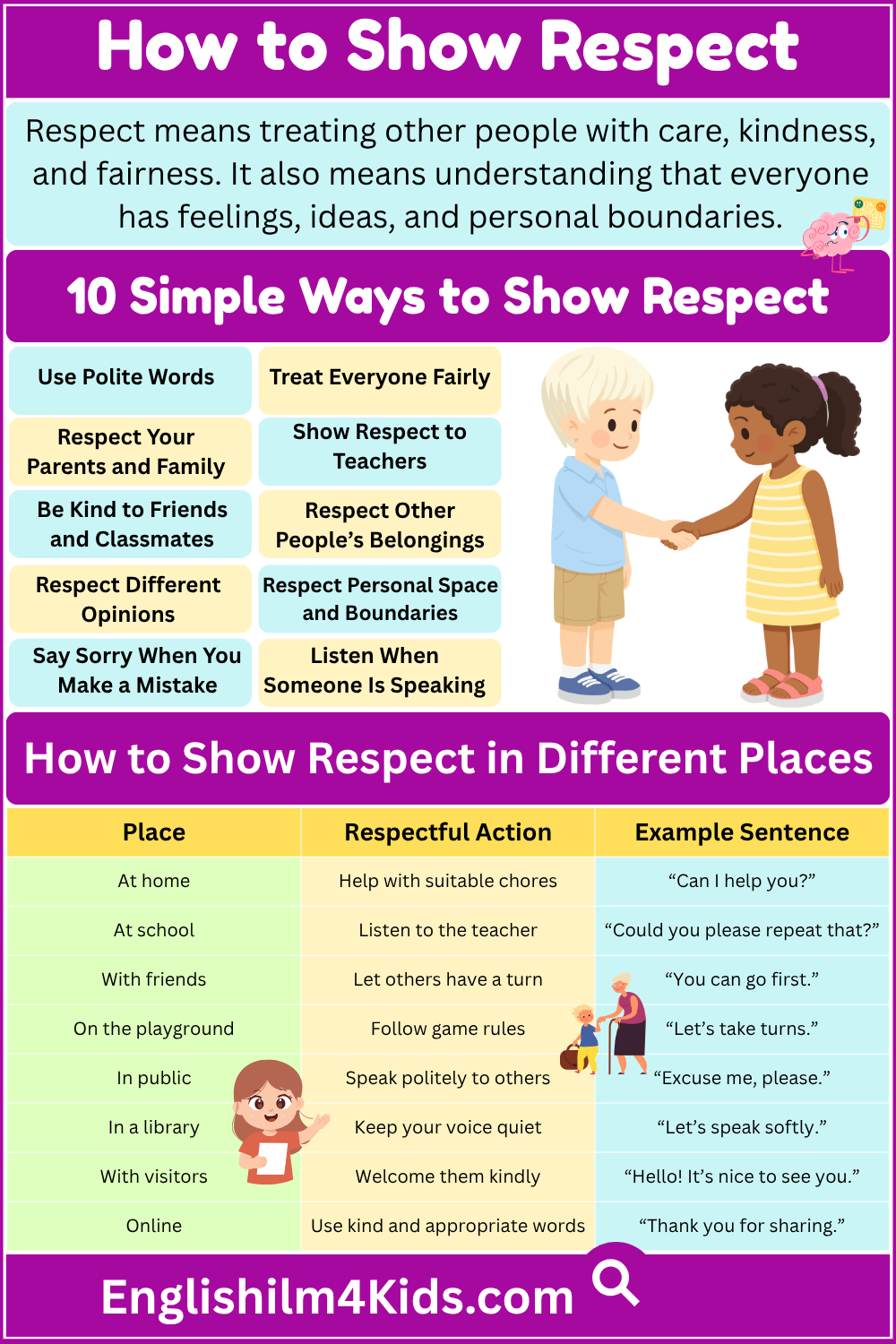
How to Show Respect in Different Places
| Place | Respectful Action | Example Sentence |
|---|---|---|
| At home | Help with suitable chores | “Can I help you?” |
| At school | Listen to the teacher | “Could you please repeat that?” |
| With friends | Let others have a turn | “You can go first.” |
| On the playground | Follow game rules | “Let’s take turns.” |
| In public | Speak politely to others | “Excuse me, please.” |
| In a library | Keep your voice quiet | “Let’s speak softly.” |
| With visitors | Welcome them kindly | “Hello! It’s nice to see you.” |
| Online | Use kind and appropriate words | “Thank you for sharing.” |
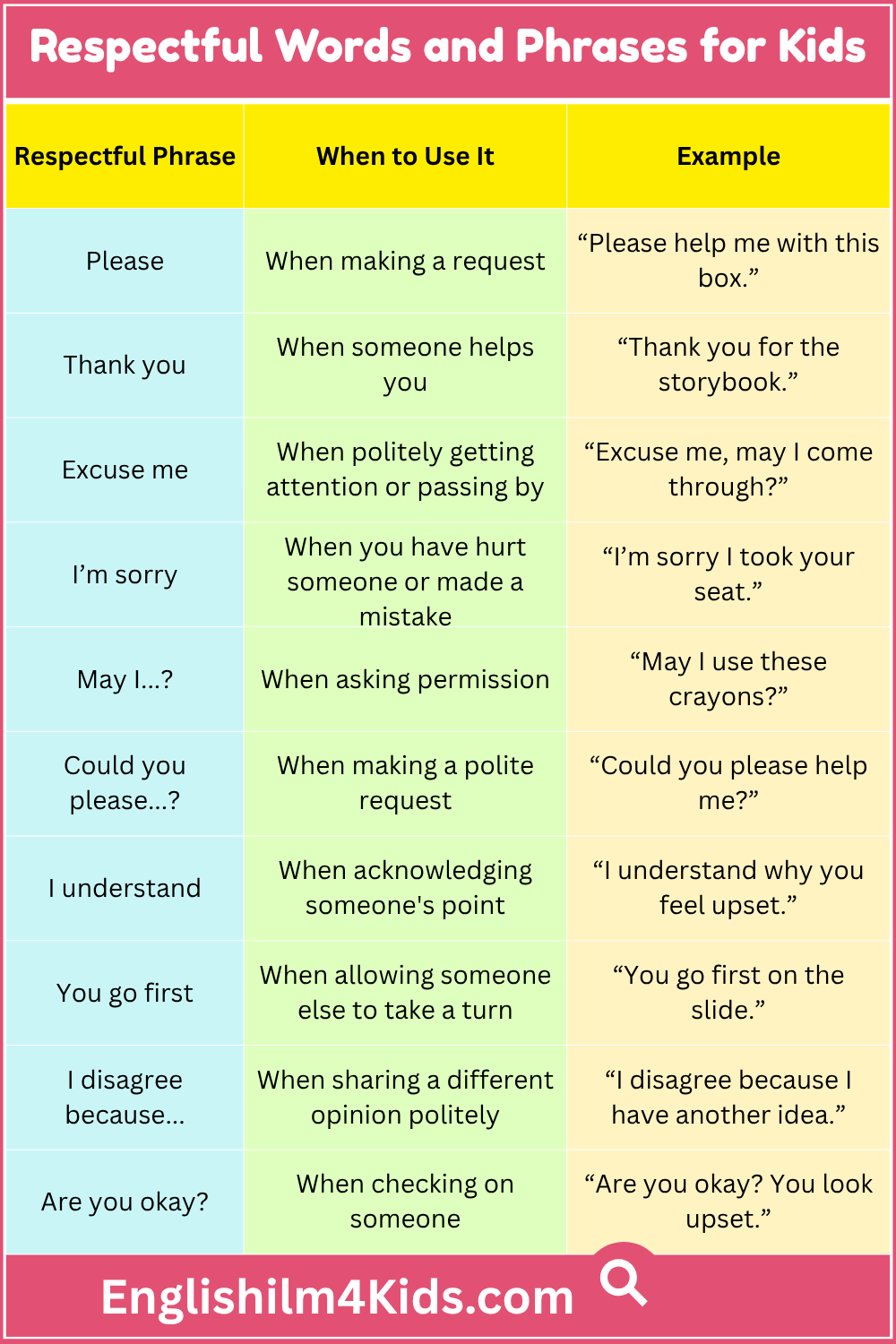
Respectful Words and Phrases for Kids
| Respectful Phrase | When to Use It | Example |
|---|---|---|
| Please | When making a request | “Please help me with this box.” |
| Thank you | When someone helps you | “Thank you for the storybook.” |
| Excuse me | When politely getting attention or passing by | “Excuse me, may I come through?” |
| I’m sorry | When you have hurt someone or made a mistake | “I’m sorry I took your seat.” |
| May I…? | When asking permission | “May I use these crayons?” |
| Could you please…? | When making a polite request | “Could you please help me?” |
| I understand | When acknowledging someone’s point | “I understand why you feel upset.” |
| You go first | When allowing someone else to take a turn | “You go first on the slide.” |
| I disagree because… | When sharing a different opinion politely | “I disagree because I have another idea.” |
| Are you okay? | When checking on someone | “Are you okay? You look upset.” |
Examples of Respectful and Disrespectful Behavior
| Situation | Respectful Behavior | Disrespectful Behavior |
|---|---|---|
| Someone is speaking | Listen and wait for your turn | Interrupt repeatedly |
| You want a toy | Ask before using it | Grab it from someone |
| A friend has a different opinion | Listen and respond politely | Laugh at the friend |
| You make a mistake | Admit it and apologize | Blame someone else |
| Someone says no to a hug | Respect their answer | Hug them anyway |
| You lose a game | Congratulate the winner | Insult the winner |
| A classmate needs help | Offer help if appropriate | Make fun of the classmate |
| You feel angry | Explain your feelings calmly | Shout insults at others |
Frequently Asked Questions
1. What does it mean to show respect?
Showing respect means treating people with kindness, fairness, and consideration. It includes listening, using polite words, respecting boundaries, and caring for other people’s belongings.
2. How can kids show respect at home?
Kids can show respect at home by speaking politely, listening to family members, helping with suitable chores, asking before borrowing belongings, and respecting privacy.
3. How can students show respect at school?
Students can listen to teachers and classmates, follow reasonable classroom rules, take care of school materials, wait for their turn, and treat others fairly.
4. What are some examples of respectful words?
Examples include “please,” “thank you,” “excuse me,” “I’m sorry,” and “May I…?” Children can also say, “I understand your opinion,” or “Could you please help me?”
5. Why is respect important for children?
Respect helps children communicate more kindly, understand boundaries, and work through disagreements. It can support positive relationships at home, at school, and with friends.
Read more