
Learning magic words is a simple way for children to become kind, polite, and respectful in everyday life. Words like please, thank you, sorry, excuse me, and you’re welcome may be short, but they can make a big difference in how children talk to others. Kids can use these words at home, at school, on the playground, and when meeting new people. When children practice polite words regularly, they learn how to express themselves kindly and make others feel valued. In this guide, we will explore common magic words for kids and see how they can use them in simple everyday situations.
The Core 5 Magic Words Every Child Must Know
1. “Please” — The Gateway to Respectful Requests
- When a Child Should Use It: Whenever they are requesting a snack, asking for a favorite toy, seeking help with homework, or wanting a turn on the playground slide.
- The Psychological Value: Young children are naturally egocentric; they instinctively view the world through their immediate needs. Left unchecked, their requests sound like demanding orders (“Give me that juice!”). Introducing “Please” forces a cognitive pause. It reframes a command into a polite choice. This simple adjustment teaches children that they are not inherently entitled to everything they want immediately, and that they must value the other person’s willingness to help them.
2. “Thank You” — The Foundation of Lifelong Gratitude
- When a Child Should Use It: Upon receiving a birthday gift, a compliment from a teacher, a meal cooked by a parent, or assistance from a sibling.
- The Psychological Value: Gratitude is one of the strongest indicators of long-term mental well-being and happiness. Saying “Thank you” encourages children to look outside of themselves. It helps them recognize the invisible currency of human relationships: time, effort, and kindness. By acknowledging a good deed, children internalize appreciation, which counteracts feelings of entitlement and fosters a naturally optimistic worldview.
3. “I’m Sorry” — Cultivating Accountability and Deep Empathy
- When a Child Should Use It: When they accidentally knock over a classmate’s block tower, break a household rule, speak rudely, or cause physical harm during play.
- The Psychological Value: Apologizing is difficult, even for adults. When we teach children to say “I’m sorry,” we are teaching them the vital skill of accountability. It forces them to confront the direct consequences of their actions on someone else’s emotional state. A true apology bridges the gap between an accidental mistake and active emotional repair, helping children learn that making mistakes is human, but taking responsibility is what preserves strong friendships.
4. “Excuse Me” — Learning Personal Space and Healthy Boundaries
- When a Child Should Use It: When they need to interrupt an adult conversation, safely maneuver through a crowded hallway, or right after an involuntary bodily reflex like a sneeze, cough, or burp.
- The Psychological Value: Children are often bursting with urgent thoughts they want to share immediately. “Excuse me” teaches them the concept of patience and social timing. It instills an early respect for boundaries—both their own and those of others. It teaches the child that while their voice matters immensely, they must enter a social space smoothly rather than barging through forcefully.
5. “You’re Welcome” — Completing the Positive Social Cycle
- When a Child Should Use It: Whenever a peer, parent, or stranger expresses appreciation to them for a kind act or shared item.
- The Psychological Value: Human communication relies heavily on micro-feedback loops. When a child says “You’re welcome,” it completes the cycle of positive social reinforcement. It validates the other person’s gratitude and reinforces the child’s own identity as a helpful, kind individual. It turns helping others from a forced chore into a rewarding, mutually satisfying experience.
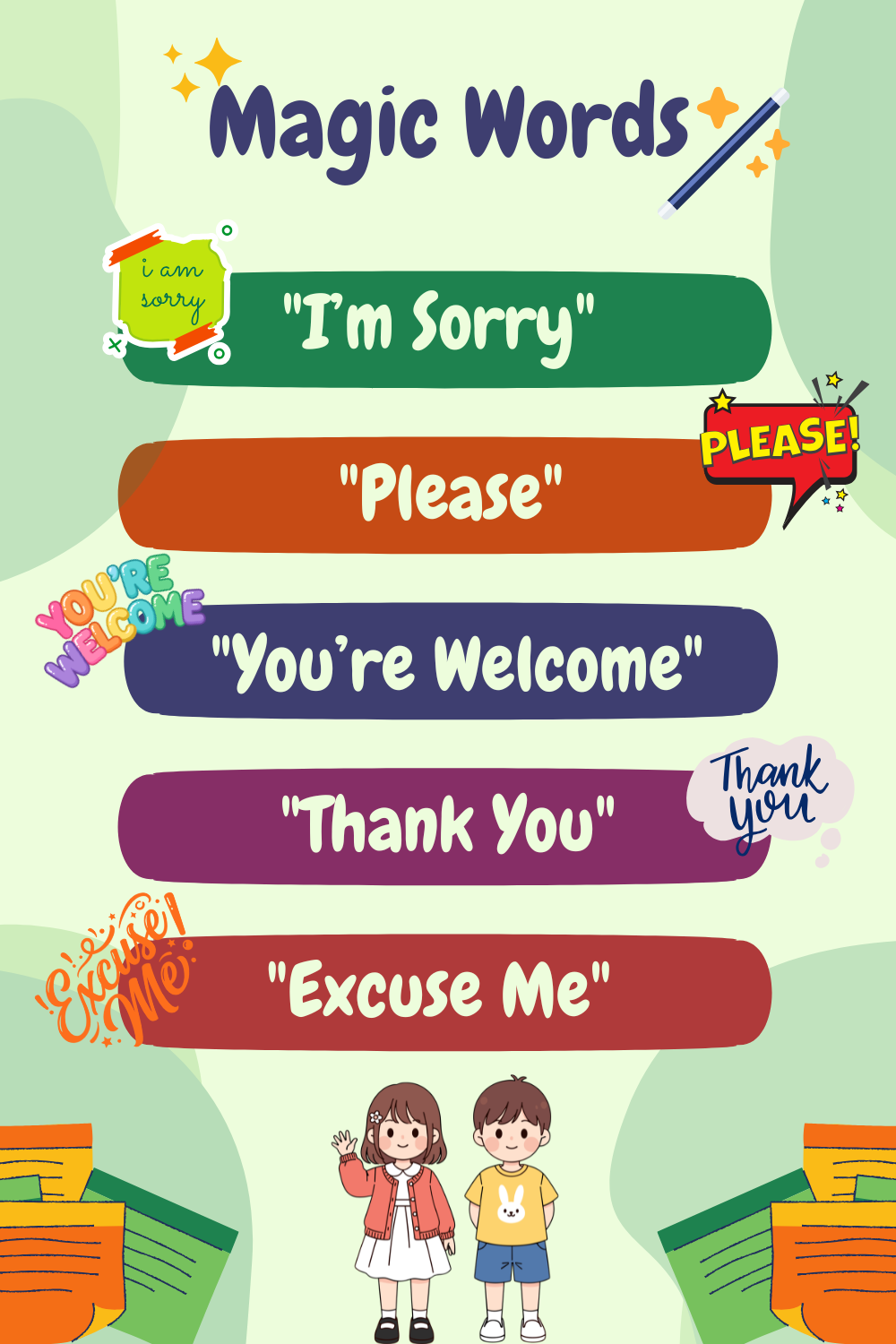
Quick-Reference Guide: Scenarios, Timing, and Impact
| The Magic Word | Everyday Target Scenario | Core Psychological Value | Long-term Social Benefit |
|---|---|---|---|
| Please | Requesting an item, food, or help | Respect & Anti-entitlement | Easier collaboration with peers |
| Thank You | Receiving gifts, food, or active favors | Gratitude & Emotional warmth | Deeper, more resilient friendships |
| I’m Sorry | Causing a mistake, spill, or hurt feelings | Accountability & Empathy | Stronger conflict-resolution skills |
| Excuse Me | Navigating crowds or interrupting talks | Patience & Boundary respect | High situational and social awareness |
| You’re Welcome | Responding to someone’s gratitude | Kindness & Reciprocity | Seen as warm, approachable, and polite |
Beyond the Basics: Advanced Phrases for Older Kids
- “May I?”: A powerful upgrade to “Please” that explicitly asks for permission before crossing a boundary (e.g., “May I borrow your colored pencil?”).
- “I Forgive You”: The necessary counterpart to an apology. Teaching children to accept an apology graciously helps them learn conflict resolution without holding long-lasting grudges.
- “After You”: A brilliant way to practice selflessness, patience, and chivalry by allowing others to walk through doorways or enter lunch lines first.
- “Gladly” / “With Pleasure”: Instead of grumbling when asked to perform a simple chore, replying with a cheerful phrase shifts the child’s mind into a cooperative, helpful state.
Frequently Asked Questions (FAQs) for Parents & Teachers
Q1: At what age should I start teaching magic words to my child?
Q2: My child refuses to say “I’m sorry.” Should I force them?
Q3: What should I do if my child stops using these words at school?
More Kids retested articles