
The Future Indefinite and Future Continuous Tense are used to describe future events. These tenses are commonly used to express future actions, intentions, plans, and ongoing activities that will occur at a specific time in the future. Future Indefinite, also known as Simple Future, is used to state what will happen. Future Continuous is used to indicate what will be happening at a specific point in time. Both tenses are relatively easy to learn and understand.
What Is Future Indefinite Tense?
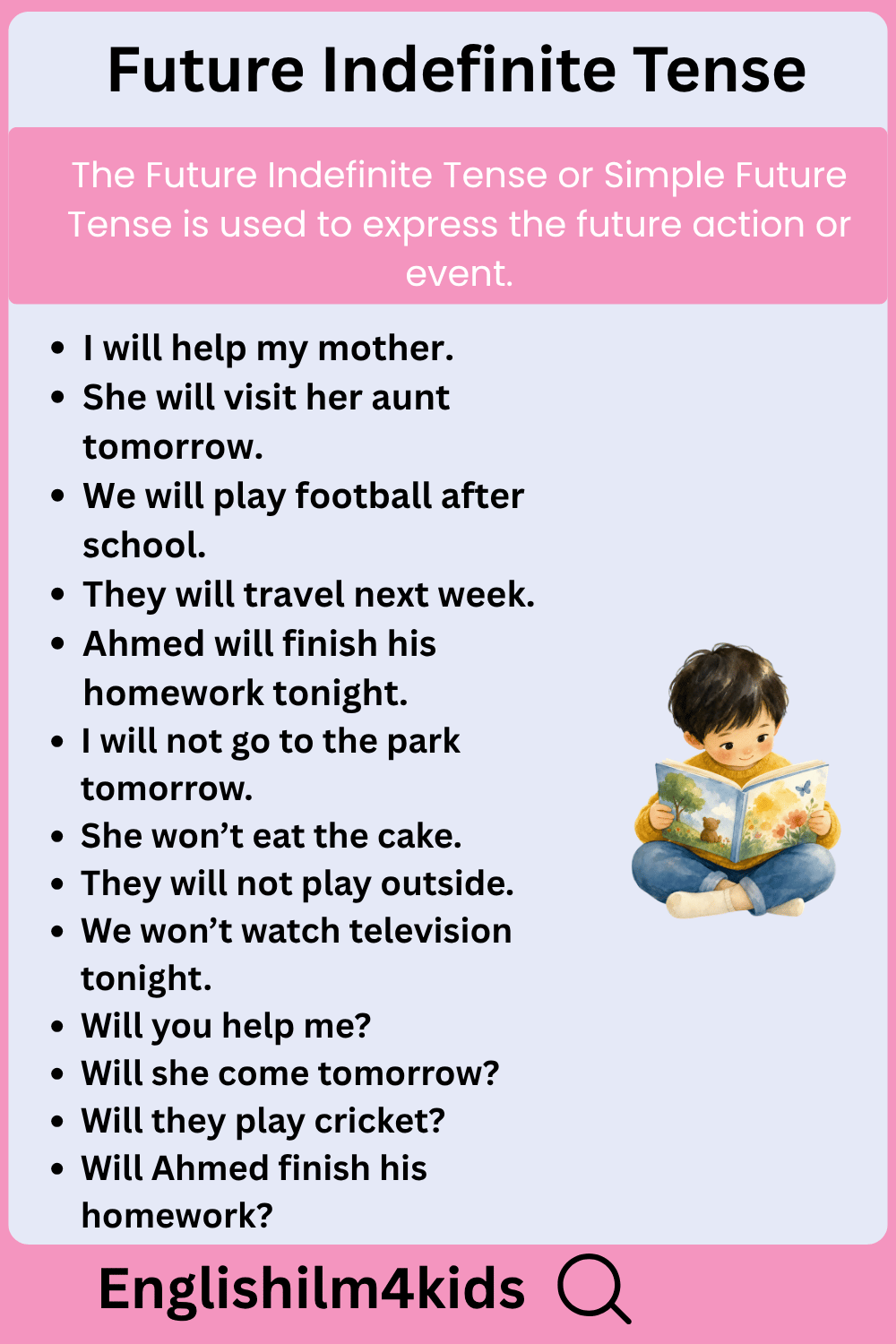
| The Future Indefinite Tense or Simple Future Tense is used to express the future action or event. |
It always contains the word will.
For example:
- “I will visit my grandmother tomorrow.”
- The action of visiting my grandmother has not occurred yet and will occur in the future.
- Future Indefinite Tense Formula
The Future Indefinite Tense follows a simple rule and formula.
Subject + will + V1 + object
Examples:
- I will help my mother.
- She will visit her aunt tomorrow.
- We will play football after school.
- They will travel next week.
- Ahmed will finish his homework tonight.
The most important part of the Future Indefinite Tense formula is that the verb always remains in its base form.
- will go
- will eat
- will read
- will play
- will write
Future Indefinite Tense Negative Form
To make negative sentences in the Future Indefinite Tense, use will not or won’t.
Subject + will not + V1 + object
Examples:
- I will not go to the park tomorrow.
- She won’t eat the cake.
- They will not play outside.
- We won’t watch television tonight.
Future Indefinite Tense Question Form
To make questions in Future Indefinite Tense, put will at the beginning of a sentence.
Will + subject + V1 + object?
Examples:
- Will you help me?
- Will she come tomorrow?
- Will they play cricket?
- Will Ahmed finish his homework?
The short answers for these questions can be:
- Yes, I will.
- No, I won’t.
What Is Future Continuous Tense?
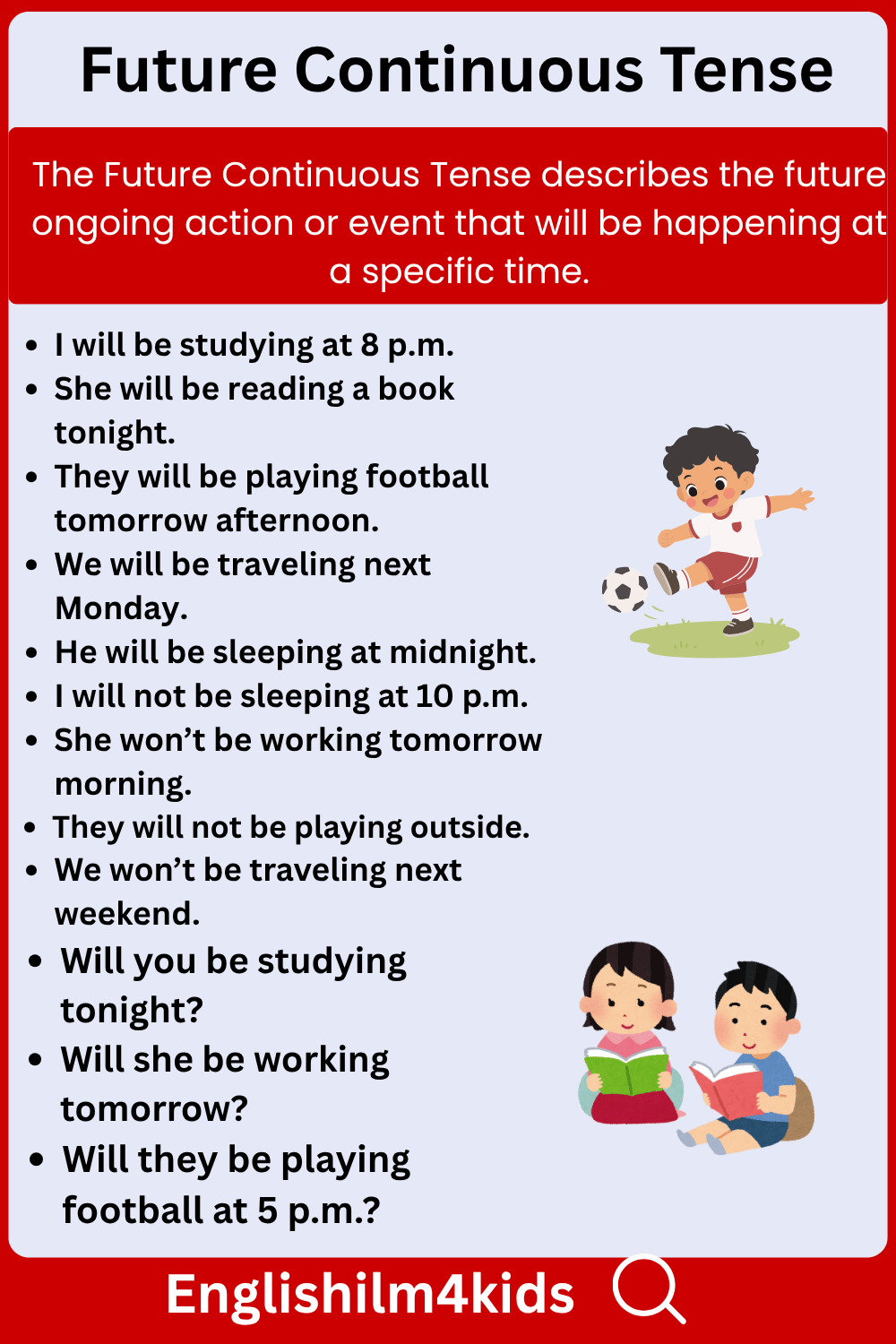
| The Future Continuous Tense describes the future ongoing action or event that will be happening at a specific time. |
For example:
“I will be studying at 8 p.m. tonight.”
This sentence clearly tells us that the speaker will be studying tonight at 8 p.m.
Future Continuous Tense Formula
The Future Continuous Tense also follows a simple rule and formula.
Subject + will be + verb-ing + object/time
Examples:
- I will be studying at 8 p.m.
- She will be reading a book tonight.
- They will be playing football tomorrow afternoon.
- We will be traveling next Monday.
- He will be sleeping at midnight.
The most important part of the Future Continuous Tense formula is:
will be + verb-ing
Future Continuous Tense Negative Form
To make negative sentences in Future Continuous Tense, use will not be or won’t be.
Subject + will not be + verb-ing + object/time
Examples:
- I will not be sleeping at 10 p.m.
- She won’t be working tomorrow morning.
- They will not be playing outside.
- We won’t be traveling next weekend.
Future Continuous Tense Question Form
To make questions in Future Continuous Tense, put will at the beginning.
Will + subject + be + verb-ing + object/time?
Examples:
- Will you be studying tonight?
- Will she be working tomorrow?
- Will they be playing football at 5 p.m.?
- Will he be sleeping at midnight?
Future Indefinite and Future Continuous Tense Difference
Future Indefinite and Future Continuous Tenses are used to express future events. Still, there is a slight difference between these two tenses. The table below depicts the contrast between Future Indefinite and Future Continuous tenses.
| Future Indefinite | Future Continuous |
|---|---|
| Describes a future action or event | Describes a future ongoing action or event |
| Uses will + V1 | Uses will be + verb-ing |
| I will study tonight. | I will be studying at 8 p.m. |
| She will cook dinner. | She will be cooking dinner at 7 p.m. |
Difference Between Future Indefinite and Future Continuous Tense for Kids
We can easily identify the Future Indefinite and Future Continuous Tenses by asking a simple question.
What will happen? → Future Indefinite
What will be happening? → Future Continuous
For example:
Ali will play cricket tomorrow.
Ali will be playing cricket at 4 p.m. tomorrow.
In the first sentence, we know Ali will play cricket, and in the second sentence, we know he will be playing cricket at 4 p.m.
Future Indefinite Tense Examples
| Future Indefinite Tense is mostly used to talk about future events, promises, intentions, predictions, and offers. Following are some examples of Future Indefinite Tense. |
Examples:
- I will call you tomorrow.
- We will visit the museum next week.
- She will help her brother.
- They will clean the classroom.
- He will buy a new school bag.
- I will carry your books.
- It will rain tomorrow.
There is no complexity in Future Indefinite Tense, as the verb does not change after will.
- I will go.
- She will go.
- They will go.
The verb go remains the same after will.
Future Continuous Tense Examples
| Future Continuous Tense is used to express future activities that will be occurring at a specific time. |
Examples:
- I will be doing my homework at 7 p.m.
- She will be sleeping when you arrive.
- We will be watching a movie tonight.
- They will be traveling this time next week.
- He will be studying at the library tomorrow afternoon.
- The children will be playing in the garden at 5 p.m.
When you use Future Continuous Tense, you can also use the following time expressions to state the time when the ongoing activity will occur:
- At 5 p.m. tomorrow
- This time next week
- Tomorrow morning
- When you arrive
Common Mistakes Kids Make
Future Indefinite and Future Continuous Tense Common Mistakes
| Incorrect Sentence | Correct Sentence | Reason |
|---|---|---|
| I will going to school tomorrow. | I will go to school tomorrow. | Use the base form of the verb after will. |
| She will reading a book at 8 p.m. | She will be reading a book at 8 p.m. | Use will be + verb-ing for Future Continuous Tense. |
| He will went to the park. | He will go to the park. | Use the base form of the verb after will. |
| They will be play football at 5 p.m. | They will be playing football at 5 p.m. | The continuous form of the verb always ends with -ing. |
| I will be study tomorrow. | I will study tomorrow. | Use Future Indefinite Tense to state that something will happen. |
Use Future Continuous Tense to state that something will be happening.
Future Indefinite and Future Continuous Tense Short Notes
Remember these two tenses by keeping in mind the following two points.
| Future Indefinite | Future Continuous |
|---|---|
| Will + V1 | Will be + verb-ing |
| What will happen? | What will be happening? |
For example:
“I will visit my grandmother tomorrow.”
“I will be visiting my grandmother at 10 a.m. tomorrow .”
Practice Future Indefinite and Future Continuous Tense by making sentences about what you will do tomorrow and what you will be doing at a specific time.
Future Indefinite and Future Continuous Tense Quiz
1. Choose the correct sentence.
A. She will be reading a book.
B. She reads a book.
C. She will read a book.
D. She was reading a book.
| Correct Answer: C. She will read a book. |
2. Choose the sentence that uses Future Continuous Tense.
A. They will play football.
B. They played football.
C. They will be playing football.
D. They play football.
| Correct Answer: C. They will be playing football. |
3. Choose the correct sentence.
A. He will went home.
B. He will going home.
C. He will go home.
D. He will goes home.
| Correct Answer: C. He will go home. |
4. Choose the correct formula for Future Continuous Tense.
A. will + V1
B. will + be + verb-ing
C. had + V3
D. is + verb-ing
| Correct Answer: B. will + be + verb-ing. |
5. Fill in the blank: At 8 p.m. tonight, I ___ my homework.
A. will do
B. did
C. will be doing
D. am do
| Correct Answer: C. will be doing. |
Frequently Asked Questions
What Is Future Indefinite Tense?
Future Indefinite, also known as Simple Future, is used to describe a future action or event. It uses the auxiliary verb will.
What Is Future Continuous Tense?
Future Continuous, also known as Future Progressive, is used to describe a future ongoing action or event. It uses will be.
What Is the Difference Between Future Indefinite and Future Continuous?
The main difference between Future Indefinite and Future Continuous is that Future Indefinite tells us what will happen, while Future Continuous tells us what will be happening at a specific time.
What Verb Form Comes After “Will”?
The base form of the verb always comes after will.
Examples:
- will go
- will eat
- will play
How Can Kids Remember Future Indefinite and Future Continuous Tenses?
Kids can remember Future Indefinite and Future Continuous Tenses by learning their formulas.
|
Future Indefinite: Will + V1 Future Continuous: Will be + verb-ing |
Once kids have learned the formulas, it will be easier for them to make sentences using these tenses.
| Conclusion
Future Indefinite and Future Continuous Tense are used to describe future actions and events. Future Indefinite is used to state what will happen, whereas Future Continuous is used to state what will be happening at a specific time. Both tenses have a simple formula that makes them easy to learn. Future Indefinite consists of will + base form of the verb, whereas Future Continuous consists of will be + continuous form of the verb. Understanding the difference between these two tenses will assist kids in mastering the future tenses of the English language. Practice Future Indefinite and Future Continuous Tense by making simple sentences about what will happen tomorrow, next week and what will be happening at a specific time in the future. |
Learn More Tense
Pingback: Sharing and Taking Turns for Kids: Easy Friendship Skills - Englishilm4kids.com