
The Past Perfect and Past Perfect Continuous Tense help us talk about actions that happened before another event in the past. These tenses may look difficult because their names are long, but their rules are quite easy. Past Perfect tells us that an action was completed before another past action. Past Perfect Continuous shows that an activity continued for some time before another event happened. Once you understand this small difference, you can use both tenses more confidently in speaking and writing.
What Is Past Perfect Tense?
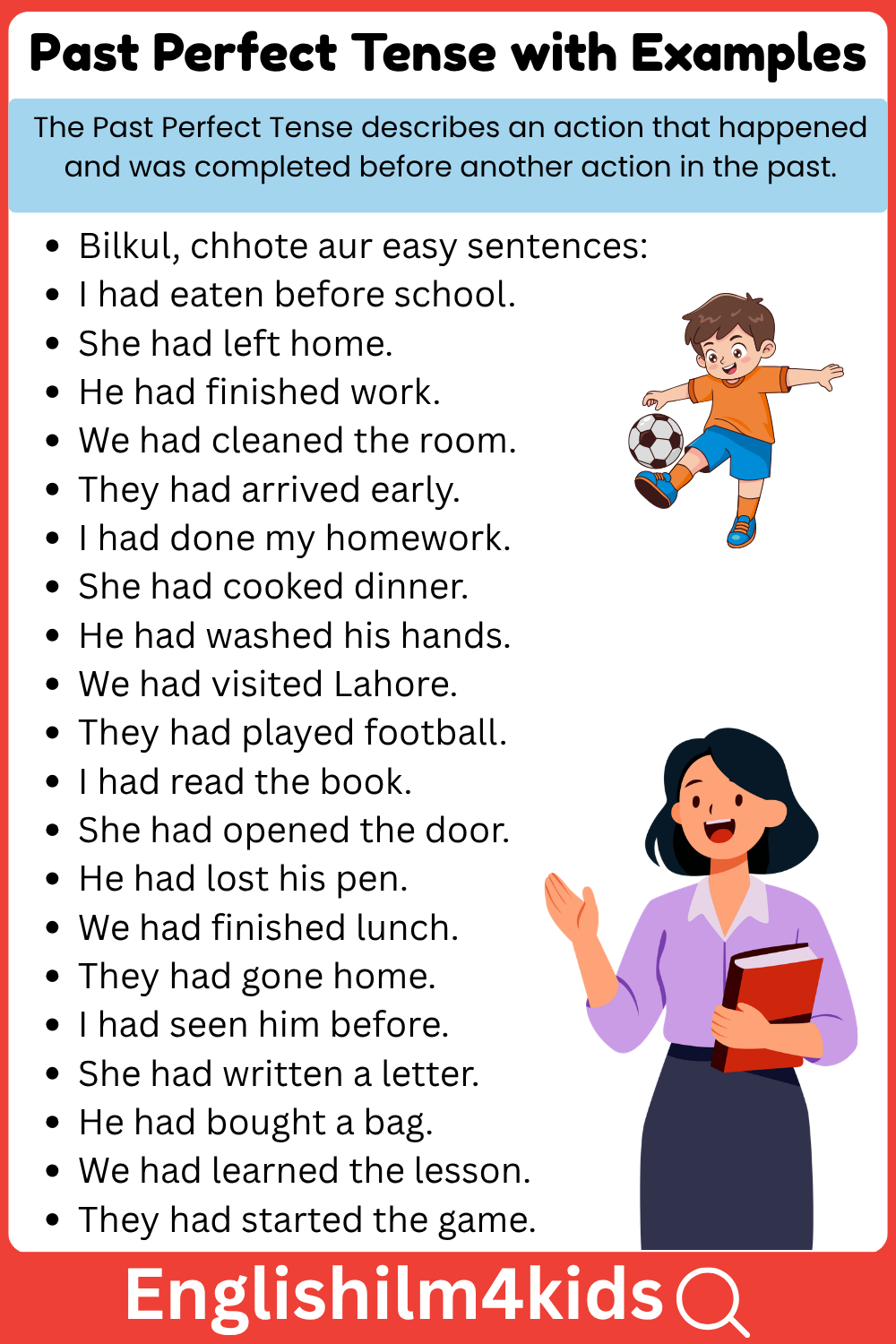
| The Past Perfect Tense describes an action that happened and was completed before another action in the past. |
Look at this example:
Sara had finished her homework before she went outside.
Sara finished her homework first. After that, she went outside. The word had helps us show which action happened earlier.
Past Perfect Tense Formula
The basic formula is:
| Subject + had + past participle (V3) + object |
Here are some examples:
- Ali had eaten breakfast before school.
- She had cleaned her room before her friends arrived.
- We had completed the project before Friday.
- They had left before the bus arrived.
Remember that had is used with all subjects: I, you, he, she, it, we, and they.
Negative Sentences in Past Perfect
To make a negative sentence, use had not or hadn’t.
Formula:
| Subject + had not + V3 + object |
Examples:
- Ali had eaten breakfast before school.
- She had cleaned her room before her friends arrived.
- We had completed the project before Friday.
- They had left before the bus arrived.
Questions in Past Perfect
For a question, place had before the subject.
Formula:
| Had + subject + V3 + object? |
Examples:
- Had you finished your homework?
- Had she left before you arrived?
- Had they eaten breakfast?
- Had Ahmed completed the task?
What Is Past Perfect Continuous Tense?
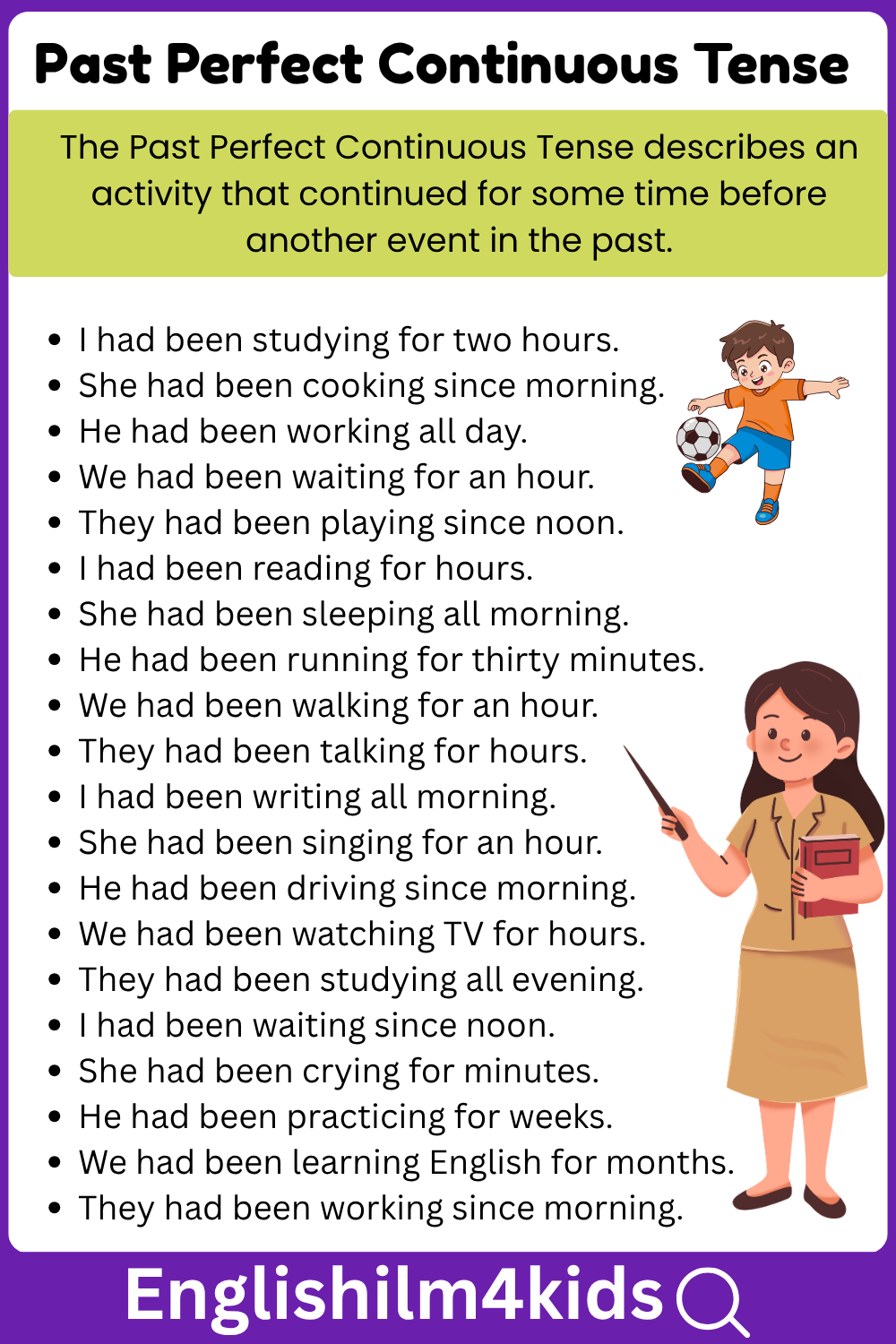
| The Past Perfect Continuous Tense describes an activity that continued for some time before another event in the past. |
This tense often focuses on the duration of an activity.
For example:
Hamza had been studying for two hours before his mother called him.
Hamza started studying earlier and continued for two hours. His mother called him afterward.
Past Perfect Continuous Tense Formula
The basic formula is:
| Subject + had been + verb-ing + object/time |
Examples:
- I had been reading for an hour before dinner.
- She had been waiting for thirty minutes when the bus arrived.
- They had been playing football before it started raining.
- We had been studying since morning.
The important pattern to remember is:
had + been + verb-ing
Negative Sentences in Past Perfect Continuous
Use had not been or hadn’t been before the main verb.
Formula:
| Subject + had not been + verb-ing + object/time |
Examples:
- He had not been sleeping well.
- She hadn’t been feeling well.
- We had not been waiting for long.
- They hadn’t been playing outside.
Questions in Past Perfect Continuous
Start the question with had.
Formula:
| Had + subject + been + verb-ing + object/time? |
Examples:
- Had you been studying before I called?
- Had she been waiting for an hour?
- Had they been playing football?
- Had he been working all morning?
Past Perfect and Past Perfect Continuous Tense Difference
Both tenses describe actions connected to the past, but they do not have exactly the same purpose.
| Past Perfect | Past Perfect Continuous |
|---|---|
| Focuses on a completed action | Focuses on an ongoing activity |
| Uses had + V3 | Uses had been + verb-ing |
| Often focuses on the result | Often focuses on duration |
| She had cleaned the room. | She had been cleaning the room for an hour. |
| They had finished the work. | They had been working since morning. |
Easy Way to Remember the Difference
Think about these two questions:
What was completed? → Past Perfect
How long was the activity happening? → Past Perfect Continuous
For example:
Tom had painted the wall before his friends arrived.
The sentence focuses on the completed job.
Tom had been painting the wall for two hours before his friends arrived.
This sentence focuses on the activity and the amount of time.
Past Perfect Tense Examples
Past Perfect is useful when you want to show that one past action happened before another.
Examples:
- The teacher had started the lesson before I entered.
- We had packed our bags before the taxi arrived.
- Maria had already finished dinner when her brother came home.
- The children had gone to bed before their parents returned.
- I had read the book before I watched the movie.
Words such as before, after, already, just, and by the time can often appear with Past Perfect.
For example:
By the time we reached the park, our friends had left.
Our friends left first, and we reached the park later.
Past Perfect Continuous Tense Examples
Past Perfect Continuous is useful when the activity continued for a period of time before another past event.
Examples:
- Ali had been running for thirty minutes before he stopped.
- Sara had been reading since morning before she took a break.
- The children had been playing outside for an hour before it rained.
- I had been waiting for the bus for twenty minutes when it arrived.
- They had been practicing for weeks before the competition.
The words for and since are common with this tense.
For tells us the length of time:
She had been studying for three hours.
Since tells us when the activity started:
She had been studying since morning.
Easy Tips to Remember These Tenses
Learning two similar tenses can be confusing, so keep these simple points in mind:
- Had + V3 = Past Perfect
- Had been + verb-ing = Past Perfect Continuous
- Past Perfect often focuses on a completed action.
- Past Perfect Continuous often focuses on an activity or its duration.
- For usually shows a period of time.
- Since usually shows the starting point of an activity.
Try creating your own examples about school, games, homework, or family activities. Using familiar situations makes grammar easier to remember.
Let’s Play a Quiz!
1. Which sentence is in the Past Perfect Tense?
A. She is cooking dinner.
B. She had cooked dinner.
C. She was cooking dinner.
D. She cooks dinner.
| Answer: B. She had cooked dinner. |
2. Which sentence uses the Past Perfect Continuous Tense?
A. They had played cricket.
B. They play cricket.
C. They had been playing cricket.
D. They are playing cricket.
| Answer: C. They had been playing cricket. |
3. Choose the correct sentence.
A. He had went home.
B. He had gone home.
C. He had going home.
D. He has went home.
| Answer: B. He had gone home. |
4. Which tense can emphasize how long an activity continued?
A. Simple Present
B. Simple Past
C. Past Perfect Continuous
D. Present Continuous
| Answer: C. Past Perfect Continuous. |
5. Complete the sentence: “We ___ finished our homework before dinner.”
A. has
B. have
C. had
D. are
| Answer: C. had. |
ConclusionThe Past Perfect and Past Perfect Continuous Tense are useful for describing actions that happened before another event in the past. Past Perfect uses had + V3 and usually shows a completed action. Past Perfect Continuous uses had been + verb-ing and often shows an activity or its duration. Practice both patterns with simple examples from daily life. With regular practice, these two past tenses will become much easier to understand and use correctly. |
Learn More Tense