
Learning English grammar becomes much easier when children understand when an action happens. Tenses for Kids is a simple way to teach children how to talk about actions that happened before, are happening now, or may happen later. In this guide, Tenses for Kids: Three Types of Tenses With Easy Examples, children will learn about the three main types of tenses: present, past, and future. Each type is explained in easy language with simple examples to help kids understand the difference and use English sentences with more confidence.
What Is a Tense?
| A tense is a form of a verb that tells us when an action happens. |
A verb is a word that shows an action, such as:
|
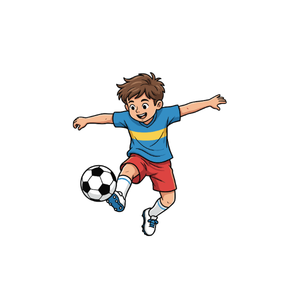
I play football.
|
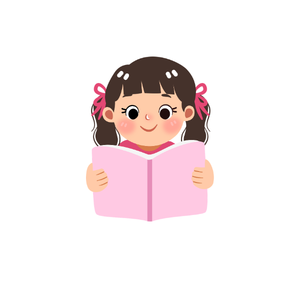
I read a book.
|
|
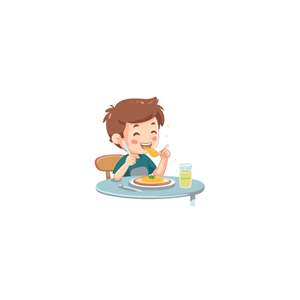
I eat food.
|
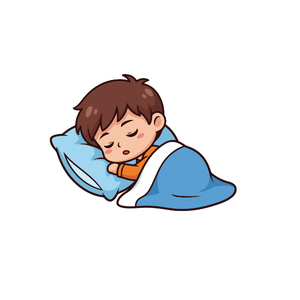
I sleep early.
|
|
I write a letter.
|
I walk in the park.
|
Look at these three sentences:
I play football.
The action happens in the present or regularly.
I played football.
The action happened in the past.
I will play football.
The action will happen in the future.
So, an easy way to remember tenses is:
Present = Now
Past = Before
Future = Later
What Are the Three Types of Tenses for children?
- Present Tense
- Past Tense
- Future Tense
| No. | Type of Tense | When Do We Use It? | Example |
|---|---|---|---|
| 1 | Present Tense | Now or regularly | I play football. |
| 2 | Past Tense | Something that happened before | I played football. |
| 3 | Future Tense | Something that will happen later | I will play football. |
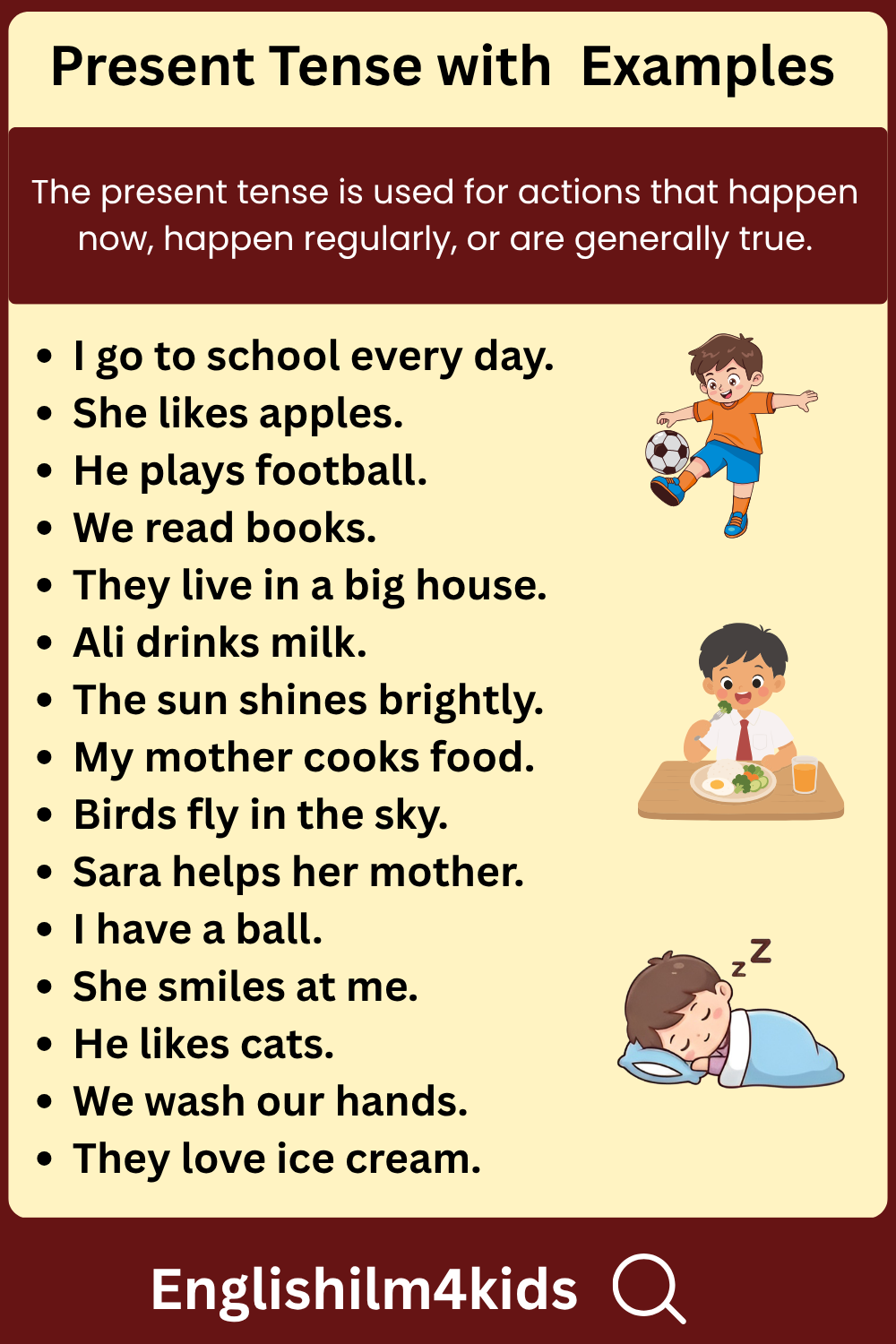
1. Present TenseThe present tense is used for actions that happen now, happen regularly, or are generally true. Present Tense ExamplesI go to school every day. She likes apples. He plays football. We read books. They live in a big house. Ali drinks milk. The sun shines brightly. My mother cooks food. Birds fly in the sky. Sara helps her mother. Words such as every day, usually, often, and always are often used when talking about regular actions. Simple Present RuleWith many simple present sentences, we use: Subject + base verb Example: I play football. With he, she, and it, the verb often takes -s or -es. Examples: He plays football. She reads a story . Ali watches TV. |
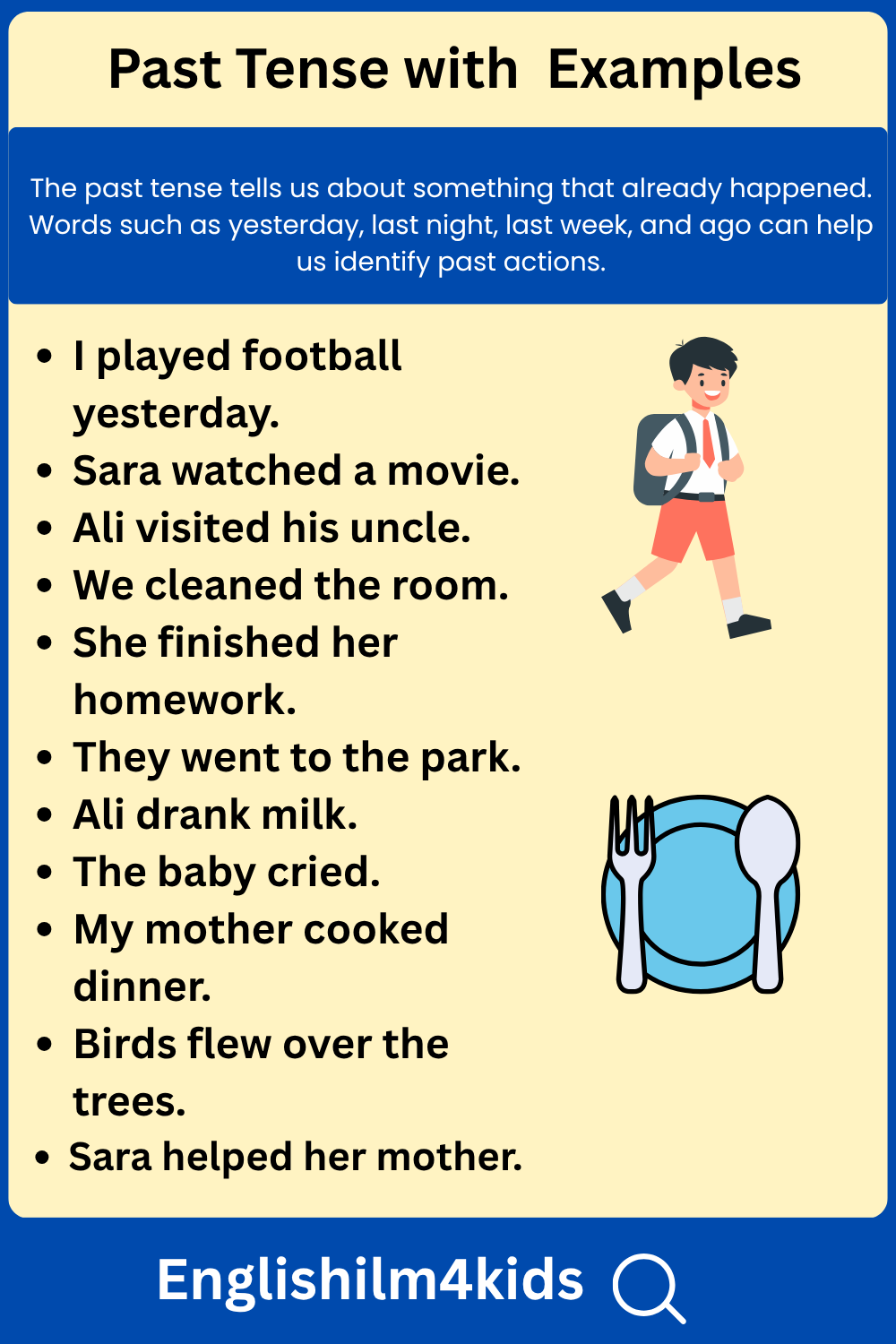
2. Past TenseThe past tense tells us about something that already happened. Words such as yesterday, last night, last week, and ago can help us identify past actions. Past Tense ExamplesI played football yesterday. Sara watched a movie. Ali visited his uncle. We cleaned the room. She finished her homework. They went to the park. Ali drank milk. The baby cried. My mother cooked dinner. Birds flew over the trees. Sara helped her mother. Many regular verbs form the past tense by adding -ed. For example: play → played walk → walked clean → cleaned watch → watched Some verbs are irregular and change in a different way. For example: go → went eat → ate see → saw come → came |
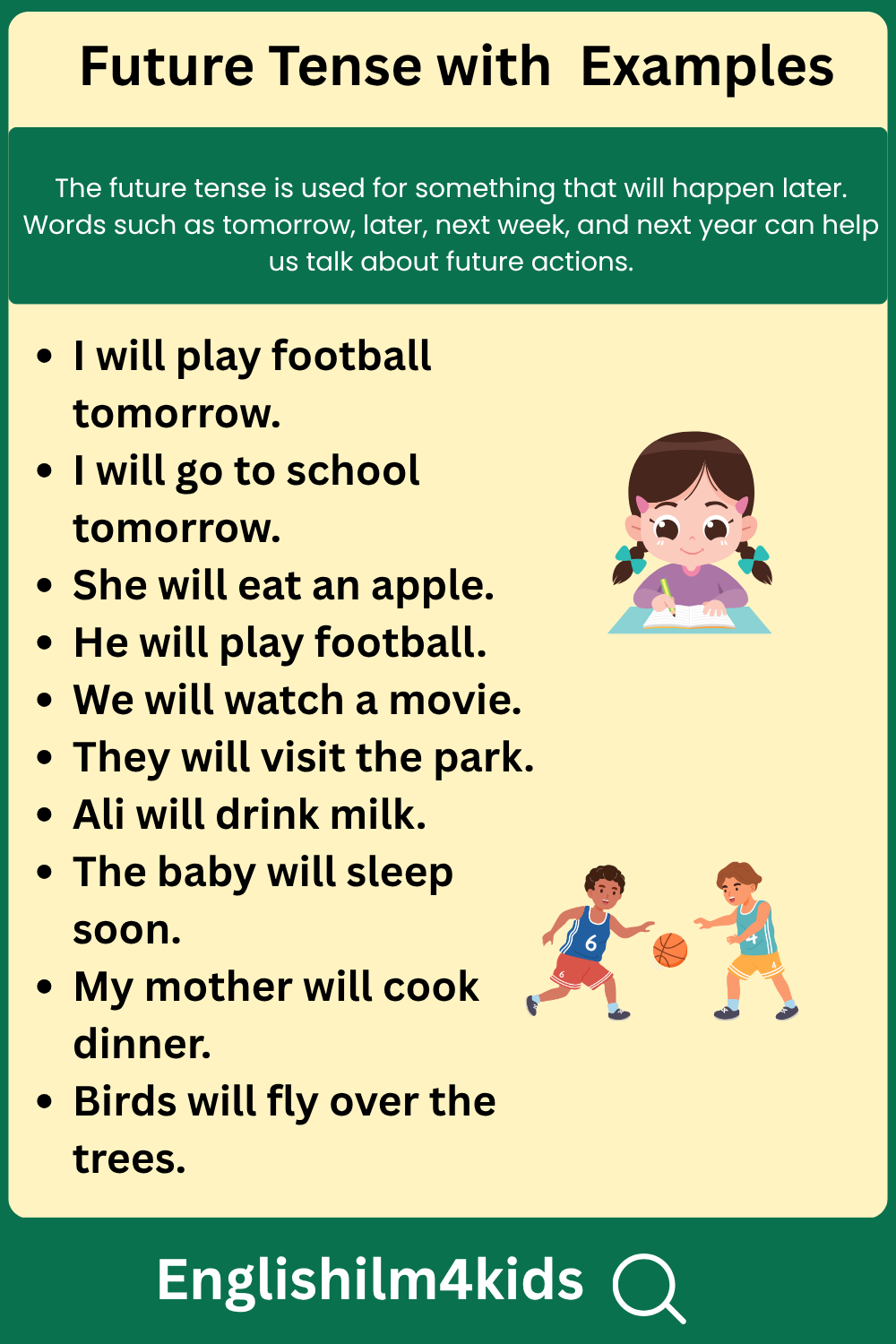
3. Future TenseThe future tense is used for something that will happen later. Words such as tomorrow, later, next week, and next year can help us talk about future actions. Future Tense ExamplesI will play football tomorrow. Simple Future RuleA simple future sentence often follows this pattern: Subject + will + base verb Examples: I will play. She will read. They will eat. |
Present, Past, and Future Tense Examples
One of the easiest ways to understand tenses for kids is to compare the same action at different times.
Let’s use the verb play:
| Tense | Sentence |
|---|---|
| Present | I play football. |
| Past | I played football. |
| Future | I will play football. |
Here is another example using the verb eat:
| Tense | Sentence |
|---|---|
| Present | I eat an apple. |
| Past | I ate an apple. |
| Future | I will eat an apple. |
The action is similar, but the verb changes to show when it happens.
Easy Tips to Remember | A Simple Guide for Kids
Kids can remember the three basic tenses with one simple trick:
Present → Now
Past → Before
Future → Later
When you see a sentence, ask:
“When did this action happen?”
If it is happening now or regularly, it may be present tense.
If it already happened, it is past tense.
If it will happen later, it is future tense.
Practicing with everyday activities such as eat, play, read, walk, and sleep can make tenses easier to understand.
Let’s Play a Quiz!
Now it’s time to check what you have learned about tenses for kids.
Question 1
Which tense is used for an action that happens regularly?
A. Present tense
B. Past tense
C. Future tense
D. Perfect tense
| Answer: A. Present tense |
Question 2
Which sentence is in the past tense?
A. I play football.
B. I played football.
C. I will play football.
D. I am playing football.
| Answer: B. I played football. |
Question 3
Which sentence is in the future tense?
A. Sara reads a book.
B. Sara read a book.
C. Sara will read a book.
D. Sara is reading a book.
| Answer: C. Sara will read a book. |
Question 4
Choose the correct sentence:
A. He play football every day.
B. He plays football every day.
C. He played football every day.
D. He will plays football every day.
| Answer: B. He plays football every day. |
Question 5
Choose the correct future-tense sentence:
A. She will plays tomorrow.
B. She will played tomorrow.
C. She will play tomorrow.
D. She will playing tomorrow.
| Answer: C. She will play tomorrow. |
Frequently Asked Questions
What Is a Tense?
A tense is a form of a verb that tells us when an action happens. It helps us understand whether an action happens in the present, happened in the past, or will happen in the future.
What Are the Three Types of Tenses?
The three basic types are present tense, past tense, and future tense. Present talks about now, past talks about before, and future talks about later.
What Is an Example of Present Tense?
“I play football every day” is an example of present tense because it describes a regular action.
What Is an Example of Past Tense?
“I played football yesterday” is an example of past tense because the action happened before now.
What Is an Example of Future Tense?
“I will play football tomorrow” is an example of future tense because the action will happen later.
| Conclusions
Understanding tenses for kids does not have to be difficult. Children can start with three simple ideas: present means now, past means before, and future means later. By practicing short sentences and everyday verbs, kids can gradually become more confident in English grammar. Try making one present, one past, and one future sentence each day to practice what you have learned. |
Read More