
Being a good friend is about more than playing together and having fun. A good friend listens, shares, helps, uses kind words, and cares about other people’s feelings. Learning how to be a good friend for kids can help children build happy and respectful friendships at school, at home, and during everyday activities. Simple habits can make a big difference. In this guide, children will learn easy ways to be a caring friend, handle disagreements, show kindness, and make their friendships stronger.
What Does It Mean to Be a Good Friend?
A good friend is someone who treats others with kindness, respect, honesty, and care.
- Listen when a friend is speaking.
- Share and take turns.
- Use kind and polite words.
- Help when someone needs support.
- Respect personal space and feelings.
- Say sorry after making a mistake.
- Celebrate a friend’s success.
- Include others in games and activities.
- Tell the truth in a kind way.
- Solve disagreements calmly.
- 10 Simple Ways to Be a Good Friend
1. Use Kind Words
Words can make people feel happy, welcome, and respected.
- Please.
- Thank you.
- You are welcome.
- Are you okay?
- Can I help you?
- Good job!
- Would you like to play?
- I’m sorry.
2. Listen to Your Friend
Good friends listen when someone is talking. Try not to interrupt or look away while your friend is sharing something.
For example:
- Friend: “I was nervous about my class test.”
- You: “I understand. How did it go?”
4. Help Your Friends
If your friend drops some books, you can help pick them up. If a friend does not understand a classroom activity, you can offer help.
You might say:
“Do you need some help?”
5. Include Others
Sometimes a child may feel left out when other children are playing.
If it is appropriate, invite them to join.
You can say:
“Would you like to play with us?”
6. Respect Feelings
Everyone has feelings. A friend may sometimes feel happy, sad, worried, angry, or disappointed.
You do not have to solve every problem. Sometimes listening and showing care is enough.
You can say:
“I’m sorry you’re feeling sad. Do you want to talk about it?”
Respecting feelings means listening without laughing at someone or making fun of them.
7. Be Honest and Trustworthy
Good friendships need honesty.
Being honest does not mean saying whatever comes into your mind. Try to tell the truth in a respectful and kind way.
For example, if your friend asks whether you like a drawing, you can say:
“I like the colors. Maybe you could add some more details.”
Honesty and kindness can work together.
8. Say Sorry When You Make a Mistake
Everyone makes mistakes, including good friends.
If you hurt someone’s feelings, break something, or say something unkind, take responsibility.
A simple apology can be:
“I’m sorry I said that. I should have used kinder words.”
A sincere apology shows that you understand your mistake and want to do better.
9. Celebrate Your Friend’s Success
If your friend gets a good grade, finishes a drawing, scores a goal, or learns something new, you can congratulate them.
- “Great job!”
- “I’m happy for you!”
- “You worked hard!”
- “Congratulations!”
10. Solve Problems Calmly
- Stop and calm down.
- Listen to the other person.
- Explain how you feel.
- Avoid shouting or name-calling.
- Look for a fair solution.
- Ask a trusted adult for help when needed.
For example:
“I felt upset when you took my pencil. Please ask me before using my things.”
Good Friend vs. Unkind Friend
| Good Friend | Unkind Behavior |
|---|---|
| Listens to others | Always interrupts |
| Shares and takes turns | Never lets others have a turn |
| Uses kind words | Uses hurtful words |
| Helps when appropriate | Laughs when someone needs help |
| Respects feelings | Makes fun of feelings |
| Includes others | Deliberately leaves others out |
| Says sorry for mistakes | Refuses to take responsibility |
| Respects boundaries | Ignores someone’s “no” |
| Tells the truth kindly | Lies to hurt someone |
| Solves problems calmly | Uses threats or fighting |
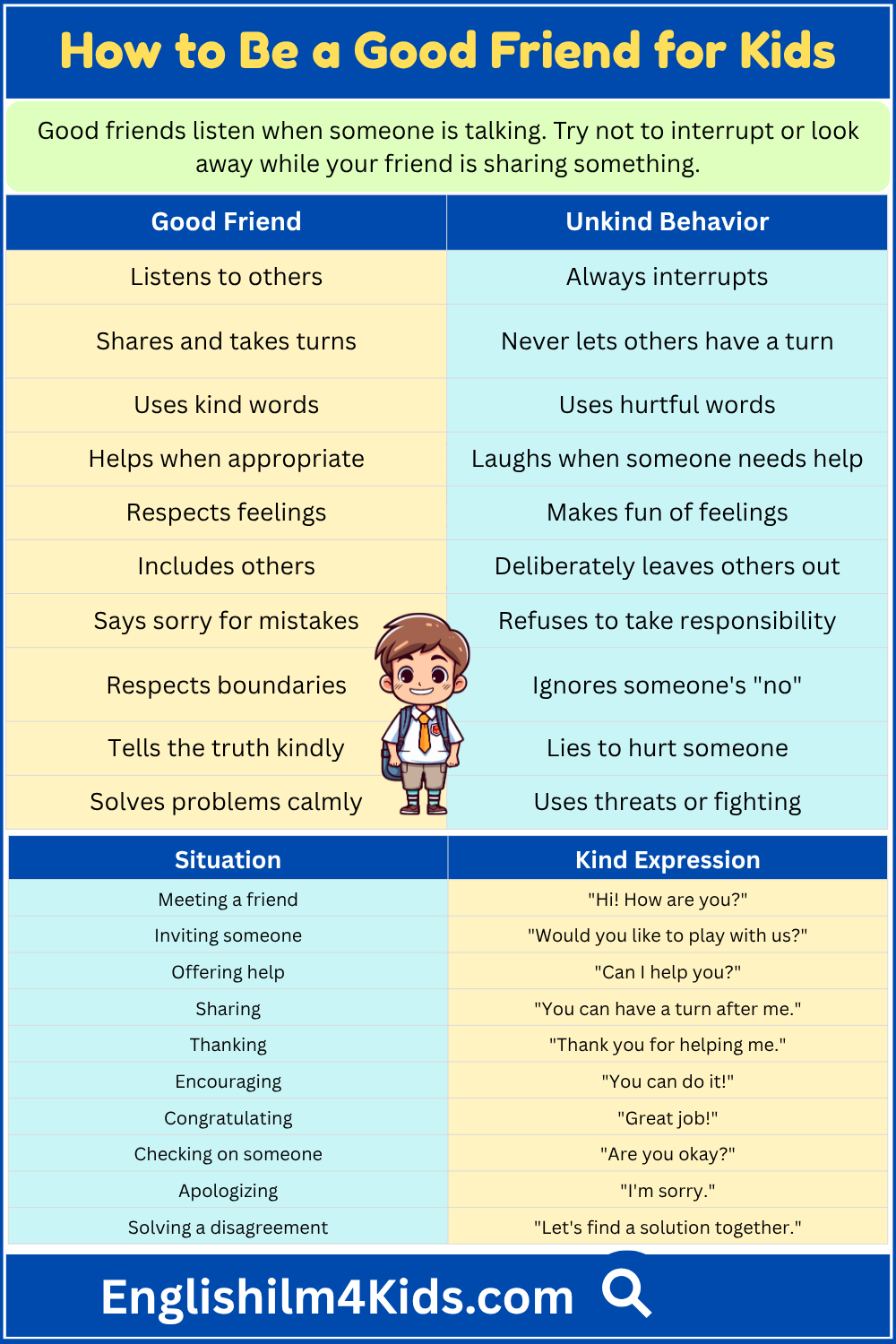
Kind Things Kids Can Say to Friends
| Situation | Kind Expression |
|---|---|
| Meeting a friend | “Hi! How are you?” |
| Inviting someone | “Would you like to play with us?” |
| Offering help | “Can I help you?” |
| Sharing | “You can have a turn after me.” |
| Thanking | “Thank you for helping me.” |
| Encouraging | “You can do it!” |
| Congratulating | “Great job!” |
| Checking on someone | “Are you okay?” |
| Apologizing | “I’m sorry.” |
| Solving a disagreement | “Let’s find a solution together.” |
What Should You Do If a Friend Is Sad?
- Ask if they are okay.
- Listen to them.
- Sit with them if they want company.
- Offer reasonable help.
- Use kind words.
- Give them space if they need it.
- Tell a trusted adult if you are worried about their safety or well-being.
What If You and Your Friend Have an Argument?
- Step 1: Take a breath and calm down.
- Step 2: Listen to your friend’s side.
- Step 3: Explain your own feelings without blaming.
- Step 4: Avoid insults and shouting.
- Step 5: Think about a solution that is fair.
- Step 6: Say sorry if you made a mistake.
Simple Friendship Activities for Kids
Parents and teachers can help children practice friendship skills through simple activities.
Friendship Role-Play
Give children everyday situations to act out.
Examples:
- A friend feels sad.
- Two children want the same toy.
- A new student wants to join a game.
- Someone accidentally breaks a friend’s pencil.
- Two friends disagree about what game to play.
Kindness Challenge
Examples include:
- Helping a classmate.
- Sharing supplies.
- Saying thank you.
- Inviting someone to play.
- Giving someone encouragement.
Friendship Sentence Practice
Children can complete these sentences:
- A good friend listens when __________.
- I can help my friend by __________.
- I can show kindness by __________.
- When I make a mistake, I can say __________.
- If my friend feels sad, I can __________.
Practice: Choose the Best Answer
1. Your friend drops some books. What can you do?
A. Laugh
B. Walk away
C. Help pick them up
2. Your friend is talking to you. What should you do?
A. Interrupt
B. Listen
C. Shout
3. You make your friend upset. What can you say?
A. “It’s your fault.”
B. “Go away.”
C. “I’m sorry.”
4. Someone wants to join your game. What can you say?
A. “Would you like to play with us?”
B. “You can’t play.”
C. “Go away.”
5. You disagree with your friend. What should you do?
A. Shout
B. Talk calmly
C. Call your friend names
Answer Key
- C — Help pick them up
- B — Listen
- C — I’m sorry
- A — Would you like to play with us?
- B — Talk calmly
Questions Kids Can Ask Their Friends
- What is your favorite game?
- What book do you like?
- What do you like to draw?
- What is your favorite animal?
- What do you like to do after school?
- What game should we play?
- How was your day?
- What would you like to learn?
Frequently Asked Questions
How can a child be a good friend?
A child can be a good friend by listening, sharing, helping, using kind words, respecting feelings, including others, and solving disagreements calmly.
What are the qualities of a good friend?
Important qualities include kindness, honesty, respect, helpfulness, patience, good listening, and consideration for other people’s feelings.
How can kids make new friends?
Kids can start by saying hello, asking friendly questions, joining suitable activities, sharing interests, and inviting others to play.
What should a child do when a friend is sad?
A child can ask if the friend is okay, listen, offer reasonable help, and tell a trusted adult if they are seriously concerned.
Is it okay to say no to a friend?
Yes. Children can be kind while also saying no when they feel uncomfortable, do not want to participate, or need to protect their personal boundaries.
What should kids do after an argument with a friend?
They can calm down, listen to each other, explain their feelings respectfully, apologize when necessary, and look for a fair solution.
More Kids related articles
Pingback: Sharing and Taking Turns for Kids: Easy Friendship Skills - Englishilm4kids.com