
Knowing how to ask for help politely is an important part of everyday English and good manners. Children may need help at school, at home, or while talking with friends and other people. Instead of simply saying “Help me,” they can use kind and respectful expressions such as “Could you help me, please?” or “Can you please help me?” In this guide, kids will learn simple ways to ask for help in English, when to use different expressions, and how to respond politely. Easy examples, short dialogues, and practice activities will help children use these phrases confidently in real-life situations.
What Does It Mean to Ask for Help Politely?
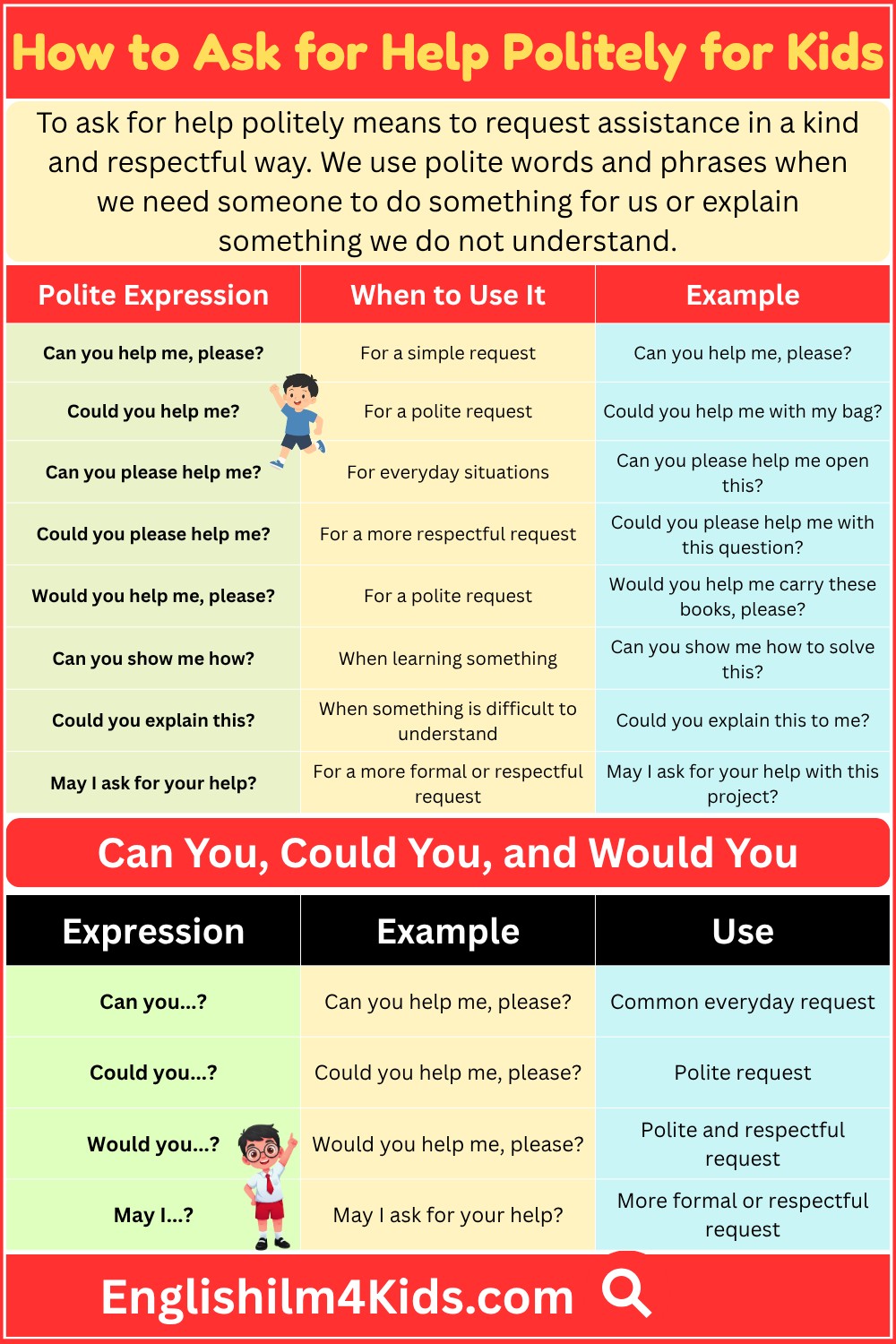
To ask for help politely means to request assistance in a kind and respectful way. We use polite words and phrases when we need someone to do something for us or explain something we do not understand.
For example:
- Can you help me, please?
- Could you help me with this?
- Would you please help me?
- Can you show me how to do this?
- Could you explain this to me, please?
Why Should Kids Ask for Help Politely?
Everyone needs help sometimes. A child may not understand a school lesson, may need help carrying something, or may be unable to find something.
- Need help with homework
- Do not understand a question
- Need help opening something
- Cannot find an item
- Need directions
- Want someone to explain something
- Need assistance at school
- Need help at home
Simple Polite Ways to Ask for Help
There are many easy expressions children can use. The best phrase depends on the situation and the person they are speaking to.
| Polite Expression | When to Use It | Example |
|---|---|---|
| Can you help me, please? | For a simple request | Can you help me, please? |
| Could you help me? | For a polite request | Could you help me with my bag? |
| Can you please help me? | For everyday situations | Can you please help me open this? |
| Could you please help me? | For a more respectful request | Could you please help me with this question? |
| Would you help me, please? | For a polite request | Would you help me carry these books, please? |
| Can you show me how? | When learning something | Can you show me how to solve this? |
| Could you explain this? | When something is difficult to understand | Could you explain this to me? |
| May I ask for your help? | For a more formal or respectful request | May I ask for your help with this project? |
How to Ask for Help Politely for Kids
How to Ask a Teacher for Help
Children often need to ask teachers for help when they do not understand a lesson or assignment.
Instead of saying:
“I don’t understand.”
They can make the request clearer and more polite:
- Could you please explain this again?
- Can you help me with this question, please?
- Could you show me how to solve this problem?
- May I ask you a question?
- Could you please help me understand this lesson?
- I need some help with my homework. Could you help me, please?
Example Conversation With a Teacher
- Student: Excuse me, Mrs. Brown. Could you please help me?
- Teacher: Of course. What do you need help with?
- Student: I do not understand this question.
- Teacher: Let me explain it to you.
- Student: Thank you very much.
- How to Ask Your Parents for Help
Children also ask their parents for help many times during the day. They may need help with homework, food, clothing, toys, or other activities.
Here are some useful examples:
- Mom, could you please help me with my homework?
- Dad, can you help me fix this toy?
- Could you please help me find my shoes?
- Can you help me open this jar, please?
- Could you show me how to do this?
- Can you please help me carry this box?
How to Ask a Friend for Help
Children can use simple and friendly expressions when asking classmates or friends for help.
For example:
- Can you help me with this question?
- Could you show me how you did it?
- Can you please pass me my pencil?
- Could you help me carry these books?
- Can you explain this part to me?
- Would you help me find my notebook?
How to Ask for Help When You Do Not Understand
Sometimes a child understands most of a lesson but gets confused about one part. Instead of staying silent, they can politely ask for an explanation.
Useful phrases include:
- Could you explain that again, please?
- Can you please say that again?
- Could you show me an example?
- Can you explain this part to me?
- I’m not sure how to do this. Could you help me?
- Could you please show me the first step?
Polite Requests for Everyday Situations
Asking for help is not limited to school. Children can use polite English in many everyday situations.
At Home
Can you please help me clean my room?
At School
Could you help me find my book, please?
At the Library
Could you help me find this book, please?
At a Store
Excuse me, could you help me find this item?
With a Friend
Can you help me carry these books?
During an Activity
Could you show me how to play this game?
Polite Word That Make Requests Better
Certain words and expressions can make a request sound more respectful.
Please
Please is one of the easiest polite words to use.
Example:
Can you help me, please?
Could
Could is commonly used to make a polite request.
Example:
Could you help me with this?
Would
Would can also be used in polite requests.
Example:
Would you please help me?
Excuse Me
Excuse me is useful when you need to get someone’s attention politely.
Example:
Excuse me, could you help me?
Thank You
After someone helps you, remember to thank them.
Example:
Thank you for helping me.
Can You, Could You, and Would You
| Expression | Example | Use |
|---|---|---|
| Can you…? | Can you help me, please? | Common everyday request |
| Could you…? | Could you help me, please? | Polite request |
| Would you…? | Would you help me, please? | Polite and respectful request |
| May I…? | May I ask for your help? | More formal or respectful request |
How to Ask for Help Without Sounding Rude
A request can sound unfriendly if it is too direct.
For example:
“Give me your pencil.”
This sounds like an order.
A kinder way is:
“Could you please lend me your pencil?”
Another example:
“Help me with this.”
A more polite version is:
“Could you please help me with this?”
The goal is not to use difficult words. Simple words spoken kindly are often enough.
What to Say After Someone Helps You
Good manners do not end after someone helps you. Children should show appreciation.
Useful responses include:
- Thank you.
- Thank you very much.
- Thanks for helping me.
- I really appreciate your help.
- That was very helpful.
- Thank you for explaining it to me.
What If Someone Cannot Help You?
Sometimes a person may be busy or unable to help. Children should respond respectfully instead of becoming upset.
They can say:
- Okay, thank you anyway.
- That’s okay. Thank you.
- No problem.
- I understand.
- I’ll ask someone else.
Short Dialogues for Asking for Help
Dialogue 1: Asking a Teacher
Ali: Excuse me, can you help me, please?
Teacher: Of course. What do you need?
Ali: I don’t understand this question.
Teacher: Let me explain it.
Ali: Thank you!
Dialogue 2: Asking a Friend
Sara: Could you help me with this exercise?
Mia: Sure. Which question is difficult?
Sara: Number five.
Mia: Let’s work on it together.
Sara: Thank you for helping me.
Dialogue 3: Asking a Parent
Child: Dad, could you please help me?
Dad: Sure. What happened?
Child: I cannot find my school bag.
Dad: Let’s look for it together.
Child: Thank you!
Dialogue 4: Asking for an Explanation
Student: Excuse me, could you explain this again, please?
Teacher: Yes. I’ll explain it step by step.
Student: Thank you. I understand it now.
Polite and Impolite Requests
| Impolite or Too Direct | More Polite |
|---|---|
| Give me your pencil. | Could you please lend me your pencil? |
| Help me now. | Could you please help me? |
| Explain this. | Could you please explain this to me? |
| Show me how. | Could you show me how, please? |
| Get my book. | Could you please get my book? |
| Open this. | Could you please open this for me? |
Common Mistakes When Asking for Help
Forgetting “Please”
Instead of:
Can you help me?
Children can say:
Can you help me, please?
Both sentences can be grammatically correct, but adding please can make the request sound more polite.
Forgetting to Say Thank You
After receiving help, remember to say:
Thank you for helping me.
Giving an Order
Avoid making every request sound like a command.
Instead of:
Give me your book.
Try:
Could I please borrow your book?
Being Too Shy to Ask
Children sometimes remain quiet because they are afraid of making a mistake. Asking for help is a normal part of learning. A simple, polite sentence is enough.
Practice: Complete the Polite Requests
Fill in each blank with please, could, or thank you.
- ______ you help me with this question?
- Can you help me, ______?
- ______ for helping me with my homework.
- ______ you please show me how to do this?
- Could you explain this to me, ______?
Answers
- Could
- please
- Thank you
- Could
- please
Speaking Practice for Kids
- Could you help me, please?
- Can you show me how to do this?
- Could you explain this again?
- Can you please help me find my book?
- Would you help me carry these books?
- May I ask for your help?
- Thank you for helping me.
Frequently Asked Questions
What is a polite way to ask for help?
A simple polite way is “Can you help me, please?” You can also say “Could you please help me?”
How can kids ask a teacher for help?
Kids can say, “Excuse me, could you please help me with this question?” This is clear, respectful, and appropriate for a classroom.
Is “Can you help me?” polite?
Yes. “Can you help me?” is a normal and polite everyday request. Adding please can make it sound even more courteous.
What should I say after someone helps me?
Say “Thank you” or “Thank you for helping me.” Showing appreciation is an important part of good manners.
What is the difference between “Can you” and “Could you”?
Both can be used to make requests. “Could you” is often used when you want your request to sound especially polite or respectful.
How can children ask for help when they do not understand something?
They can say, “Could you explain this again, please?” or “Can you show me how to do this?”
What should I do if someone cannot help me?
Stay polite and say “Okay, thank you anyway” or “That’s okay. I’ll ask someone else.”
Kids related articles
Pingback: Sharing and Taking Turns for Kids: Easy Friendship Skills - Englishilm4kids.com