
Talking about the past is a big part of everyday English. We often tell our friends what we did yesterday or explain what we were doing at a certain time. That is why learning the Past Indefinite and Past Continuous Tense is useful for kids. These two tenses both talk about the past, but they are not used in the same way. The Past Indefinite usually tells us about something that happened and finished, while the Past Continuous describes something that was happening at a particular time.
What Is Past Tense?
| Past tense is used when we talk about something that happened before now. |
For example:
- I played football yesterday.
- Sara visited her grandmother.
- We watched a movie last night.
- Ali was reading a book.
All of these sentences talk about the past. However, each sentence can give us a slightly different idea about the action.
In this lesson, we will look at two common forms:
- Past Indefinite Tense
- Past Continuous Tense
Let’s learn them one at a time.
What Is Past Indefinite Tense?
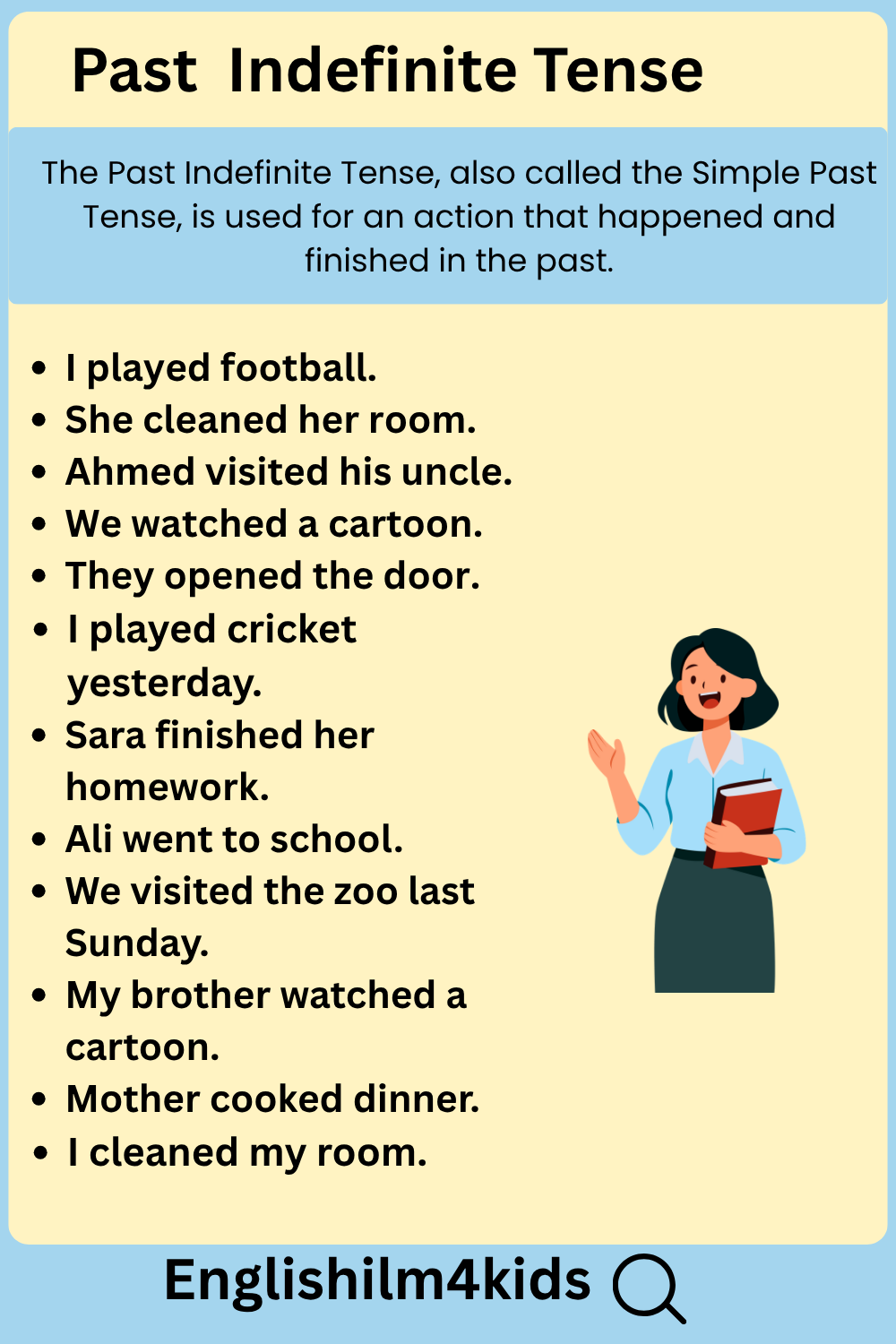
| The Past Indefinite Tense, also called the Simple Past Tense, is used for an action that happened and finished in the past. |
For instance, if you played cricket yesterday, you can say:
I played cricket yesterday.
The sentence tells us that the game happened in the past. It does not focus on the action while it was happening.
Past Indefinite Tense Rule
The basic structure is:
Subject + past form of verb + object
Here are some examples:
- I played football.
- She cleaned her room.
- Ahmed visited his uncle.
- We watched a cartoon.
- They opened the door.
Regular verbs often take -ed when we change them into the past form.
| Present Verb | Past Verb |
|---|---|
| play | played |
| clean | cleaned |
| walk | walked |
| watch | watched |
| visit | visited |
Some verbs are different. These are called irregular verbs.
| Present Verb | Past Verb |
|---|---|
| go | went |
| eat | ate |
| see | saw |
| come | came |
| write | wrote |
Past Indefinite Examples for Kids
Children can practice with simple sentences like these:
- I played cricket yesterday.
- Sara finished her homework.
- Ali went to school.
- We visited the zoo last Sunday.
- My brother watched a cartoon.
- Mother cooked dinner.
- I cleaned my room.
Words such as yesterday, last night, last week, last year, and ago are often used when talking about completed past actions.
What Is Past Continuous Tense?
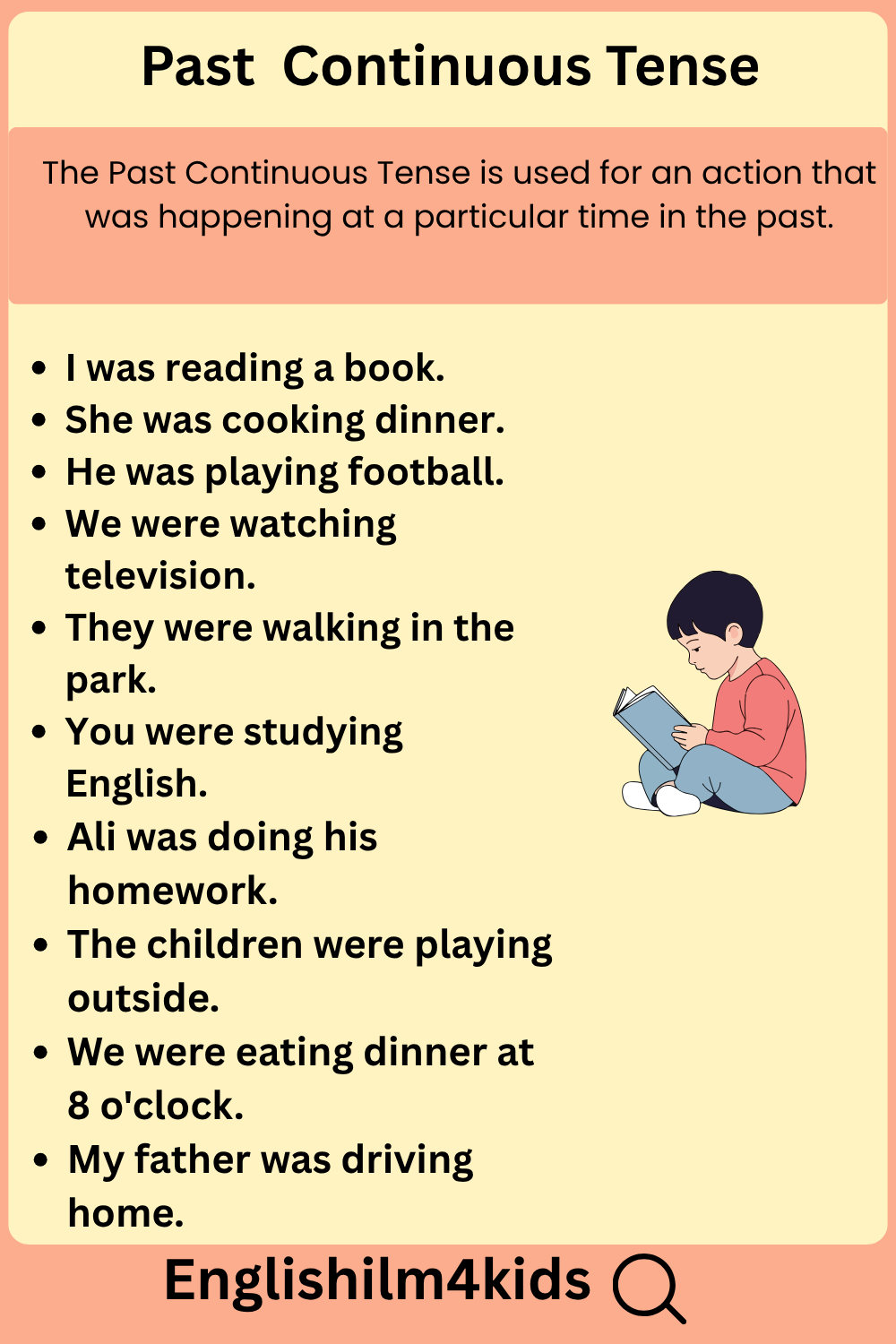
| The Past Continuous Tense is used for an action that was happening at a particular time in the past. |
Think about looking at a photograph from yesterday. If the picture shows you reading a book at 6 p.m., you could say:
I was reading a book at 6 p.m.
The action was still in progress at that time.
Past Continuous Tense Rule
The basic structure is:
Subject + was/were + verb-ing + object
Use was with:
- I
- he
- she
- it
Use were with:
- you
- we
- they
Past Continuous Examples for Kids
Here are some easy examples:
- I was reading a book.
- She was cooking dinner.
- He was playing football.
- We were watching television.
- They were walking in the park.
- You were studying English.
For example, Sara was sleeping at 10 p.m. tells us that her sleep was in progress at that particular time.
Likewise, we can say:
- Ali was doing his homework.
- The children were playing outside.
- We were eating dinner at 8 o’clock.
- My father was driving home.
The -ing form is an important part of this tense.
For example:
play → playing
read → reading
eat → eating
sleep → sleeping
Past Indefinite vs Past Continuous Tense
The difference between the Past Indefinite and Past Continuous Tense becomes easier when we think about what we want to say.
The Past Indefinite usually tells us what happened.
On the other hand, the Past Continuous tells us what was happening at a certain time.
Compare these sentences:
I played football yesterday.
This simply tells us about the football game.
I was playing football at 5 o’clock yesterday.
Now we know that the game was in progress at 5 o’clock.
Easy Comparison of the Two Tenses
| Past Indefinite | Past Continuous |
|---|---|
| I played football. | I was playing football. |
| She cooked dinner. | She was cooking dinner. |
| They watched TV. | They were watching TV. |
| He cleaned his room. | He was cleaning his room. |
A useful trick for children is:
Past Indefinite → What happened?
Past Continuous → What was happening?
Once kids remember these two questions, choosing the right tense becomes much easier.
Negative Sentences in Past Tense
Both tenses can also be used in negative sentences.
Past Indefinite Negative
The basic structure is:
Subject + did not + base verb
Examples:
- I did not play football.
- She did not watch TV.
- They did not visit the park.
- Ali did not finish his homework.
Remember one important rule: after did not, use the base form of the verb.
✅ She did not play.
❌ She did not played.
Past Continuous Negative
For the Past Continuous, use:
Subject + was/were + not + verb-ing
Examples:
- I was not sleeping.
- She was not reading.
- He was not playing.
- They were not watching TV.
This pattern is easy to remember because was/were comes before not, followed by the -ing form.
Questions/Interrogative With Past Indefinite and Past Continuous
Questions are another useful way to practice these tenses.
Past Indefinite Questions/Interrogative
Use:
Did + subject + base verb?
For example:
- Did you play football?
- Did Sara visit her grandmother?
- Did they watch the movie?
- Did Ali finish his homework?
Notice that the main verb stays in its base form after did.
Past Continuous Questions/Interrogative
Use:
Was/Were + subject + verb-ing?
Examples:
- Was Ali playing football?
- Was she reading a book?
- Were they watching TV?
- Were you sleeping?
Therefore, a quick look at did or was/were + -ing can help children recognize the sentence pattern.
Easy Tips to Remember Past Tenses
Children do not need to memorize every rule at once. Instead, start with the main idea.
Ask yourself:
What happened?
Use the Past Indefinite.
What was happening?
Use the Past Continuous.
For example:
I watched a movie last night.
This tells us what happened.
I was watching a movie at 8 p.m.
This tells us what was happening at that time.
You can also practice with things children do every day. Try making sentences with play, eat, read, sleep, walk, study, and watch. As a result, the rules will start to feel more natural.
Let’s Play a Quiz!
Now it’s time to see what you have learned about the Past Indefinite and Past Continuous Tense.
1. Which sentence is in the Past Indefinite Tense?
A. I am playing football.
B. I was playing football.
C. I played football yesterday.
D. I will play football.
| Answer: C. I played football yesterday. |
2. Which sentence is in the Past Continuous Tense?
A. Sara reads a book.
B. Sara was reading a book.
C. Sara read a book.
D. Sara will read a book.
| Answer: B. Sara was reading a book. |
3. Choose the correct sentence.
A. They was playing outside.
B. They were playing outside.
C. They playing outside.
D. They were play outside.
| Answer: B. They were playing outside. |
4. Which sentence shows an action happening at a particular time in the past?
A. Ali played football.
B. Ali plays football.
C. Ali will play football.
D. Ali was playing football at 5 p.m.
| Answer: D. Ali was playing football at 5 p.m. |
5. Choose the correct sentence.
A. She was read a book.
B. She was reading a book.
C. She were reading a book.
D. She reading a book.
| Answer: B. She was reading a book. |
Conclusion
| The Past Indefinite and Past Continuous Tense help us describe past actions in two different ways. Past Indefinite tells us about something that happened and finished, while Past Continuous shows an action that was in progress at a certain time. A simple way to remember the difference is to ask, “What happened?” or “What was happening?” With a little practice using everyday examples, kids can become more comfortable with both tenses and use them correctly in their writing and speaking. |
Learn More Tense