
School is a wonderful place for children to learn, make friends, and practice English. Kids use English every day to greet their teachers, ask questions, talk to classmates, and explain what they need. Learning English sentences kids use at school can help children communicate more clearly and feel more comfortable speaking English. These simple sentences are useful in the classroom, on the playground, in the library, and during group activities. In this guide, children will learn common school sentences, short conversations, and polite expressions they can practice with teachers, friends, and family.
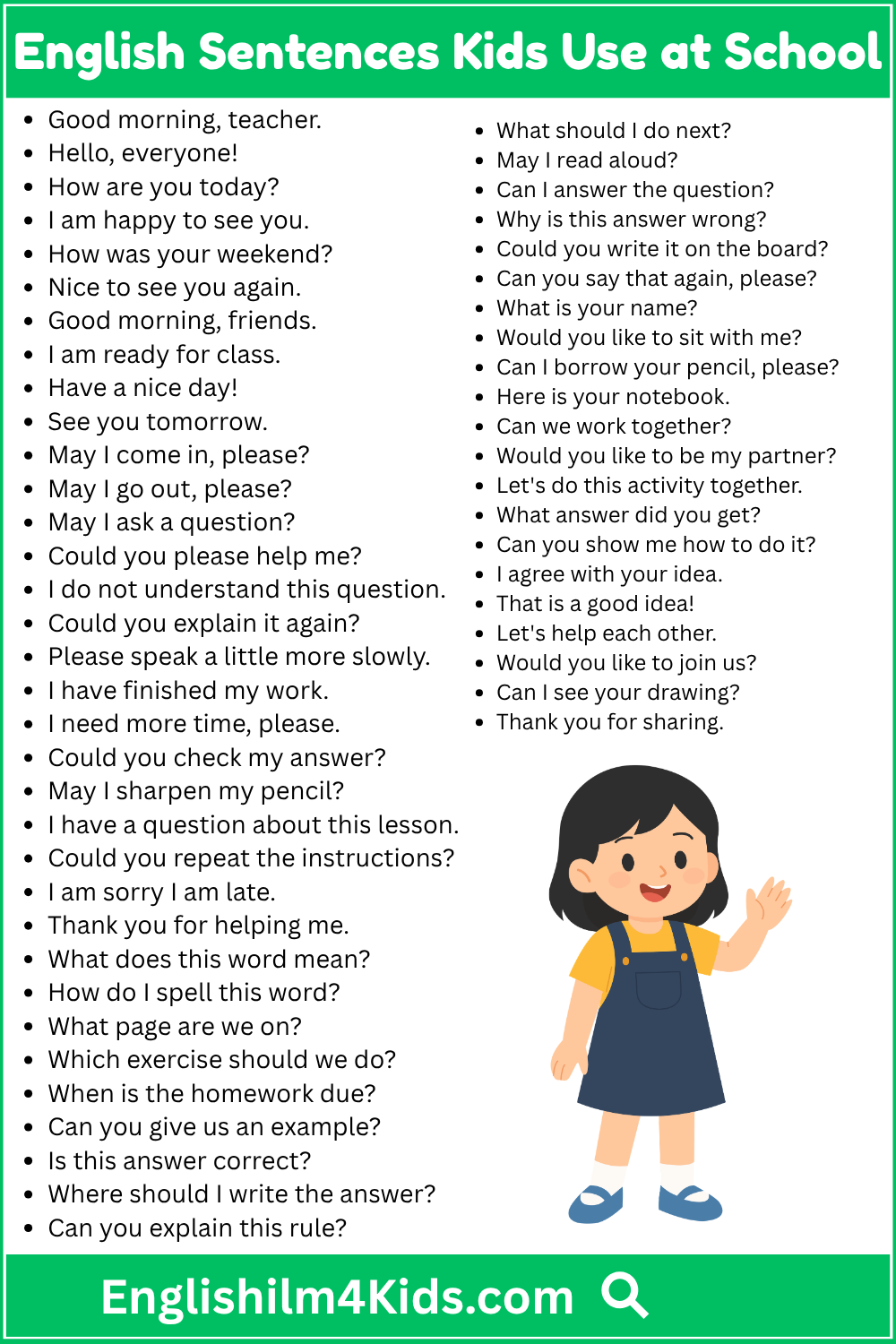
English Sentences Kids Use at School
Children can start the school day with friendly greetings. These sentences are easy to remember and use every day.
- Good morning, teacher.
- Hello, everyone!
- How are you today?
- I am happy to see you.
- How was your weekend?
- Nice to see you again.
- Good morning, friends.
- I am ready for class.
- Have a nice day!
- See you tomorrow.
English Sentences Kids Use to Talk to Teachers
Children often need to ask their teachers questions or explain something. These sentences help them speak politely.
- May I come in, please?
- May I go out, please?
- May I ask a question?
- Could you please help me?
- I do not understand this question.
- Could you explain it again?
- Please speak a little more slowly.
- I have finished my work.
- I need more time, please.
- Could you check my answer?
- May I sharpen my pencil?
- I have a question about this lesson.
- Could you repeat the instructions?
- I am sorry I am late.
- Thank you for helping me.
English Sentences for Asking Questions in Class
Asking questions is a good way to learn. Children can use these sentences when they need information or want to understand a lesson.
- What does this word mean?
- How do I spell this word?
- What page are we on?
- Which exercise should we do?
- When is the homework due?
- Can you give us an example?
- Is this answer correct?
- Where should I write the answer?
- Can you explain this rule?
- What should I do next?
- May I read aloud?
- Can I answer the question?
- Why is this answer wrong?
- Could you write it on the board?
- Can you say that again, please?
English Sentences for Talking to Classmates
Children use English to make friends, share ideas, and work together. These sentences are helpful during lessons and free time.
- What is your name?
- Would you like to sit with me?
- Can I borrow your pencil, please?
- Here is your notebook.
- Can we work together?
- Would you like to be my partner?
- Let’s do this activity together.
- What answer did you get?
- Can you show me how to do it?
- I agree with your idea.
- That is a good idea!
- Let’s help each other.
- Would you like to join us?
- Can I see your drawing?
- Thank you for sharing.
English Sentences for Asking for Help
Sometimes children need help with a difficult question, a school task, or a problem with their belongings. They can use these simple expressions.
| Situation | Useful Sentence |
|---|---|
| You cannot solve a question. | Can you help me, please? |
| You do not understand the lesson. | I need some help with this lesson. |
| You cannot find your book. | Can you help me find my book? |
| You need help with a task. | Could you show me what to do? |
| You missed the instructions. | What should I do first? |
| You need help from a classmate. | Can you explain this to me? |
| You have finished one step. | What should I do next? |
| Someone helps you. | Thank you for your help. |
English Sentences for Sharing and Taking Turns
Sharing and taking turns help children play and work together fairly. These sentences are especially useful during group work, games, and classroom activities.
- Can I have a turn, please?
- You can go first.
- I will wait for my turn.
- Let’s take turns.
- Can I use it when you finish?
- Here, you can use my pencil.
- Would you like to share?
- Let’s share the crayons.
- It is your turn now.
- Now it is my turn.
- You can use it after me.
- Let’s play together.
- Thank you for sharing with me.
- We can use it together.
- Everyone will get a turn.
English Sentences for the Classroom
These everyday sentences help children communicate during lessons and classroom activities.
- Please open your books.
- Please close your books.
- I am writing the answer.
- I am reading the question.
- Please pass me the ruler.
- I need a sheet of paper.
- My pencil is broken.
- I cannot find my eraser.
- I have completed the exercise.
- I am ready to present my work.
- Let me think for a moment.
- I would like to try again.
- Please look at my work.
- I made a mistake.
- I will correct my answer.
English Sentences for the Playground
Children can use these friendly sentences while playing with classmates.
- Would you like to play with us?
- Can I join your game?
- Let’s play together.
- It is your turn.
- Please wait for me.
- Be careful!
- Watch where you are going.
- Let’s play a different game.
- That was fun!
- Are you okay?
- Do you want to sit here?
- Let’s make teams.
- We should follow the rules.
- Please do not push.
- Let’s solve this problem calmly.
English Sentences for Lunch and Break Time
These sentences help children talk about food, drinks, and break-time activities.
- What did you bring for lunch?
- I brought a sandwich.
- May I have some water, please?
- This is my lunch box.
- Would you like to sit with me?
- Please pass me my bottle.
- I am thirsty.
- I am hungry.
- Would you like to share a snack?
- Thank you. That is kind of you.
- I have finished my lunch.
- Where should I put my lunch box?
- Let’s clean our table.
- Please put your rubbish in the bin.
- I am ready to go back to class.
Children should only share food when it is allowed and safe. They should follow their school’s rules about food allergies and personal belongings.
English Sentences for Following Classroom Rules
Simple English sentences can help children understand and remember classroom expectations.
- Please listen carefully.
- Raise your hand before speaking.
- Keep your desk clean.
- Walk slowly in the classroom.
- Keep your hands to yourself.
- Please wait quietly.
- Follow the teacher’s instructions.
- Put your books away.
- Speak kindly to others.
- Take care of school supplies.
- Keep the classroom tidy.
- Be respectful to everyone.
- Listen when someone else is speaking.
- Ask before borrowing something.
- Return things to their proper place.
English Sentences for Saying Sorry and Thank You
Good manners help children build friendly relationships. These sentences are useful when they make a mistake or receive help.
| Purpose | Sentence |
|---|---|
| Apologizing | I am sorry. |
| Apologizing for a mistake | I am sorry I made a mistake. |
| Asking for forgiveness | Please forgive me. |
| Thanking a teacher | Thank you for teaching us. |
| Thanking a classmate | Thank you for helping me. |
| Responding to thanks | You are welcome. |
| Asking politely | Could you help me, please? |
| Getting someone’s attention | Excuse me, please. |
| Asking permission | May I borrow this? |
| Showing kindness | Are you okay? Can I help you? |
English Sentences Kids Use at School : Practice at School
Reading short conversations aloud helps children practice speaking naturally. Practice with a friend, parent, or teacher.
Conversation 1: Asking the Teacher for Help
Student: Excuse me, teacher.
Teacher: Yes, how can I help you?
Student: I do not understand question three.
Teacher: Let me explain it again.
Student: Thank you, teacher.
Conversation 2: Borrowing a Pencil
Hamza: Can I borrow your pencil, please?
Bilal: Sure. Here you go.
Hamza: Thank you!
Bilal: You are welcome.
Conversation 3: Joining a Game
Sara: Can I play with you?
Mina: Of course! We are playing a word game.
Sara: Great! What should I do?
Mina: You can choose the next word.
Sara: Thank you. Let’s begin!
Conversation 4: Sharing Classroom Supplies
Ali: Can I use the red marker when you finish?
Zain: Yes. I just need one more minute.
Ali: No problem. I will wait.
Zain: Here you go. It is your turn.
Ali: Thanks for sharing.
Tips to Help Kids Learn School Sentences in English
- Learn five sentences at a time. Start with greetings or classroom questions.
- Say the sentences aloud. Speaking helps children become familiar with the words.
- Practice with a partner. Take turns being the teacher and the student.
- Use sentences in real situations. Ask for help in English when you need it.
- Listen carefully. Notice how teachers and classmates use English.
- Learn polite expressions. Words such as “please,” “thank you,” and “excuse me” are useful every day.
- Do not worry about small mistakes. Correct mistakes and keep practicing.
- Review old sentences. Repeat familiar expressions before learning new ones.
Read more
Pingback: 50 English Sentences for the Classroom for Kids - Englishilm4kids.com