
What Are Table Manners?
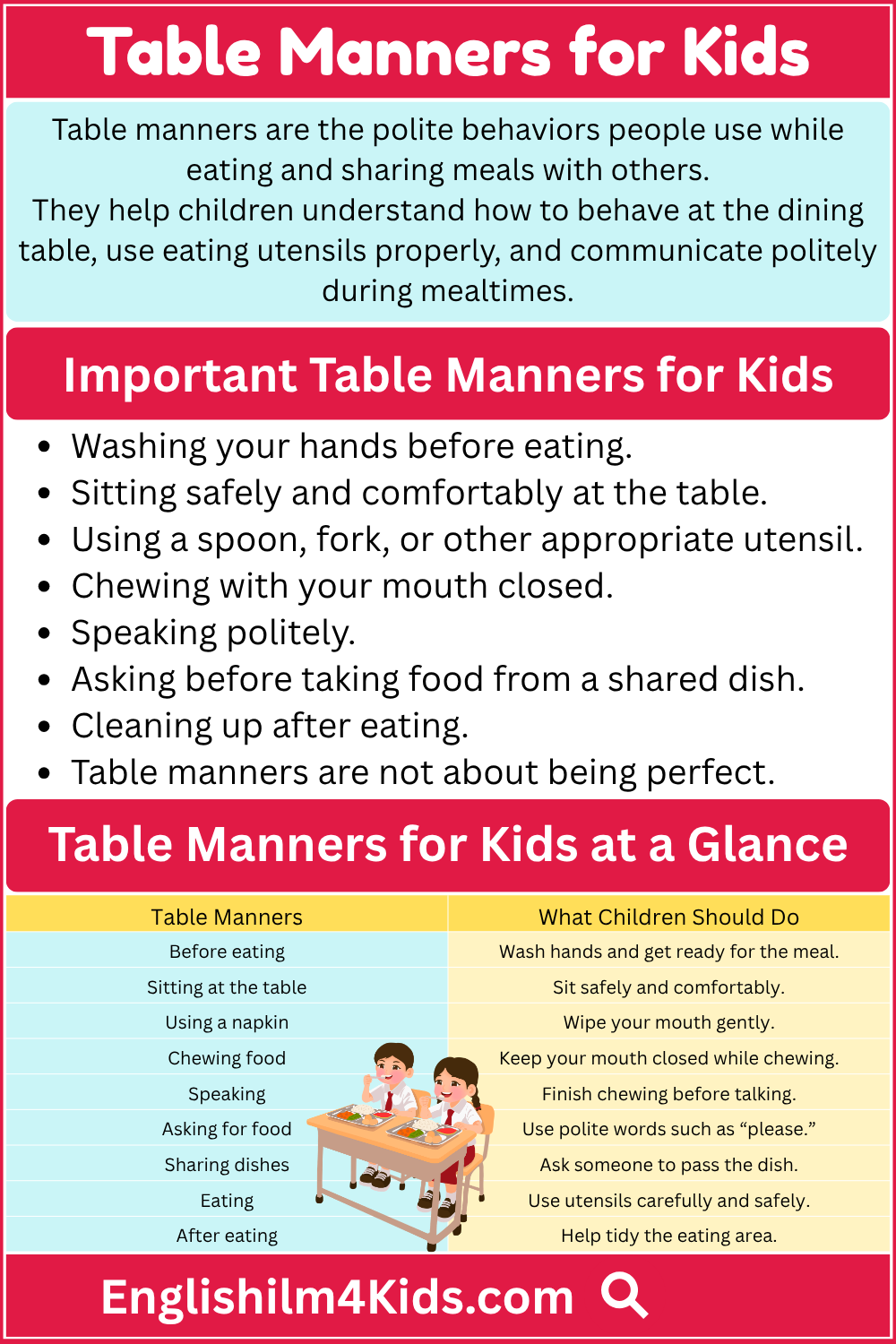
Table manners are the polite behaviors people use while eating and sharing meals with others.
They help children understand how to behave at the dining table, use eating utensils properly, and communicate politely during mealtimes.
- Washing your hands before eating.
- Sitting safely and comfortably at the table.
- Using a spoon, fork, or other appropriate utensil.
- Chewing with your mouth closed.
- Speaking politely.
- Asking before taking food from a shared dish.
- Cleaning up after eating.
- Table manners are not about being perfect.
15 Important Table Manners for Kids
Here are 15 simple table manners children can practice at home, school, and restaurants.
1. Wash Your Hands Before Eating
Clean hands help reduce the spread of germs during meals.
Wash your hands with soap and water before sitting down to eat.
Example: Wash your hands before eating lunch at school.
2. Sit Properly at the Table
Sit safely and comfortably while eating.
-
Keep your chair stable.
-
Sit facing the table.
-
Avoid standing on the chair.
-
Keep your feet in a comfortable position.
Example: Sit on your chair instead of kneeling on the dining table.
3. Use a Napkin
A napkin helps keep your hands and mouth clean during a meal.
Place it on your lap when appropriate, and use it gently to wipe your mouth or fingers.
Example: If a little food gets on your lips, use your napkin instead of your sleeve.
4. Chew With Your Mouth Closed
Chew food with your mouth closed whenever possible.
This is polite and helps prevent food from spilling out while you eat.
Example: Take a bite, close your mouth, and chew before speaking.
5. Do Not Talk With Food in Your Mouth
Finish chewing and swallowing before speaking.
This makes conversations more pleasant and helps prevent choking.
Example: If your friend asks you a question, finish your bite before answering.
6. Use Polite Words
Remember to use kind words when asking for food or thanking someone.
Useful expressions include:
- Please.
- Thank you.
- Excuse me.
- No, thank you.
- May I have some, please?
Example: “Could you please pass the rice?”
7. Wait Until Everyone Is Ready
When sharing a family meal, wait until everyone has their food and the host or family members are ready before beginning, when that is the custom.
Example: Wait until your family is seated before starting dinner.
8. Ask Before Taking Shared Food
Some meals have dishes that everyone shares. Ask politely before reaching for food, especially if it is far away.
Example: “Could you please pass the bread?”
Use serving spoons or other shared utensils when provided.
9. Take a Reasonable Portion
Take an amount of food you think you can eat. You can ask for more if you are still hungry.
Example: Take a small serving of vegetables first, then ask for more if you want it.
Children should not be pressured to finish food when they are comfortably full.
10. Use Eating Utensils Carefully
Use a spoon, fork, or other utensil suitable for the food and your age.
- Hold utensils safely.
- Avoid waving them around.
- Do not use them to point at people.
- Place them down carefully when finished.
Example: Use your spoon to eat soup instead of splashing it.
11. Keep Food on Your Plate
Try to keep food on your plate rather than dropping it on the table or floor.
If you spill something accidentally, let an adult know and help clean it up when appropriate.
Example: Use your spoon carefully so rice stays on your plate.
12. Speak Kindly During Meals
Use a calm voice and speak politely to family members, friends, and other diners.
Avoid shouting, teasing people about their food, or interrupting conversations.
Example: Ask your brother a question without shouting across the table.
13. Try New Foods Politely
You may not enjoy every food, and that is okay.
If you do not want to try something, respond politely instead of making rude comments about it.
Example: “No, thank you. I don’t want any more right now.”
Children can learn to respect other people’s food choices, too.
14. Stay at the Table Until You Finish
When possible, remain seated while eating instead of running around with food.
If you need to leave, ask politely or let an adult know.
Example: “Excuse me, may I leave the table?”
For young children, an adult can help decide when they are ready to leave safely.
15. Help Clean Up After the Meal
Good table manners also include helping care for the eating area.
Depending on your age, you can:
- Carry your plate to the kitchen.
- Put your cup in the proper place.
- Throw away rubbish.
- Wipe up small spills with help.
- Help clear the table safely.
Example: After dinner, carry your plate to the kitchen sink.
Table Manners for Kids at a Glance
| Table Manners | What Children Should Do |
|---|---|
| Before eating | Wash hands and get ready for the meal. |
| Sitting at the table | Sit safely and comfortably. |
| Using a napkin | Wipe your mouth gently. |
| Chewing food | Keep your mouth closed while chewing. |
| Speaking | Finish chewing before talking. |
| Asking for food | Use polite words such as “please.” |
| Sharing dishes | Ask someone to pass the dish. |
| Serving food | Use shared serving utensils when available. |
| Eating | Use utensils carefully and safely. |
| After eating | Help tidy the eating area. |
Polite Words and Sentences to Use at the Table
| Situation | Polite Sentence |
|---|---|
| Asking for water | Could I have some water, please? |
| Asking for food | May I have some rice, please? |
| Requesting a dish | Could you pass the bread, please? |
| Receiving food | Thank you. |
| Offering food | Would you like some fruit? |
| Refusing politely | No, thank you. |
| Asking to leave | Excuse me, may I leave the table? |
| Apologizing for a spill | I’m sorry I spilled my water. |
| Asking for a napkin | May I have a napkin, please? |
| Finishing the meal | Thank you for the meal. |
| Offering help | Can I help clear the table? |
| Asking for more | May I have some more, please? |
Good Table Manners vs. Poor Table Manners
| Good Table Manners | Poor Table Manners |
|---|---|
| Washing hands before eating | Sitting down to eat with dirty hands |
| Chewing with the mouth closed | Chewing with the mouth open |
| Asking politely for food | Grabbing food from another person’s plate |
| Speaking after swallowing | Talking with food in the mouth |
| Using a napkin | Wiping the mouth on clothing |
| Using a calm voice | Shouting across the table |
| Asking before leaving | Running away from the table |
| Cleaning up spills | Ignoring a mess |
| Respecting others’ food choices | Making fun of someone’s meal |
| Helping after dinner | Leaving everything for others to clean |
Table Manners Activities for Kids
These simple activities help children remember table manners through practice.
Activity 1: Choose the Correct Answer
1. What should you do before eating?
a) Run around the room.
b) Wash your hands.
c) Touch everyone else’s food.
2. How should you chew your food?
a) With your mouth closed.
b) While shouting.
c) With your mouth full while talking.
3. You want someone to pass the water. What should you say?
a) Give it to me!
b) Pass it now!
c) Could you please pass the water?
4. You accidentally spill your drink. What should you do?
a) Ignore it.
b) Tell an adult and help clean it up when appropriate.
c) Blame someone else.
5. What should you do after eating?
a) Leave rubbish on the table.
b) Throw your plate on the floor.
c) Help tidy up safely.
Answer Key: 1-b, 2-a, 3-c, 4-b, 5-c.
Activity 2: Fill in the Blanks
Choose the correct words from the word bank.
Word Bank
1. Wash your ____ before eating.
2. Use a ____ to wipe your mouth.
3. Say ____ when someone gives you food.
4. Chew with your mouth ____.
5. Say ____ when asking for food politely.
Check answers
Activity 3: Good Manners or Poor Manners?
Decide whether each behavior shows good or poor table manners.
-
Saying “please” when asking for food.
-
Taking food from another person’s plate without asking.
-
Washing your hands before eating.
-
Talking with your mouth full.
-
Helping clear the table.
-
Making fun of someone else’s food.
Answers:
-
Good manners: 1, 3, and 5.
-
Poor manners: 2, 4, and 6.
Activity 4: Practice a Mealtime Conversation
Read the dialogue with a parent, teacher, or friend.
Child: Could you please pass the bread?
Adult: Here you are.
Child: Thank you.
Adult: You’re welcome.
Child: May I have some more water, please?
Adult: Of course.
Child: Thank you very much.
Try changing the words bread and water to rice, fruit, milk, or another suitable food or drink.
Frequently Asked Questions
What are table manners for kids?
Table manners for kids are polite and considerate behaviors practiced during meals. Examples include washing hands, chewing with the mouth closed, using a napkin, and speaking politely.
What are the five basic table manners?
Five basic table manners are washing your hands before eating, sitting safely, chewing with your mouth closed, using polite words, and cleaning up after the meal.
How do you teach table manners to a child?
Start with a few simple rules, demonstrate the behaviors, practice polite phrases, and give gentle reminders during meals. Add new habits gradually.
Why are table manners important?
Table manners help children practice respect, cleanliness, patience, and social communication. They also make shared meals more pleasant for everyone.
What should children say when asking for food?
Children can say, “Could you please pass the bread?” or “May I have some more rice, please?”
What are good table manners at a restaurant?
Children should use a calm voice, sit safely, speak politely to restaurant staff, avoid running between tables, and respect other diners.
Should children be forced to finish everything on their plates?
Children should be encouraged to take reasonable portions and listen to their hunger and fullness cues. They should not be pressured to finish food when they are comfortably full.
At what age should children learn table manners?
Children can begin learning simple habits as soon as they can participate in family meals. Expectations should match their age, abilities, and stage of development.
ConclusionLearning table manners for kids helps children develop polite habits that they can use at home, at school, and in restaurants. Simple actions such as washing hands, chewing with the mouth closed, asking for food politely, and helping clean up can make mealtimes more comfortable for everyone. Children learn these habits through everyday practice, gentle reminders, and positive examples from adults. Start with a few easy rules and encourage children as they improve. With patience and practice, good table manners can become a natural part of family meals and daily life.
Read Also
Pingback: Playground Rules for Kids: 15 Safe and Fun Rules - Englishilm4kids.com