
Sharing and taking turns are important skills that help children play, learn, and spend time happily with other people. Young children may feel excited about a favorite toy or game and want to use it first or keep it for themselves. Learning to share does not happen all at once. Children need simple explanations, practice, and gentle reminders. Taking turns teaches children that everyone deserves a chance to participate, while sharing teaches them to think about other people’s needs. In this guide, kids will learn what sharing and taking turns mean, why they matter, useful phrases to say, everyday examples, and fun activities for practicing these skills.
What Does Sharing Mean?
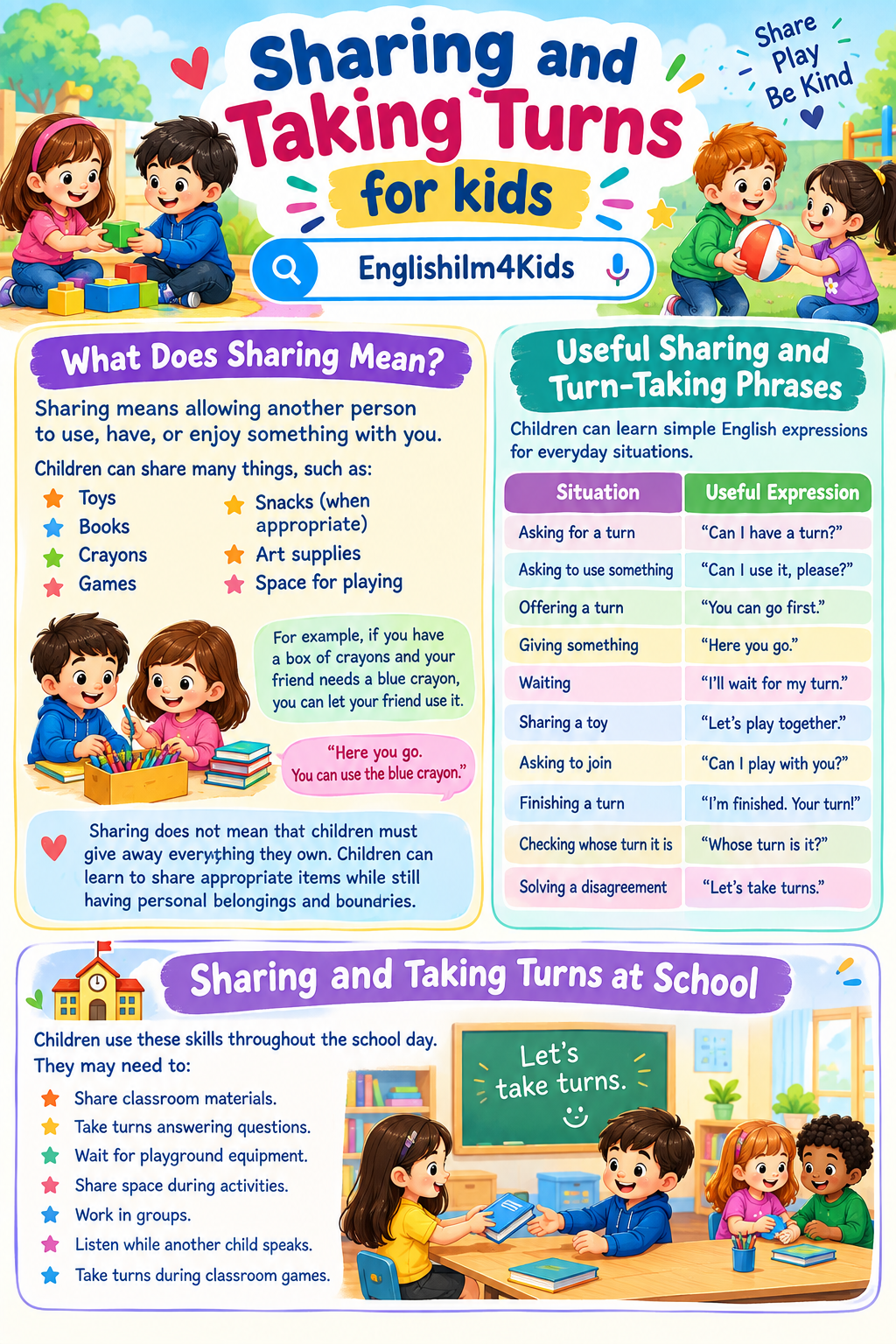
Sharing means allowing another person to use, have, or enjoy something with you.
- Toys
- Books
- Crayons
- Games
- Snacks when appropriate
- Art supplies
- Space for playing
For example, if you have a box of crayons and your friend needs a blue crayon, you can let your friend use it.
You can say:
“Here you go. You can use the blue crayon.”
Sharing does not mean that children must give away everything they own. Children can learn to share appropriate items while still having personal belongings and boundaries.
What Does Taking Turns Mean?
Taking turns means giving each person a chance to do something one after another.
For example, two children want to play with the same ball.
Instead of arguing, they can take turns:
Child 1: “I will play first.”
Child 2: “Okay. Then it will be my turn.”
Taking turns is useful when children:
- Play games
- Use playground equipment
- Read books together
- Use classroom materials
- Play with toys
- Answer questions
- Choose activities
Why Are Sharing and Taking Turns Important?
Sharing and taking turns can help children enjoy activities together and handle common situations more calmly.
- Be considerate of others.
- Wait patiently.
- Cooperate with friends.
- Follow simple rules.
- Communicate their needs.
- Solve small disagreements.
- Include others in activities.
- Respect other people’s opportunities.
- Use polite language.
10 Simple Ways to Practice Sharing and Taking Turns
1. Share Toys With Friends
If two children want to use toys together, encourage them to find a fair way to share.
For example:
“You can use the blocks while I use the cars.”
They can also play together with the same toy when possible.
2. Take Turns on the Playground
Children may both want to use the same swing, slide, or other playground equipment.
A simple turn-taking sentence is:
“You can go first. I will wait for my turn.”
Taking turns gives everyone an opportunity to play.
3. Share Art Supplies
Children can share crayons, markers, paintbrushes, and other classroom supplies.
Instead of grabbing something, they can ask:
“Can I use the red marker when you are finished?”
This teaches children to ask before taking something another person is using.
4. Take Turns During Games
Many children’s games naturally involve turns.
A child can say:
“Whose turn is it?”
or:
“It’s your turn now.”
This simple language helps children understand whose turn comes next.
5. Share Books
Two children can look at a picture book together.
One child can hold the book while the other points to pictures or reads aloud.
They can also take turns choosing which book to read.
6. Wait Patiently
Taking turns often means waiting.
Waiting can be difficult when children are excited, but simple reminders can help.
Try saying:
“Your turn is next. Please wait.”
Children can use the waiting time to watch, talk, or prepare for their turn.
7. Ask Before Taking
Children should learn to ask before using something another person is holding or using.
Useful questions include:
- “Can I use it?”
- “Can I have a turn?”
- “May I play with you?”
- “Can we share?”
- “Can I use it when you’re finished?”
8. Give Others a Chance
Sharing is not only about objects. Children can also share opportunities.
During a group activity, children can let everyone have a chance to participate.
For example:
“You can answer first. Then I will answer.”
9. Use a Timer for Difficult Turns
Sometimes children have trouble deciding when a turn should end.
For appropriate activities, a parent or teacher can use a simple timer.
For example:
“You can play for five minutes. Then your friend can have a turn.”
A clear time limit can make turn-taking easier to understand.
10. Practice With Adults
Parents and teachers can model sharing and turn-taking during everyday activities.
For example:
Adult: “I’ll use the blue pencil first. Then you can have a turn.”
Children can learn by watching how adults ask, wait, share, and respond politely.
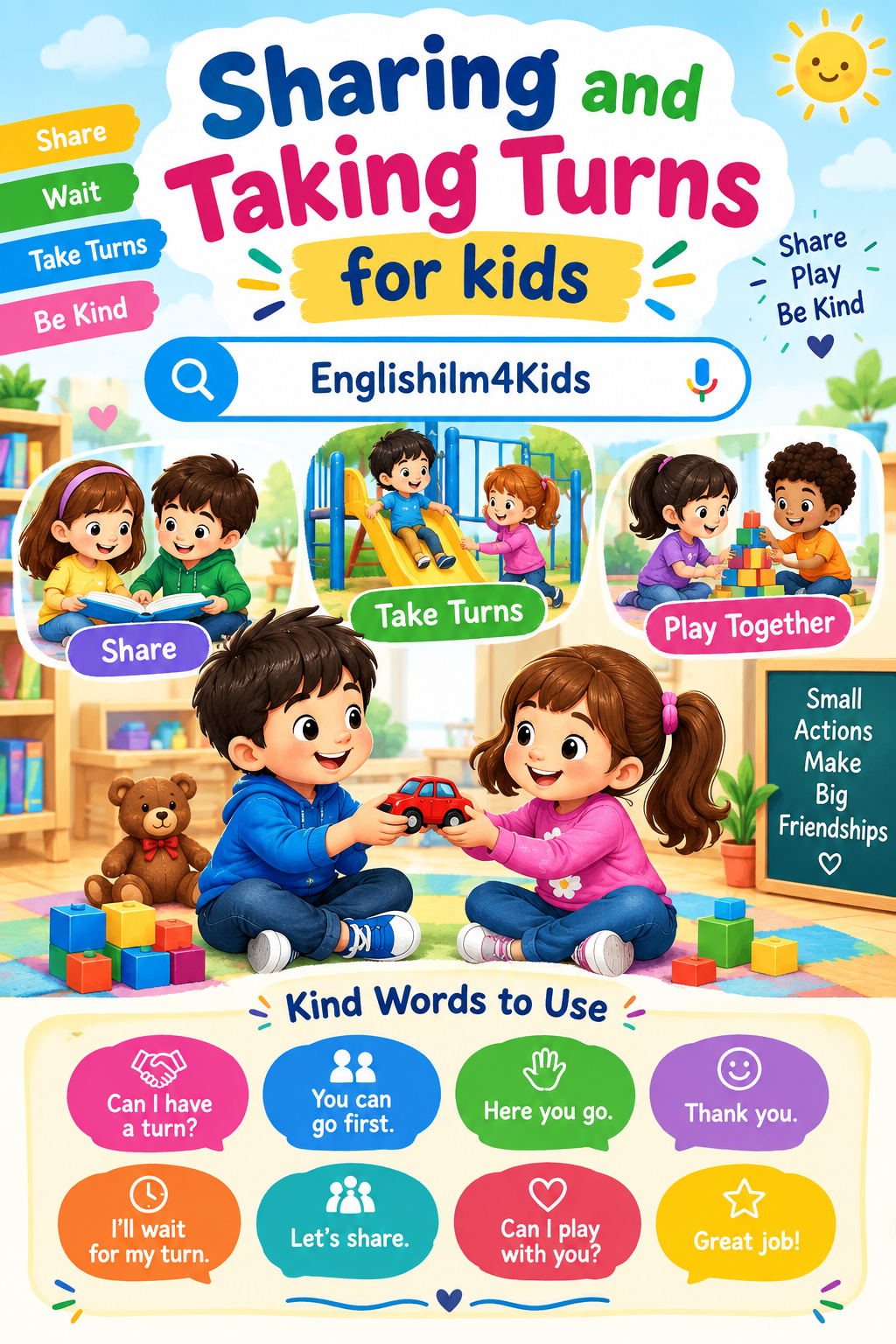
Useful Sharing and Turn-Taking Phrases
Children can learn simple English expressions for everyday situations.
| Situation | Useful Expression |
|---|---|
| Asking for a turn | “Can I have a turn?” |
| Asking to use something | “Can I use it, please?” |
| Offering a turn | “You can go first.” |
| Giving something | “Here you go.” |
| Waiting | “I’ll wait for my turn.” |
| Sharing a toy | “Let’s play together.” |
| Asking to join | “Can I play with you?” |
| Finishing a turn | “I’m finished. Your turn!” |
| Checking whose turn it is | “Whose turn is it?” |
| Solving a disagreement | “Let’s take turns.” |
Sharing and Taking Turns at Home
Home is a great place for children to practice these skills.
Parents can use everyday activities such as:
Playing Board Games
Children can take turns rolling dice, moving pieces, or choosing cards.
Useful sentence:
“It’s your turn to roll the dice.”
Sharing Snacks
When appropriate, children can learn to offer suitable food to siblings or family members.
“Would you like some?”
Parents should still teach children that they do not have to share food when doing so would be unsafe or inappropriate.
Sharing Household Items
Children can practice asking before using something another family member is using.
“Can I use the tablet when you are finished?”
This teaches patience and respectful communication.
Sharing and Taking Turns at School
Children use these skills throughout the school day.
- Share classroom materials.
- Take turns answering questions.
- Wait for playground equipment.
- Share space during activities.
- Work in groups.
- Listen while another child speaks.
- Take turns during classroom games.
For example:
Teacher: “Let’s take turns reading.”
Child: “Okay. I’ll read after Sara.”
This kind of simple language helps children participate respectfully.
Common Mistakes Children Can Avoid
Grabbing
Instead of grabbing a toy, ask:
“Can I have a turn when you’re finished?”
Interrupting
If someone is speaking, wait until they finish before talking.
Refusing Every Turn
It is not fair to keep a shared game or toy forever.
Try:
“I’m almost finished. Then you can have a turn.”
Getting Angry While Waiting
Waiting can be difficult, but children can practice staying calm.
Try taking a breath and reminding yourself:
“My turn is coming.”
Forgetting to Return Something
If someone lets you borrow something, return it when you finish.
You can say:
“Thank you for sharing with me.”
Fun Activities for Learning to Share and Take Turns
1. Turn-Taking Ball Game
Sit in a circle and pass a ball from one child to another.
Each child gets one turn before passing the ball.
Practice saying:
“My turn.”
“Your turn.”
2. Sharing Role-Play
Create simple situations for children to act out.
For example:
- Two children want the same toy.
- A friend wants to join a game.
- Two students need the same pencil.
- Siblings want to watch different programs.
- Two children want the first turn.
Ask children to find polite solutions.
3. Sharing Sentence Practice
Ask children to complete these sentences:
- Can I have __________?
- You can have a __________.
- I will wait for __________.
- Let’s take __________.
- Can I play __________?
- Thank you for __________ with me.
4. Turn-Taking Story
Create a short story about two children who want the same toy.
Ask:
- Who should go first?
- How can they share?
- What could they say?
- How can they solve the problem?
This lets children practice both English and social skills.
Practice: Choose the Correct Answer
1. Your friend is using a toy you want. What should you say?
A. “Give it to me!”
B. “Can I have a turn when you’re finished?”
C. “I’m taking it.”
Answer: B
2. It is your friend’s turn. What should you do?
A. Wait.
B. Grab the toy.
C. Shout.
Answer: A
3. You want to join a game. What can you say?
A. “Move!”
B. “Can I play with you?”
C. “This game is mine.”
Answer: B
4. Your friend shares a toy with you. What should you say?
A. “Thank you.”
B. “Give me another one.”
C. “Go away.”
Answer: A
5. Two children want the same book. What can they do?
A. Fight over it.
B. Tear the book.
C. Take turns.
Answer: C
Speaking Practice: Simple Dialogues
Dialogue 1: Sharing a Toy
Ali: Can I play with your car?
Hamza: Sure. You can have a turn.
Ali: Thank you!
Hamza: You’re welcome.
Dialogue 2: Taking Turns
Sara: Can I use the swing?
Mina: I’m almost finished.
Sara: Okay. I’ll wait.
Mina: Your turn now!
Sara: Thank you!
Dialogue 3: Joining a Game
Ayan: Can I play with you?
Zain: Yes. We’re playing a ball game.
Ayan: Great! Thank you.
Zain: You’re welcome.
Tips for Parents and Teachers
- Model polite sharing language.
- Give children opportunities to practice.
- Explain whose turn it is.
- Use simple routines.
- Praise specific helpful behavior.
- Let children practice solving small problems.
- Avoid expecting children to share every personal possession.
- Teach children how to say no politely.
- Remind children that waiting is part of taking turns.
Instead of simply saying “Share!”, give children useful language such as:
“Ask your friend, ‘Can I have a turn when you’re finished?'”
This gives children both the social skill and the English words they need to use it.
Frequently Asked Questions
What is sharing for kids?
Sharing means allowing another person to use, have, or enjoy something with you when it is appropriate.
What does taking turns mean?
Taking turns means giving each person a chance to participate one after another.
Why should children learn to take turns?
Taking turns helps children practice waiting, cooperation, communication, fairness, and respectful participation.
How can I teach my child to share?
Give your child simple opportunities to share appropriate items, model kind language, and practice through games and everyday activities.
What can a child say when they want a turn?
A child can say, “Can I have a turn, please?” or “Can I use it when you’re finished?”
Should children share everything?
No. Children can learn to share appropriate things while also having personal belongings and boundaries.
What should children do when they both want the same toy?
They can stay calm, talk about the problem, and make a fair plan such as taking turns.
How can teachers practice turn-taking in class?
Teachers can use group games, classroom materials, reading activities, and structured activities where children have clear turns.
Conclusion
Learning sharing and taking turns helps children communicate, cooperate, and enjoy activities with others. Children can practice these skills by sharing appropriate toys and materials, waiting patiently, asking politely, and giving others a chance. They can also learn that it is okay to have personal belongings and politely say no when necessary. With regular practice at home and school, sharing and turn-taking can become a natural part of children’s everyday interactions. Simple phrases such as “Can I have a turn?”, “You can go first,” and “Let’s share” give children useful English they can use in real-life situations.
Kids related articles
Pingback: Listening Skills for Kids: Simple Ways to Listen Better - Englishilm4kids.com