
The classroom is a great place for children to practice speaking English. Students use English to ask questions, talk to teachers, work with classmates, and understand instructions. Learning English sentences for the classroom helps children express their needs and participate in daily school activities. Beginners do not need to learn difficult words or long sentences. They can start with simple expressions and practice them every day. In this article, you will learn 50 useful classroom sentences, their meanings, and examples of how to use them in real situations. These sentences are helpful for kids, teachers, parents, and anyone learning basic English.
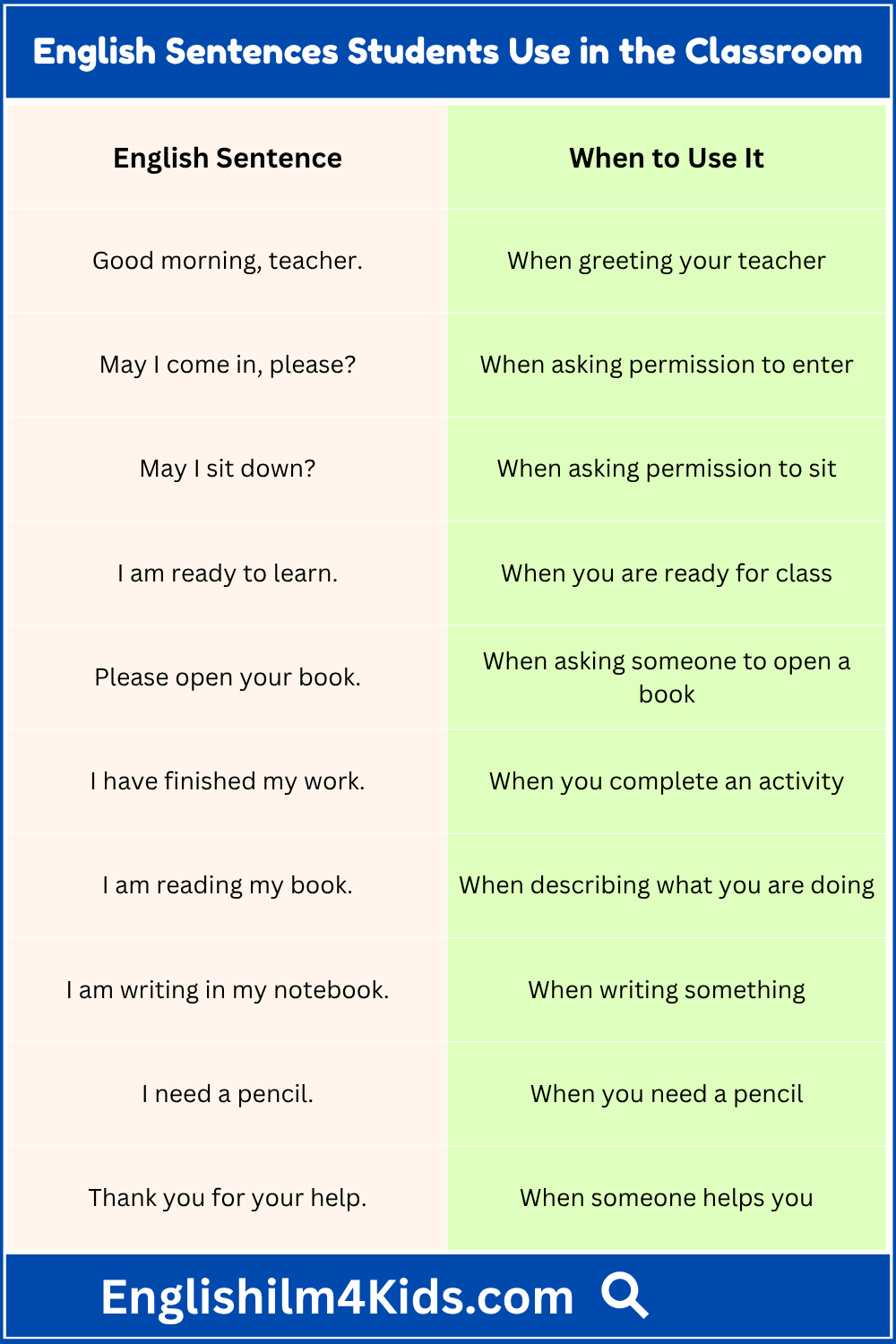
English Sentences Students Use in the Classroom
| No. | English Sentence | When to Use It |
|---|---|---|
| 1 | Good morning, teacher. | When greeting your teacher |
| 2 | May I come in, please? | When asking permission to enter |
| 3 | May I sit down? | When asking permission to sit |
| 4 | I am ready to learn. | When you are ready for class |
| 5 | Please open your book. | When asking someone to open a book |
| 6 | I have finished my work. | When you complete an activity |
| 7 | I am reading my book. | When describing what you are doing |
| 8 | I am writing in my notebook. | When writing something |
| 9 | I need a pencil. | When you need a pencil |
| 10 | Thank you for your help. | When someone helps you |
English Sentences for Asking the Teacher for Help
| No. | English Sentence | When to Use It |
|---|---|---|
| 11 | May I ask a question? | When you want to ask something |
| 12 | Could you please help me? | When you need help |
| 13 | I do not understand this question. | When a question is confusing |
| 14 | Could you please explain it again? | When you need another explanation |
| 15 | Could you repeat that, please? | When you did not hear something |
| 16 | How do you spell this word? | When you need help with spelling |
| 17 | What does this word mean? | When you do not know a word’s meaning |
| 18 | Is my answer correct? | When checking your answer |
| 19 | Could you check my work, please? | When you want your work checked |
| 20 | May I have more time, please? | When you need extra time |
Example conversation
Student: Excuse me, teacher. May I ask a question?
Teacher: Of course. What would you like to ask?
Student: I do not understand this question.
Teacher: Let me explain it again.
Student: Thank you for your help.
3. English Sentences for Talking to Classmates
| No. | English Sentence | When to Use It |
|---|---|---|
| 21 | Can I sit beside you? | When asking to sit next to someone |
| 22 | Can I borrow your pencil, please? | When you need to borrow a pencil |
| 23 | Here you are. | When giving something to someone |
| 24 | Thank you. | When someone gives you something |
| 25 | Would you like to work together? | When inviting someone to work with you |
| 26 | Let us share our ideas. | When working as a group |
| 27 | Can you help me with this question? | When asking a classmate for help |
| 28 | It is your turn now. | When another person should take a turn |
| 29 | Let us keep our classroom clean. | When encouraging everyone to keep the room tidy |
| 30 | Great job! | When praising someone’s effort |
Example conversation
Ali: Can I borrow your ruler, please?
Sara: Sure. Here you are.
Ali: Thank you.
Sara: You are welcome.
Ali: I will return it after the lesson.
This short conversation teaches children how to ask for something, respond politely, and return borrowed items.
4. English Sentences for Following Classroom Instructions
Teachers use instructions to explain classroom activities. Students should understand these common expressions so they know what to do.
| No. | English Sentence | Meaning |
|---|---|---|
| 31 | Please sit down. | Take a seat. |
| 32 | Please stand up. | Rise to your feet. |
| 33 | Open your books to page ten. | Find and open page ten. |
| 34 | Write your name on the paper. | Put your name on the paper. |
| 35 | Listen carefully. | Pay attention to what you hear. |
| 36 | Raise your hand before speaking. | Put your hand up before you talk. |
| 37 | Read the passage aloud. | Read so others can hear you. |
| 38 | Work in pairs. | Work with one other person. |
| 39 | Complete the exercise. | Finish the activity. |
| 40 | Put your books away. | Return your books to their proper place. |
Example: Your teacher might say, “Open your books to page ten.” You should find page ten and open your book. If you do not understand the instruction, you can politely ask, “Could you please repeat that?”
5. English Sentences for Being Polite in the Classroom
Good communication is not only about using correct English. It is also about speaking respectfully to other people.
| No. | English Sentence | When to Use It |
|---|---|---|
| 41 | Please help me. | When requesting help |
| 42 | Excuse me, teacher. | When politely getting your teacher’s attention |
| 43 | May I borrow this, please? | When asking to use something |
| 44 | I am sorry. | When apologizing |
| 45 | You are welcome. | When replying to thanks |
| 46 | After you. | When letting someone go first |
| 47 | Please go ahead. | When allowing someone to continue |
| 48 | I agree with your idea. | When you share someone’s opinion |
| 49 | Let us solve this together. | When offering to work as a team |
| 50 | See you tomorrow! | When saying goodbye at the end of the school day |
Children can practice these expressions during classroom activities. They should use a polite tone and listen respectfully when someone else is speaking.
6. How to Practice Classroom English Sentences
Learning sentences becomes more useful when children understand how to use them in everyday situations. Try these simple activities at home or school.
Practice with a Partner
Choose two or three sentences and take turns speaking. One child can play the teacher, while the other plays the student.
For example:
- Student: May I ask a question?
- Teacher: Yes, of course.
- Student: What does this word mean?
- Teacher: It means something that you can understand from its definition.
- Student: Thank you.
Use English During Daily Activities
Practice classroom expressions when you pack your schoolbag, complete homework, or prepare for a lesson.
For example, say “I need a pencil” when looking for one or “I have finished my work” when completing an activity.
Write and Review Sentences
Write five sentences in your notebook. Read them aloud, learn their meanings, and try to use them in the right situations. Review the same sentences the next day before learning new ones.
Learn Polite Expressions
Practice saying “please,” “thank you,” “excuse me,” and “I am sorry.” These expressions are useful at school, at home, and in many other situations.
7. Practice Exercises for Students
Test what you have learned with these short exercises.
Exercise A: Fill in the Blanks
Choose the correct words from the word bank.
Word Bank: help, question, pencil, carefully, tomorrow
- May I ask a ______?
- Could you please ______ me?
- I need a ______ to write.
- Listen ______ to your teacher.
- See you ______!
Exercise B: Choose the Correct Sentence
1. You want your teacher to explain something again. What should you say?
a. Explain it now!
b. Could you please explain it again?
c. I do not want to listen.
2. Your classmate lends you a pencil. What should you say?
a. Thank you.
b. Give me another one.
c. Go away.
3. You want to enter the classroom. What should you ask?
a. Where is my book?
b. Move, please.
c. May I come in, please?
4. You want to work with a classmate. What should you say?
a. Do all my work.
b. Would you like to work together?
c. I will not help you.
Exercise C: Write Your Own Sentences
Write one suitable English sentence for each situation.
- You need help with a difficult question.
- You want to borrow your classmate’s ruler.
- You have finished your classwork.
- You want your teacher to repeat an instruction.
- You want to invite a classmate to work with you.
Answer Key
Exercise A
- question
- help
- pencil
- carefully
- tomorrow
Exercise B
- b
- a
- c
- b
Exercise C — Sample Answers
- Could you please help me with this question?
- Can I borrow your ruler, please?
- I have finished my classwork.
- Could you please repeat the instruction?
- Would you like to work with me?
Other grammatically correct answers are also acceptable.
8. Frequently Asked Questions
What are English sentences for the classroom?
They are common English expressions that students and teachers use during lessons, classroom activities, and everyday school routines. Examples include “May I ask a question?” and “Please open your book.”
Which classroom sentences should beginners learn first?
Beginners can start with short expressions such as “I need help,” “I understand,” “Thank you,” “May I come in?” and “I have finished my work.”
How can children improve their classroom English?
Children can read sentences aloud, practice short conversations, listen to their teachers, and use English during everyday classroom activities.
How can students ask questions politely?
Students can say “May I ask a question?” or “Could you please explain this?” These expressions help them ask for information respectfully.
What are some useful English sentences for talking to classmates?
Children can say “Can I borrow your pencil, please?” “Would you like to work together?” and “Let us share our ideas.”
How many English sentences should children learn each day?
Children can begin with three to five sentences each day, depending on their level and comfort. Regular review is more useful than trying to memorize too many sentences at once.
Why is classroom English important?
Classroom English helps students ask questions, follow instructions, request help, share ideas, and communicate with teachers and classmates.
How can parents help children practice classroom sentences?
Parents can practice short dialogues with their children, ask simple questions in English, and encourage them to speak without worrying too much about mistakes.
Read more
Pingback: Body Parts Names in English with Meanings - Englishilm4kids.com