
What Are Classroom Manners?
Classroom manners are the polite and respectful behaviors students use when learning with teachers and classmates. They include listening when someone speaks, following classroom instructions, taking turns, using kind words, and taking care of school materials.
For example, a student shows good classroom manners by raising a hand before answering a question instead of shouting out the answer.
15 Important Classroom Manners for Kids
1. Listen to Your Teacher
- Keep your attention on the lesson.
- Listen without interrupting.
- Ask questions when you need help.
Example: Listen carefully while your teacher explains a math problem.
2. Raise Your Hand Before Speaking
Give others a chance to speak. Raise your hand when you want to answer a question or share an idea.
Example: Raise your hand before answering a question during an English lesson.
3. Use Polite Words
Remember to use kind and respectful words when speaking to teachers and classmates.
- Please.
- Thank you.
- Excuse me.
- I’m sorry.
- You’re welcome.
Example: “Excuse me, may I ask a question, please?”
4. Be Kind to Your Classmates
Treat other students with kindness. Avoid teasing, name-calling, or laughing at someone who makes a mistake.
Example: Help a classmate who is having difficulty with an activity.
5. Wait for Your Turn
Be patient when someone else is speaking, playing, or using shared classroom materials.
Example: Wait until your classmate finishes speaking before sharing your idea.
6. Keep Your Classroom Clean
Put rubbish in the bin and return classroom materials to their proper places.
Example: Put used paper in the bin instead of leaving it on the floor.
7. Take Care of School Supplies
Use books, pencils, desks, and other classroom materials carefully.
Example: Return borrowed crayons after finishing your drawing.
8. Follow Classroom Rules
Every classroom has rules that help students learn safely and comfortably.
Example: Walk calmly inside the classroom instead of running between desks.
9. Respect Other People’s Belongings
Ask permission before borrowing another student’s belongings.
Example: “May I borrow your ruler, please?”
Return borrowed items in good condition.
10. Work Quietly When Needed
Some activities require students to work independently or quietly.
Example: Use a quiet voice while completing a reading exercise.
11. Share and Take Turns
Sharing materials and taking turns help children work and play together.
Example: Let your classmate use the colored pencils after you finish.
Remember, sharing does not mean you must give away everything you own. It means being considerate when sharing is appropriate.
12. Be Honest
Tell the truth about your actions and take responsibility for mistakes.
Example: If you accidentally break a pencil, tell the teacher or its owner honestly.
13. Respect Different Opinions
Classmates may have different ideas, interests, and answers. Listen politely, even when you disagree.
Example: Say, “I have a different answer,” instead of, “Your answer is stupid.”
14. Ask for Help Politely
If you do not understand a lesson, ask your teacher for help.
Example: “Could you please explain this question again?”
Asking for help is a normal part of learning.
15. Be Ready to Learn
Come prepared with the materials you need and begin your work when instructed.
Example: Take out your notebook and pencil when the lesson begins.
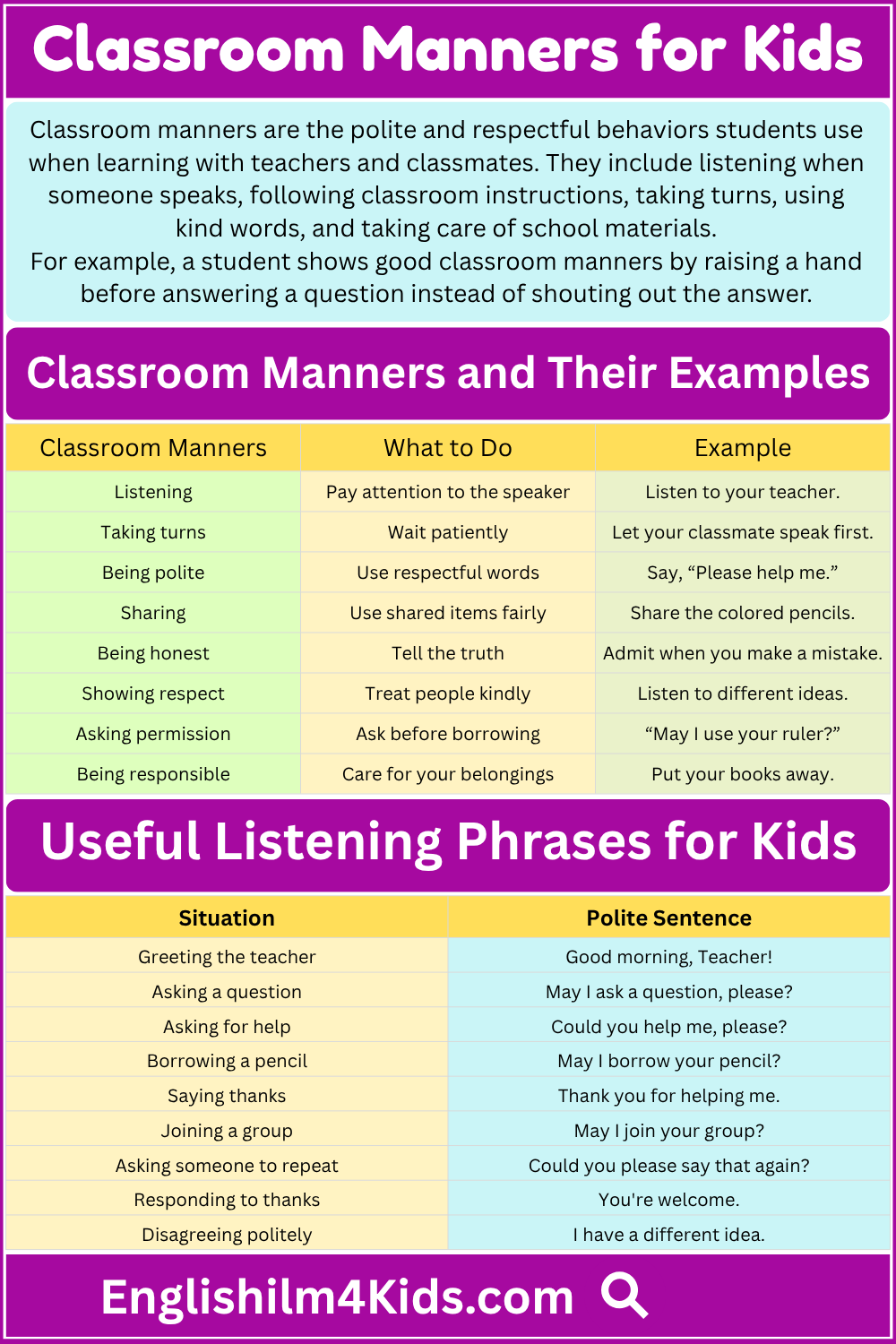
Classroom Manners and Their Examples
| Classroom Manners | What to Do | Example |
|---|---|---|
| Listening | Pay attention to the speaker | Listen to your teacher. |
| Taking turns | Wait patiently | Let your classmate speak first. |
| Being polite | Use respectful words | Say, “Please help me.” |
| Sharing | Use shared items fairly | Share the colored pencils. |
| Keeping clean | Put rubbish in the bin | Pick up a piece of paper. |
| Being honest | Tell the truth | Admit when you make a mistake. |
| Showing respect | Treat people kindly | Listen to different ideas. |
| Following rules | Do what is expected | Walk inside the classroom. |
| Asking permission | Ask before borrowing | “May I use your ruler?” |
| Being responsible | Care for your belongings | Put your books away. |
Polite Words and Sentences to Use in the Classroom
| Situation | Polite Sentence |
|---|---|
| Greeting the teacher | Good morning, Teacher! |
| Asking a question | May I ask a question, please? |
| Asking for help | Could you help me, please? |
| Borrowing a pencil | May I borrow your pencil? |
| Saying thanks | Thank you for helping me. |
| Apologizing | I’m sorry I interrupted you. |
| Asking to leave | May I leave the classroom, please? |
| Joining a group | May I join your group? |
| Asking someone to repeat | Could you please say that again? |
| Responding to thanks | You’re welcome. |
| Disagreeing politely | I have a different idea. |
| Asking someone to wait | Could you please wait a moment? |
Classroom Manners Before, During, and After a Lesson
Good classroom behavior includes more than what students do during a lesson. Children can practice manners throughout the school day.
Before the Lesson
- Arrive at the classroom on time.
- Greet your teacher politely.
- Prepare your books and pencils.
- Put your belongings in the proper place.Get ready to learn.
During the Lesson
- Listen when the teacher or another student speaks.
- Raise your hand before speaking when required.
- Follow instructions.
- Use a suitable voice.
- Respect other students’ ideas.
- Ask for help when needed.
After the Lesson
- Put away classroom materials.
- Pick up rubbish.
- Leave your desk tidy.
- Return borrowed items.
- Say goodbye politely when appropriate.
- These simple habits help children become more responsible students.
Good Manners During Group Activities
Group activities give children opportunities to practice cooperation and respect.
- Listen to everyone’s ideas.
- Take turns sharing suggestions.
- Give each person a chance to participate.
- Share materials fairly.
- Speak kindly when they disagree.
- Complete their assigned tasks.
- Thank classmates for their help.
Example:
Ali wants to draw a picture, while Sara wants to write the title. They can divide the work so both students contribute.
A helpful phrase is:
“Let’s work together and share the tasks.”
Classroom Manners During Break Time
Manners are important during break time, too.
- Waiting patiently in lines.
- Taking turns on playground equipment.
- Using kind words with friends.
- Keeping shared areas clean.
- Following playground safety rules.
- Including others in games when possible.
- Telling a trusted adult if someone is hurt or feels unsafe.
Example: If two students want to use the same ball, they can agree to take turns instead of arguing over it.
Children should also understand that they can say no to unwanted play or physical contact. Respecting others includes respecting personal boundaries.
Good Classroom Manners vs. Poor Classroom Manners
| Good Classroom Manners | Poor Classroom Manners |
|---|---|
| Raising your hand before speaking | Shouting out answers |
| Listening to the teacher | Talking over the teacher |
| Sharing classroom materials fairly | Grabbing things from classmates |
| Walking inside the classroom | Running between desks |
| Keeping the desk tidy | Leaving rubbish everywhere |
| Asking before borrowing | Taking things without permission |
| Helping classmates kindly | Laughing at their mistakes |
| Following instructions | Deliberately disturbing others |
| Waiting for your turn | Pushing ahead in a line |
| Admitting a mistake | Blaming someone else unfairly |
Classroom Manners Activities for Kids
These activities can be used at home, in school, or during homeschooling lessons.
Activity 1: Choose the Right Behavior
Read each situation and choose the best answer.
1. Your teacher is explaining a lesson. What should you do?
a) Talk loudly to your friend.
b) Listen carefully.
c) Walk around the room.
2. You want to answer a question. What should you do?
a) Shout the answer.
b) Interrupt another student.
c) Raise your hand.
3. You want to borrow a classmate’s pencil. What should you say?
a) Give me your pencil.
b) May I borrow your pencil, please?
c) I am taking your pencil.
4. You finish using the classroom crayons. What should you do?
a) Leave them on the floor.
b) Hide them in your bag without permission.
c) Return them to their proper place.
5. Your classmate gives a different answer from yours. What should you do?
a) Laugh at the classmate.
b) Listen respectfully.
c) Call the answer silly.
Answer Key: 1-b, 2-c, 3-b, 4-c, 5-b.
Activity 2: Fill in the Blanks
Complete each sentence using the words in the box.
Word Bank
1. Could you help me, ____?
2. I say ____ when someone helps me.
3. I say ____ when I make a mistake.
4. I should ____ carefully in class.
5. I wait for my ____ to speak.
Activity 3: Good Manners or Poor Manners?
Ask children to identify each behavior.
-
Raising your hand before speaking.
-
Taking a classmate’s book without asking.
-
Saying thank you after receiving help.
-
Leaving rubbish under your desk.
-
Waiting patiently in a line.
-
Laughing at someone who makes a mistake.
Answers:
-
Good manners: Raising your hand, saying thank you, waiting patiently.
-
Poor manners: Taking a book without asking, leaving rubbish, laughing at someone.
Activity 4: Practice Classroom Dialogues
Ask children to read these short dialogues with a partner.
Dialogue 1: Asking for Help
Student: Excuse me, could you help me, please?
Teacher: Of course. What do you need help with?
Student: I don’t understand this question.
Teacher: Let’s work through it together.
Student: Thank you!
Dialogue 2: Borrowing a Pencil
Student A: May I borrow your pencil, please?
Student B: Yes, here you are.
Student A: Thank you. I’ll return it when I’m finished.
Student B: You’re welcome.
These dialogues help children practice polite English in familiar classroom situations.
Frequently Asked Questions
What are classroom manners for kids?
Classroom manners for kids are polite and responsible behaviors used at school, such as listening to the teacher, raising a hand before speaking, sharing materials, and respecting classmates.
What are five good classroom manners?
Five good classroom manners are listening carefully, raising your hand before speaking, using polite words, keeping the classroom clean, and respecting other people’s belongings.
Why are classroom rules important for children?
Classroom rules help children understand expectations, learn together, use materials safely, and treat classmates and teachers respectfully.
How can children show respect in the classroom?
Children can show respect by listening, waiting for their turn, using kind words, following reasonable classroom rules, and respecting other people’s belongings and personal boundaries.
What are examples of bad classroom manners?
Examples include interrupting others, shouting during lessons, grabbing materials, running unsafely indoors, littering, and teasing classmates.
How can teachers teach good classroom manners?
Teachers can explain classroom expectations, model respectful language, use role-play, give clear reminders, and recognize helpful behavior.
What polite words should students use at school?
Students can use words and phrases such as please, thank you, excuse me, I’m sorry, you’re welcome, and may I?
How can parents help children practice classroom manners at home?
Parents can practice polite conversations, encourage children to take turns, model respectful behavior, and talk about how to handle common school situations.
ConclusionClassroom manners for kids are simple habits that help make school a better place to learn and work together. Listening carefully, using polite words, sharing materials, following classroom rules, and respecting classmates are all important parts of good behavior. Children do not have to get everything right immediately. They can improve through daily practice, clear guidance, and positive examples from adults. Parents and teachers can help by encouraging respectful communication and giving children opportunities to practice what they learn. With these simple habits, children can become more responsible students and thoughtful classmates.