
Good listening is an important skill that children use every day. Listening skills for kids help children understand instructions, learn new things, communicate with others, and take part in conversations. Listening is more than simply hearing sounds. A good listener pays attention, waits for the speaker to finish, thinks about what was said, and responds appropriately. Children can practice listening at home, in the classroom, while playing with friends, and during everyday conversations. In this guide, children will learn what good listening means, how to become better listeners, useful listening phrases, common mistakes, and simple activities that make listening practice fun.
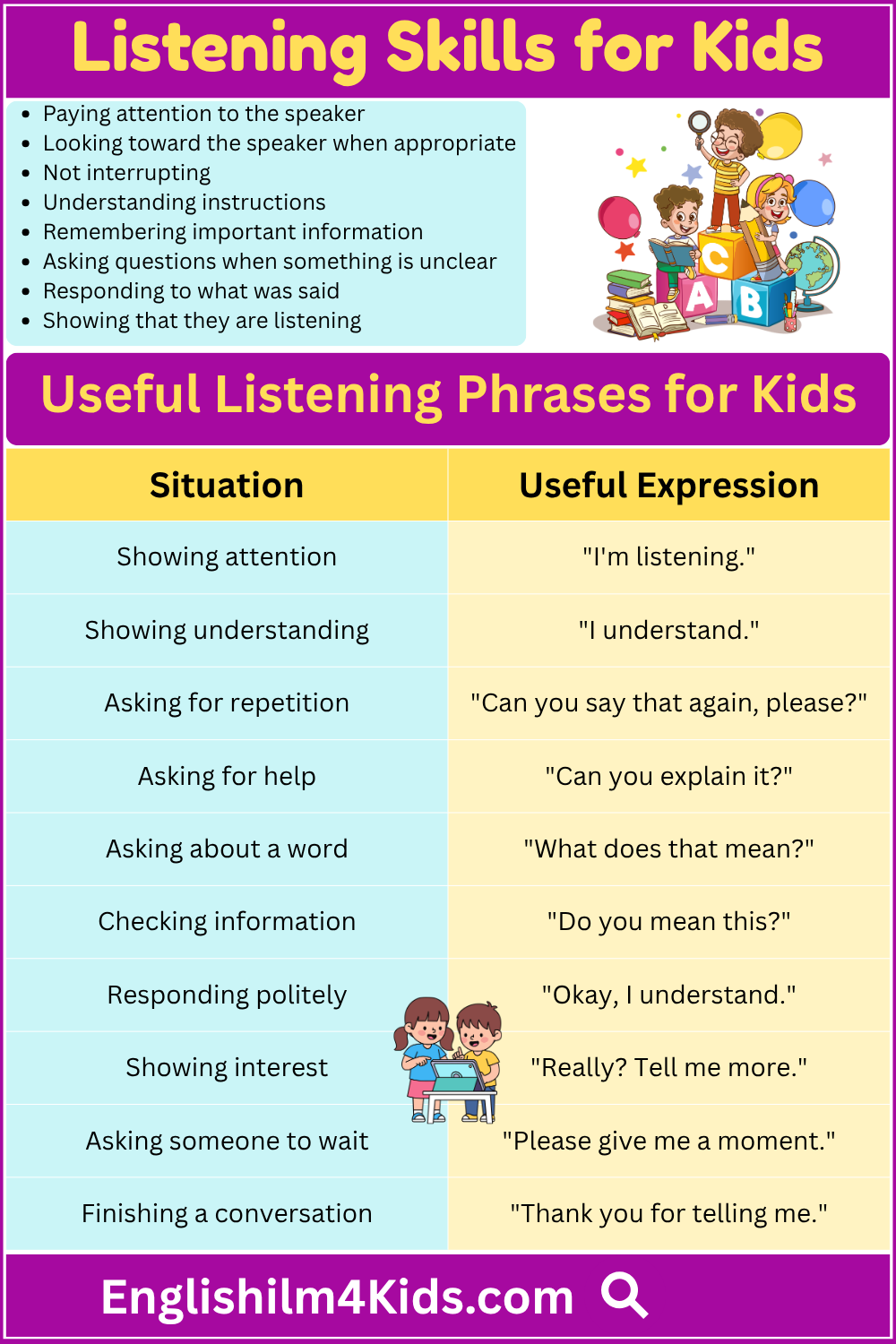
What Are Listening Skills?
- Paying attention to the speaker
- Looking toward the speaker when appropriate
- Not interrupting
- Understanding instructions
- Remembering important information
- Asking questions when something is unclear
- Responding to what was said
- Showing that they are listening
Hearing and Listening Are Not the Same
- Hearing happens when our ears detect sounds.
- Listening means paying attention to sounds or words and trying to understand their meaning.
For example,
a child may hear a parent talking while playing with a toy. However, if the child stops, pays attention, and understands what the parent is saying, the child is listening.
10 Simple Listening Skills for Kids
1. Pay Attention
When someone is speaking, try to focus on their words. If you are doing something else, pause when possible and give the speaker your attention.
For example:
- Parent: “Please put your shoes by the door.”
- Child: “Okay. I’ll put them there.”
2. Look at the Speaker When Appropriate
Looking toward the person who is speaking can show that you are paying attention. However, children do not need to stare continuously. Comfortable eye contact can be different for different people.
The important thing is to focus on the conversation.
3. Do Not Interrupt
Try to let the speaker finish before you start talking. If you have something important to say, you can wait for a natural pause. You can also say:
“Excuse me, may I say something?”
This is more polite than interrupting.
4. Listen for Important Information
Sometimes a speaker gives several pieces of information. Try to notice the most important details.
For example:
“Please put your book in your bag, take your water bottle, and line up by the door.”
A good listener remembers the three important actions.
5. Ask Questions
If you do not understand something, it is okay to ask.
- “Can you say that again, please?”
- “What does that word mean?”
- “Can you explain it?”
- “What should I do next?”
- “Could you please repeat that?”
6. Show That You Are Listening
Small responses can show that you are following the conversation.
- “Okay.”
- “I understand.”
- “Really?”
- “I see.”
- “That makes sense.”
- “Thank you for telling me.”
7. Remember What You Hear
Good listeners try to remember important information.
For example, if your teacher says:
“Tomorrow, bring your English book and a pencil,”
try to remember both things. You can also repeat the information:
“I need to bring my English book and pencil tomorrow.”
8. Think Before You Respond
Do not answer too quickly if you need time to understand the question.
Listen first, think about the answer, and then speak.
For example:
- Teacher: “Why did the character go home?”
- Child: “Let me think. I think he went home because he was tired.”
9. Listen to Other People’s Ideas
Friends and classmates may have different ideas from yours. You can listen respectfully even when you disagree.
Try saying:
“I understand your idea. I have a different idea.”
Listening does not mean that you must agree with everything someone says.
10. Be Patient
Some people need more time to explain their thoughts.
Give them time to finish speaking.
Being patient can make conversations more comfortable and respectful.
Useful Listening Phrases for Kids
| Situation | Useful Expression |
|---|---|
| Showing attention | “I’m listening.” |
| Showing understanding | “I understand.” |
| Asking for repetition | “Can you say that again, please?” |
| Asking for help | “Can you explain it?” |
| Asking about a word | “What does that mean?” |
| Checking information | “Do you mean this?” |
| Responding politely | “Okay, I understand.” |
| Showing interest | “Really? Tell me more.” |
| Asking someone to wait | “Please give me a moment.” |
| Finishing a conversation | “Thank you for telling me.” |
Listening Skills at School
Children need listening skills throughout the school day.
They may need to:
- Listen to the teacher.
- Follow classroom instructions.
- Listen during story time.
- Pay attention during lessons.
- Listen to classmates.
- Follow game rules.
- Remember homework instructions.
- Listen during group work.
- Ask questions when confused.
For example:
Teacher: “Open your book to page ten and circle the new words.”
Student: “Okay.”
The student needs to listen carefully to know what to do.
Listening Skills at Home
Listening is also important at home.
Parents may give children instructions such as:
“Please put your toys away before dinner.”
A child who listens carefully can understand what needs to be done.
Children can also practice listening when family members share stories, talk about their day, or ask questions.
A simple response might be:
“How was your day?”
“It was good. We played a new game at school.”
Good listening helps family conversations become more meaningful.
Listening to Friends
Friendship involves both speaking and listening.
When a friend is talking:
- Give them a chance to speak.
- Do not laugh at their feelings.
- Avoid interrupting.
- Ask questions when appropriate.
- Remember important things they tell you.
- Respond kindly.
For example:
Friend: “I was nervous about my class presentation.”
You: “I understand. How did it go?”
This shows interest and gives your friend a chance to continue.
Tips for Parents and Teachers
Adults can make listening practice part of everyday life.
- Give children short, clear instructions.
- Ask them to repeat important information.
- Read stories and ask questions.
- Play listening games.
- Give children time to answer.
- Reduce unnecessary distractions during important conversations.
- Praise specific listening behavior.
- Model good listening when children speak.
- Avoid expecting children to remember too many instructions at once.
Instead of simply saying “Listen!”, explain what good listening looks like:
“Please stop playing for a moment, look this way, and listen to the instructions.”
Frequently Asked Questions
What are listening skills for kids?
Listening skills are the abilities children use to pay attention, understand spoken information, remember important details, and respond appropriately.
Why are listening skills important for children?
Listening helps children understand lessons, follow instructions, communicate with others, and participate in conversations and activities.
How can I teach my child to listen better?
Use short instructions, practice listening games, read stories together, ask questions, and model good listening during everyday conversations.
What is active listening for kids?
Active listening means giving attention to the speaker, trying to understand what they say, and responding appropriately rather than simply hearing the words.
How can children practice listening at home?
Children can practice through story time, following directions, simple games, conversations, and activities such as drawing what they hear.
What should a child do if they do not understand something?
They should politely ask the speaker to repeat or explain it, such as “Can you say that again, please?”
How can teachers improve listening skills in the classroom?
Teachers can use clear instructions, stories, listening games, group activities, questions, and opportunities for children to repeat or demonstrate what they heard.
Is looking at someone always necessary for good listening?
No. Looking toward the speaker can show attention, but people listen in different ways. The most important part is paying attention and understanding the communication.
Conclusion
Strong listening skills for kids can make learning and everyday communication easier. Children can become better listeners by paying attention, waiting for others to finish, asking questions, remembering important information, and responding thoughtfully. Listening is a skill that improves with regular practice, not something children have to master immediately. Simple activities such as story time, following directions, and listening games can make practice enjoyable. When adults also listen carefully to children, they provide a positive example. With patience and daily practice, children can become confident listeners at home, at school, and with their friends.
Read More